Question
Draw a histogram to represent the following grouped frequency distribution:
Ages (in years)
Number of teachers
20-24
25-29
30-34
35-39
40-44
45-49
50-54
10
28
32
48
50
35
12

Answer

The given frequency distribution is in inclusive form. So, first we convert it into exclusive form.
Now, consider the class 20-24, 25-29.
Lower limit of 25-29 is 25.
Upper limit of 20-24 is 24.
Thus, the half of the difference is $=\frac{(25-24)}{2}=\frac{1}{2}=0.5$
So, we subtract 0.5 from each lower limit and add 0.5 to each upper limit.
The table for continuous grouped frequency distribution is given below:
Ages (in years)
Number of teachers
19.5-24.5
24.5-29.5
29.5-34.5
34.5-39.5
39.5-44.5
44.5-49.5
49.5-54.5
10
28
32
48
50
35
12
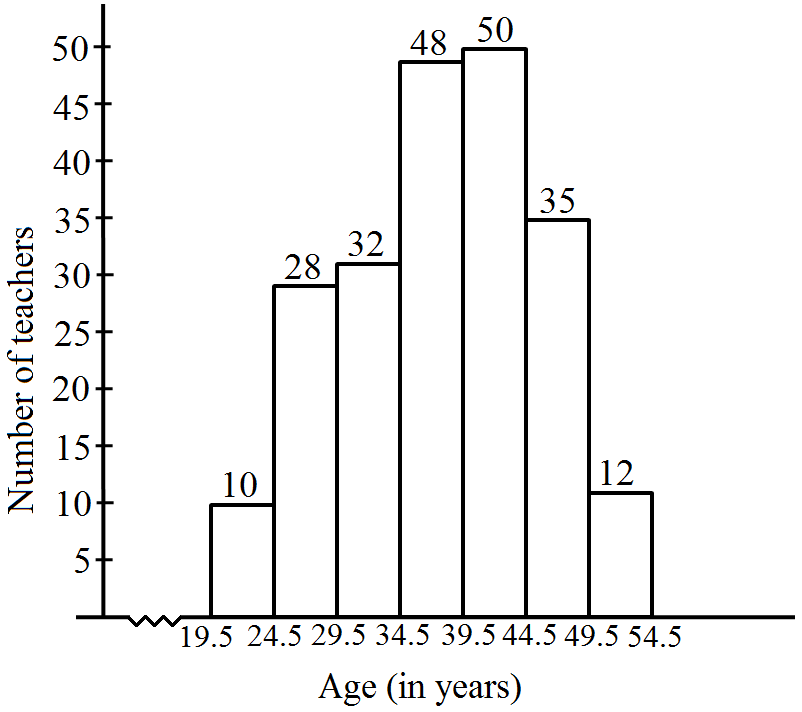
Thus, the given data becomes in exclusive form. Along the horizontal axis, we represent the class intervals of ages on some suitable scale. The corresponding frequencies of number of teachers are represented along the vertical axis on a suitable scale.
Since, the given intervals start with 19.5-24.5. It means that, there is some break (vw) indicated near the origin to signify the graph is drawn with a scale beginning at 19.5.
A histogram of the given distribution is given below:

Need a full question paper?

Generate a complete, print-ready paper with questions like this in minutes — across 16+ boards, with answer keys.

Start Generating Free

Similar questions

Using factor theorem, factorize the following polynomials:
x3 + 13x2 + 32x + 20
A chord of a circle is equal to its radius. Find the angle subtended by this chord at a point in major segment.
Prove that:
$\frac{1}{3+\sqrt{7}}+\frac{1}{\sqrt{7}+\sqrt{5}}+\frac{1}{\sqrt{5}+\sqrt{3}}+\frac{1}{\sqrt{3}+1}=1$
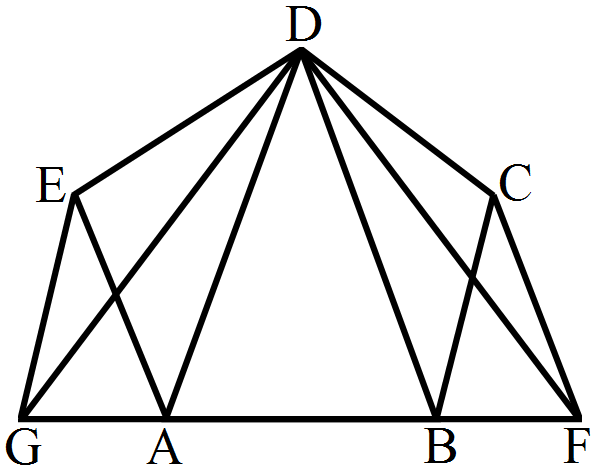
The given figure shows a pentagon ABCDE. EG, drawn parallel to DA, meets BA produced at G, and CF, drawn parallel to DB, meets AB produced at F. Show that:
 $\text{ar}(\text{pentagon ABCDE})=\text{ar}(\triangle\text{DGF}).$

ABC is an isosceles triangle with AB = AC and BD, CE are its two medians. Show that BD = CE.
It being given that $\sqrt{3}=1.732,\sqrt{5}=2.236,\sqrt{6}=2.449$ and $\sqrt{10}=3.162,$ find to three places of decimal, the value of the following:
$\frac{\sqrt{5}+\sqrt{2}}{\sqrt{5}-\sqrt{2}}$
The barrel of a fountain pen, cylindrical in shape, is 7cm long and 5mm in diameter. A full barrel of ink in the pen will be used up on writing 330 words on an average. How many words would use up a bottle of ink containing one fifth of a litre?
The following data gives the production of food grains (In thousand tonnes) for some years:
Year
1995
1996
1997
1998
19999
2000
Production (in thousand tonnes)
120
150
140
180
170
190
Represent the above data with the help of a bar graph.
In the adjoining figure, ABCD is a square and $\triangle\text{EDC}$ is an equilateral triangle. Prove that:
  1. AE = BE,
  2. $\angle\text{DAE}=15^{\circ}.$
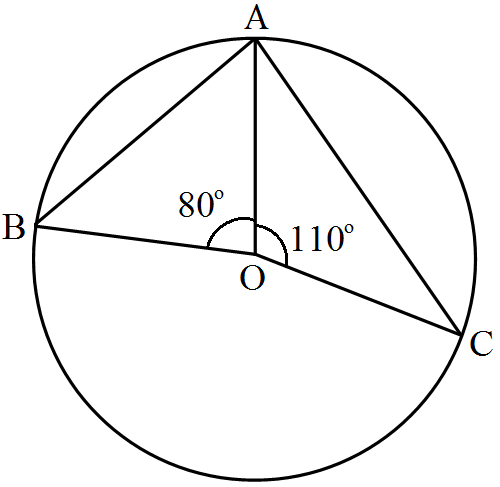
In figure, O is the centre of the circle. Find $\angle\text{BAC}.$