Questions

4 Marks Questions

🎯

Test yourself on this topic

16 questions · timed · auto-graded

Question 14 Marks
The mean of the following distribution is 50.
X
f
10
30
50
70
90
17
5a + 3
32
7a - 11
19
Find the value of a and hence the frequencies of 30 and 70.
Answer
xi
fi
fixi
10
30
50
70
90
17
5a + 3
32
7a - 11
19
170
150a + 90
1600
490a - 770
1710
Total
$\sum\text{f}_\text{i}=60+12\text{a}$
$\sum\text{f}_\text{i}\text{x}_\text{i}=2800+640\text{a}$

$\bar{\text{x}}=\frac{\sum\text{f}_\text{i}\text{x}_\text{i}}{\sum\text{f}_\text{i}}$

$=\frac{2800+640\text{a}}{60+12\text{a}}$

$\therefore\ \frac{2800+640\text{a}}{60+12\text{a}}=50$

$\Rightarrow\ 2800+640\text{a}=3000+600\text{a}$

$\Rightarrow\ 40\text{a}=200$

$\Rightarrow\ \text{a}=\frac{200}{40}$

$\Rightarrow\ \text{a}=5$

So, frequency of 30 = 5a + 3 = 5(5) + 3 = 25 + 3 = 28 and frequancy of 70 = 7a - 11 = 7(5) - 11 = 35 - 11 = 24
View full question & answer
Question 24 Marks
A recent survey found that the ages of workers in a factory is distributed as follows:
Age (in years) 20-39 30-39 40-49 50-59 60 and above
Number of workers 38 27 86 46 3
If a person is selected at random, find the probability that the person is:
  1. 40 years or more.
  2. Under 40 years.
  3. Having age from 30 to 39 years.
  4. Under 60 but over 39 years.
Answer

Total number of workers in a factory.

n(S) = 38 + 27 86 + 46 + 3 = 200

  1. Number of persons selected at the age of 40 year or more,

n(E1) = 86 + 46 + 3 = 135

Probability that the persons selected at the age of 40 year or more,

$\text{P}(\text{E}_1)=\frac{\text{n}(\text{E}_1)}{\text{n(S)}}=\frac{135}{200}=0.675$

Hence, the probability that the person selected at the age of 40 year or more is 0.675

  1. Number of persons selected under the age of 40 year

n(E2) = 38 + 27 = 65

Probability that the persons selected under the age of 40 year

$\text{P}(\text{E}_2)=\frac{\text{n}(\text{E}_2)}{\text{n(S)}}=\frac{65}{200}=0.325$

Hence, the probability that the person selected at the age of 40 year or more is 0.325

  1. Number of persons selected having age from 30 to 39 year

n(E3) = 27

Probability that the person selected having age from 30 to 39 year

$\text{P}(\text{E}_3)=\frac{\text{n}(\text{E}_3)}{\text{n(S)}}=\frac{27}{200}=0.135$

Hence, the probability that the person selected having age from 30 to 39 year is 0.135

  1. Number of persons selected having age under 60 but over 39 year

n(E4) = 86 + 46 = 132

Probability that the person selected having age under 60 but over 39 year

$\text{P}(\text{E}_4)=\frac{\text{n}(\text{E}_4)}{\text{n(S)}}=\frac{132}{200}=0.66$

Hence, the probability that the person selected having age under 60 but over 39 year is 0.66

View full question & answer
Question 34 Marks
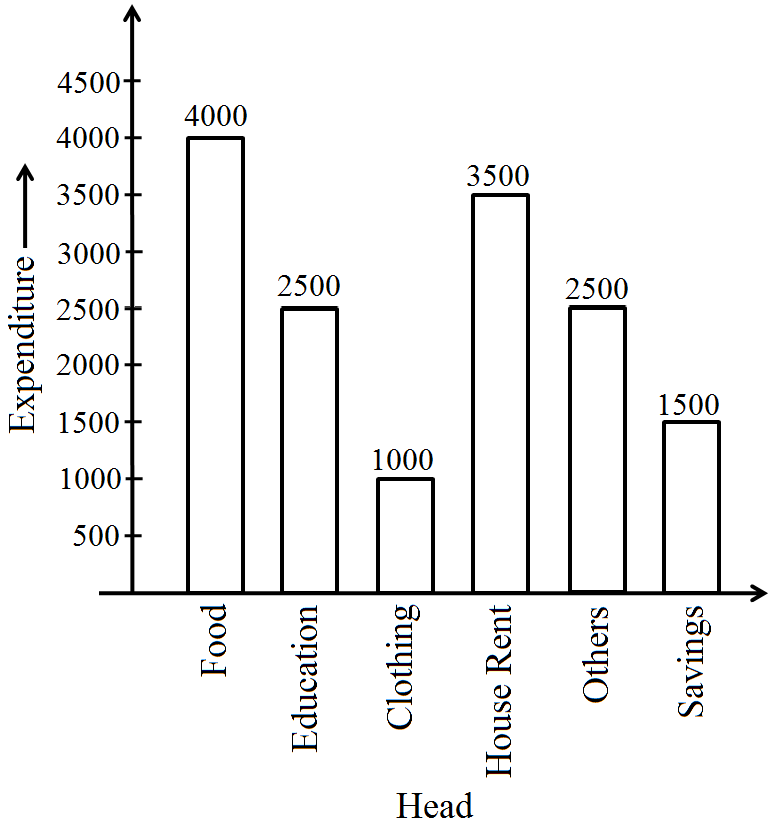
The expenditure of a family on different heads in a month is given below:
Head Food Education Clothing House Rent Others Savings
Expenditure(in Rs.) 4000 2500 1000 3500 2500 1500
Draw a bar graph to represent the data above.
Answer
We draw a bar graph of this data in the following steps.

Step I: We represent the heads (variable) on the horizontal axis choosing any scale, as the width of the bar is not important. But for clarity, we take equal widths for all bars and maintain equal gaps in between them. Let one head be represented by one unit.

Step II We represent the expenditure on the vertical axis. Since, the maximum expenditure is Rs. 4000, we can choose the scale as 1 unit = Rs. 500.

Step III To represent our first head i.e.,food, we draw a rectangular bar with width 1 unit and height 8 units.

Step IV Similarly, other heads are represented by leaving a gap of $\frac{1}{2}\text{unit}$ in between two consecutive bars.

The bar graph for given data is shown below:

View full question & answer
Question 44 Marks
The mean marks (out of 100) of boys and girls in an examination are 70 and 73, respectively. If the mean marks of all the students in that examination is 71, find the ratio of the number of boys to the number of girls.
Answer
Let the number of boys be n1 and number of girls be n2
Using $\bar{\text{x}}=\frac{\text{n}_1\bar{\text{x}}+\text{n}_2\bar{\text{x}}_2}{\text{n}_1+\text{n}_2}$
Where, $\bar{\text{x}}_1=70,\bar{\text{x}}_2=73$ and $\bar{\text{x}}_3=71$
$71=\frac{\text{n}_1\times70+\text{n}_2\times73}{\text{n}_1+\text{n}_2}$
$\Rightarrow\ 71\text{n}_1+71\text{n}_2=70\text{n}_1+73\text{n}_2$
$\Rightarrow\ \text{n}_1=2\text{n}_2$
$\Rightarrow\ \frac{\text{n}_1}{\text{n}_2}=\frac{2}{1}$
Hence, the ratio of the number of boys to the number of girls in 2 : 1
View full question & answer
Question 54 Marks
Prepare a continuous grouped frequency distribution from the following data:
Mid-point
Frequency
5
15
25
35
45
4
8
13
12
6
Also find the size of class intervals.
Answer
Here, we see that the difference between two mid-points is 15 - 5 i.e., 10
It means the width of the class interval is 10
Let the lower limit of the first class interval be a.
Then, its upper limit = a + 10
Now, mid value of the first class interval = 5
$\Rightarrow\text{ Mid value}=\frac{\text{Lower limit}+\text{Upper limit}}{2}$
$\Rightarrow5=\frac{\text{a}+\text{a}+10}{2}$
$\Rightarrow2\text{a}+10=10$
$\Rightarrow\text{a}=0$
So, the first class interval is 0-10.
Now, we prepare a continuous grouped frequency distribution table is given below.
Mid-point
Class interval
Frequency
5
15
25
35
45
0-10
10-20
20-30
30-40
40-50
4
8
13
12
6
Hence, the size of the class interval is 10 i.e., 10-0
View full question & answer
Question 64 Marks
Two dice are thrown simultaneously 500 times. Each time the sum of two numbers appearing on their tops is noted and recorded as given in the following table:
Sum
Frequency
2
3
4
5
6
7
8
9
10
11
12
14
30
42
55
72
75
70
53
46
28
15
If the dice are thrown once more, what is the probability of getting a sum:
  1. 3?
  2. More than 10?
  3. Less than or equal to 5?
  4. Between 8 and 12?
Answer
Total number of times, when two dice are thrown simultanceously, n(s) = 500

  1. Number of times of getting a sum 3, n(E) = 30

$\therefore$ Probability of getting a sum $3=\frac{\text{n(E)}}{\text{n(S)}}=\frac{30}{500}=\frac{30}{500}=\frac{3}{50}=0.06$

Hence, the probability of getting a sum 3 is 0.06

  1. Number of times of getting a sum more than 10, n(E1) = 28 + 15 = 43

$\therefore$ Probability of getting a sum $10=\frac{\text{n}(\text{E}_1)}{\text{n(S)}}=\frac{43}{500}=0.086$

Hence, the probability of getting a sum more than 10 is 0.086

  1. Number of times of getting a sum less than or equal to 5

n(E2) = 55 + 42 + 30 + 14 = 141

$\therefore$ Probability of getting a sum less than or equal to $5=\frac{\text{n}(\text{E}_2)}{\text{n(S)}}=\frac{141}{500}=0.282$

Hence, the probability of getting a sum less than or equal to 5 is 0.282

  1. The number of times of geeting a sum between 8 and 12

n(E3) = 53 + 46 + 28 = 127

$\therefore\ \text{Required probability}=\frac{\text{n}(\text{E}_3)}{\text{n(S)}}$

$=\frac{127}{500}=0.254$

Hence, the probability of getting a sum between 8 and 2 is 0.254

View full question & answer
Question 74 Marks
The lengths of 62 leaves of a plant are measured in millimetres and the data is represented in the following table:
Length (in mm)
Number of leaves
118-126
127-135
136-144
145-153
154-162
163-171
172-180
8
10
12
17
7
5
3
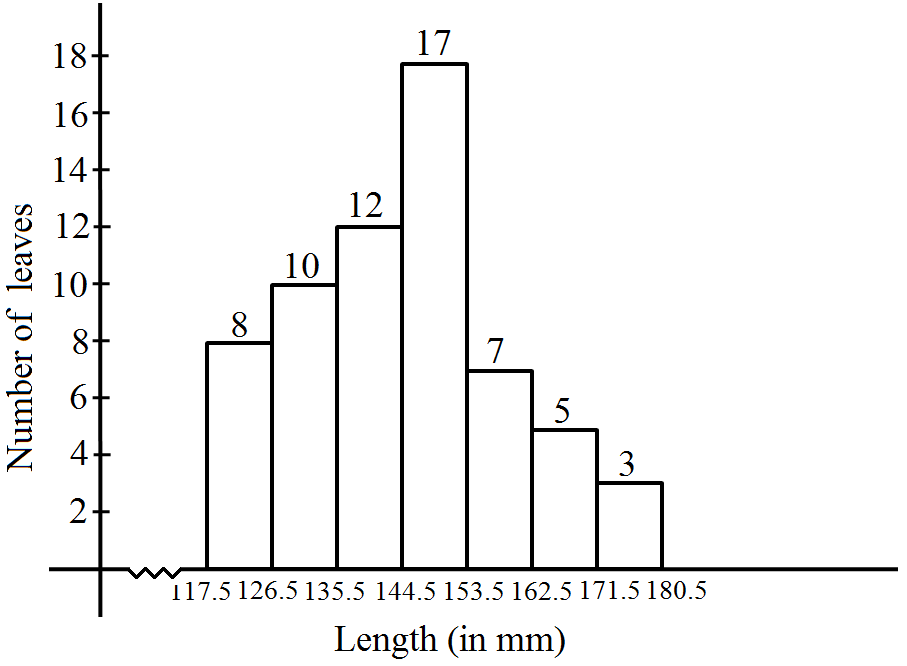
raw a histogram to represent the data above.
Answer
The given frequency distribution is in inclusive form. So, first we convert it into exclusive form.

Now, adjusting factor $=\frac{(127-126)}{2}=\frac{1}{2}=0.5$

So, we subtract 0.5 from each lower limit and add 0.5 to each upper limit.

The table for continuous grouped frequency distribution is given below:

Length (in mm)
Number of leaves
117.5-126.5
126.5-135.5
135.5-144.5
144.5-153.5
153.5-162.5
162.5-171.5
171.5-180.5
8
10
12
17
7
5
3
The table for continuous grouped frequency destribution is given below. Thus, the given data becomes in exclusive form.
Along the horizontal axis, we represent the class intervals of length on some suitable scale. The corresponding frequencies of number of leaves are represented along the Y-axis on a suitable scale. Since, the given intervals start with 117.5-126.5

It means that, there is some break (vw) indicated near the origin to signify the graph is drawn with a scale beginning at 117.5

View full question & answer
Question 84 Marks
The marks obtained (out of 100) by a class of 80 students are given below:
Marks
Number of Student
10-20
20-30
30-50
50-70
70-100
6
17
15
16
26
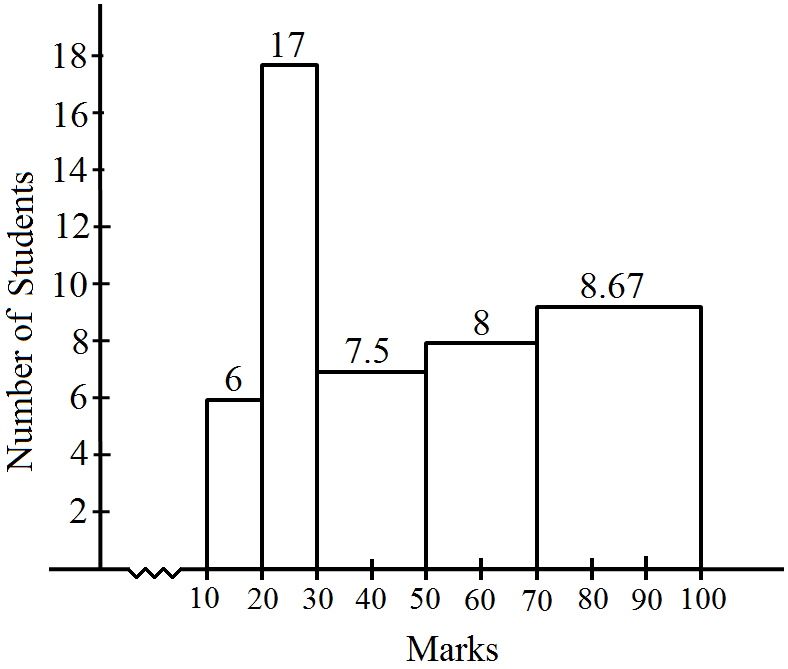
Construct a histogram to represent the data above.
Answer
In the given frequency distribution, class sizes are different. So, we calculate the adjusted frequency for each class.
Here, minimum size = 20 - 10 = 10
We use the formula,
Adjusted frequency of a class $=\frac{\text{Minimum class size}}{\text{Class size of this class}}\times\text{its frequency}$
The modified table for frequency distribution is given by,
Marks
Number of Student(Frequency)
Adjusted frequency
10-20
20-30
30-50
50-70
70-100
6
17
15
16
26
$\frac{10}{10}\times6=6$
$\frac{10}{10}\times17=17$
$\frac{10}{20}\times15=\frac{15}{2}=7.5$
$\frac{10}{20}\times16=\frac{16}{20}=8$
$\frac{10}{30}\times26=\frac{26}{3}=8.67$
Along the horizontal axis, we represent the class intervals marks on some suitable scale. The corresponding frequencies of number of students are represented along the vertical axis on a suitable scale.
Since, the given intervals start with 10-20. It means that, there is some break (AW) indicated near the origin to signify the graph is drawn with a scale beginning at 10.
Now, we draw rectangles with class intervals as the bases and the corresponding adjusted frequencies as heights.
A histogram of the given distribution, is given below:

View full question & answer
Question 94 Marks
Expenditure on Education of a country during a five year period (2002-2006), in crores of rupees, is given below:
Elementary education
Secondary Education
University Education
Teacher’s Training
Social Education
Other Educational Programmes
Cultural programmes
Technical Education
240
120
190
20
10
115
25
125
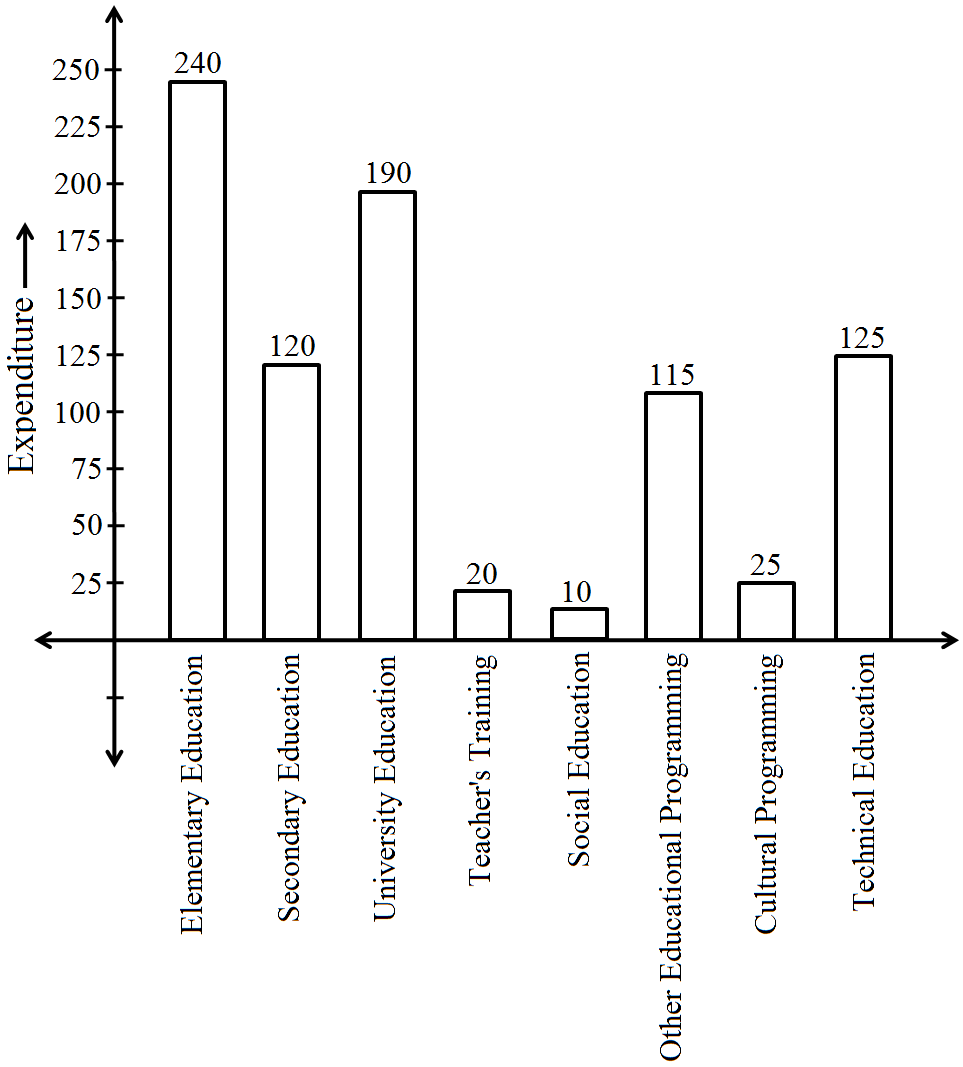
Represent the information above by a bar graph.
Answer
We draw bar graph of this data in the following steps:
Step I We represent the education of a country (variable) on the horizontal axis choosing any scale, as the width of the bar is not important. But for clarity, we take equal widths for all bars and maintain equal gaps in between them. Let one head be represented by one unit.
Step II We represent the expenditure on the vertical axis. Since, the maximum expenditure is Rs. 240 crore, we can choose the scale as 1 unit = Rs. 25 crore.
Step III To represent our first education of a country i.e.,elementary education, we draw a rectangular bar with width 1 unit and height 9.6 units.
Step IV Similarly, other heads are represented by leaving gap of ~ unit in between two consecutive bars.
The bar graph for given data is shown below:

View full question & answer
Question 104 Marks
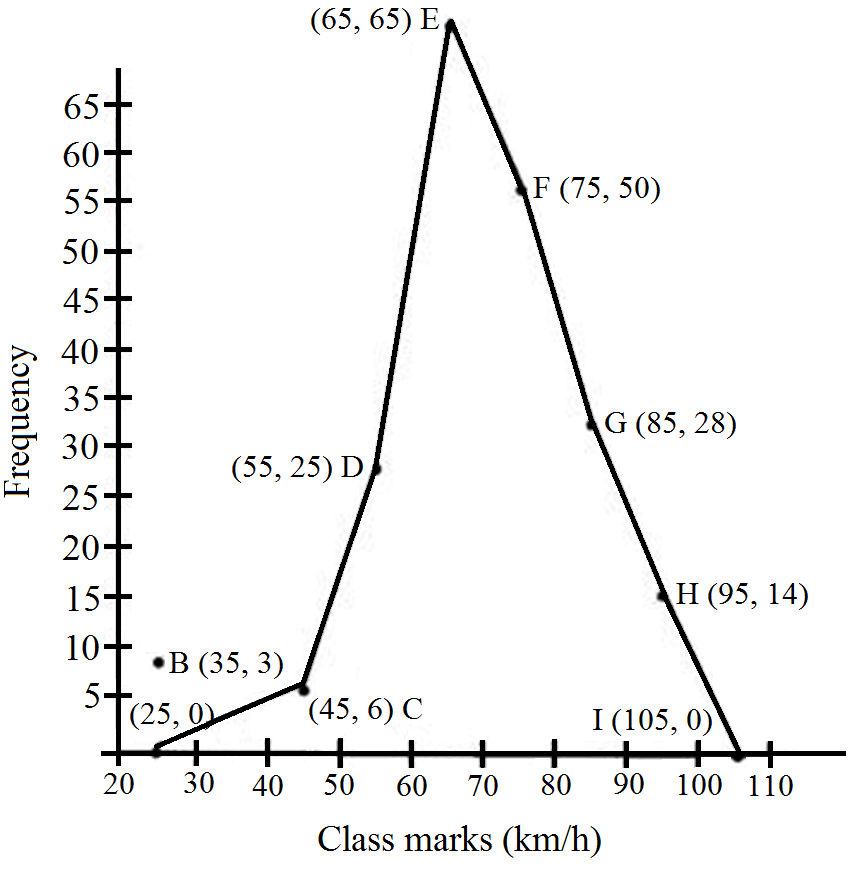
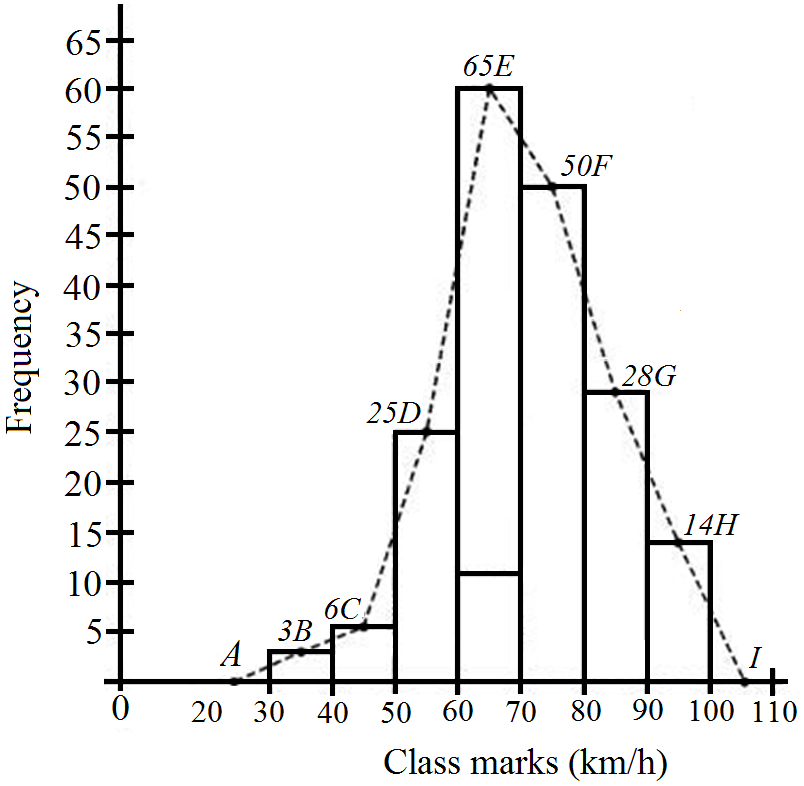
Draw the frequency polygon representing the above data without drawing the histogram.
Answer
We have to draw a frequency polygon without a histogram.
Firstly, we find the class marks of the classes given that is 30-40, 40-50, 50-60, 60-70 ....
The class mark $=\frac{(30+40)}{2}$
$\Rightarrow\frac{70}{2}=35$
Similarly, we can determine the class marks of the other classes.
So, table for class marks is shown below:
Class interval (km/ h)
Class marks
Frequency
30-40
40-50
50-60
60-70
70-80
80-90
90-100
35
45
55
65
75
85
95
3
6
25
65
50
28
14
We can draw a frequency polygon by plotting the class marks along the horizontal axis and the frequency along the vertical axis. Now, plotting all the points B(35, 3), C(45, 6), D(55, 25), E(65, 65), F(75, 50), G(85, 28), H(95,14), also plot the point corresponding to the considering classes 20-30 and 100-110 each with frequency 0. Join all these point line segments.

View full question & answer
Question 114 Marks
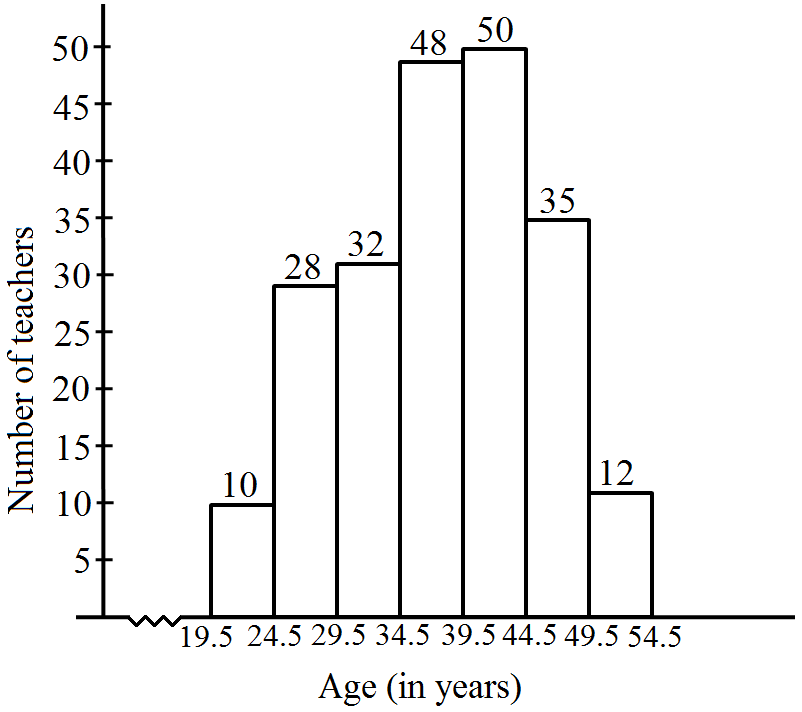
Draw a histogram to represent the following grouped frequency distribution:
Ages (in years)
Number of teachers
20-24
25-29
30-34
35-39
40-44
45-49
50-54
10
28
32
48
50
35
12
Answer
The given frequency distribution is in inclusive form. So, first we convert it into exclusive form.
Now, consider the class 20-24, 25-29.
Lower limit of 25-29 is 25.
Upper limit of 20-24 is 24.
Thus, the half of the difference is $=\frac{(25-24)}{2}=\frac{1}{2}=0.5$
So, we subtract 0.5 from each lower limit and add 0.5 to each upper limit.
The table for continuous grouped frequency distribution is given below:
Ages (in years)
Number of teachers
19.5-24.5
24.5-29.5
29.5-34.5
34.5-39.5
39.5-44.5
44.5-49.5
49.5-54.5
10
28
32
48
50
35
12
Thus, the given data becomes in exclusive form. Along the horizontal axis, we represent the class intervals of ages on some suitable scale. The corresponding frequencies of number of teachers are represented along the vertical axis on a suitable scale.
Since, the given intervals start with 19.5-24.5. It means that, there is some break (vw) indicated near the origin to signify the graph is drawn with a scale beginning at 19.5.
A histogram of the given distribution is given below:

View full question & answer
Question 124 Marks
A total of 25 patients admitted to a hospital are tested for levels of blood sugar, (mg/ dl) and the results obtained were as follows:
87
71
83
67
85
77
69
76
65
85
85
54
70
68
80
73
78
68
85
73
81
78
81
77
75
Find mean, median and mode (mg/ dl) of the above data.
Answer
Mean, Sum of akll observations = 1891
Number of observations, n = 25
$\text{Mean}(\bar{\text{x}})=\frac{\text{x}_1+\text{x}_2+\ .....\ +\text{x}_\text{n}}{\text{n}}$
$=\frac{1891}{25}=75.64$
Median, Arranging the observation in ascending orther, we get 54, 65, 67, 68, 68, 69, 70, 71, 73, 73, 75, 76, 77,. 77, 78, 78, 80, 81, 81, 83, 85, 85, 85, 87
Here, number of observation (n) = 25(odd)
$\therefore\ \text{Median}=\Big(\frac{\text{n}+1}{2}\Big)^{\text{th}}\text{value}$
$=\Big(\frac{25+1}{2}\Big)^{\text{th}}\text{value}$
$=13^{\text{th}}\text{value}=77$
We see from the given data that the onservation 85 occurs maximum number of times (4 times).
$\therefore\ \text{Mode}=85$
Hence, mean = 75.64, median = 77 and mode = 85
View full question & answer
Question 134 Marks
Following table shows a frequency distribution for the speed of cars passing through at a particular spot on a high way:
Class interval (km/ h)
Frequency
30-40
40-50
50-60
60-70
70-80
80-90
90-100
3
6
25
65
50
28
14
Draw a histogram and frequency polygon representing the data above.
Answer
Clearly, the given frequency distribution is in exclusive form. Along the horizontal axis, we represent the class intervals on some suitable scale. The corresponding frequencies are represented along the vertical axis on a suitable scale. We construct rectangles with class intervals as the bases and the respective frequencies as the heights.

Let us draw a histogram for this data and mark the mid-points of the top of the rectangles as B, C, D, E, F, G and H, respectively. Here, the first class is 30-40 and the last class is 90-100.

Also, consider the imagined classes 20-30 and 100-110 each with frequency O. The class marks of these classes are 25 and 105 at the points A and I, respectively.

Join all these points by dotted line. Then, the curve ABCDEFGHI is the required frequency polygon.

View full question & answer
Question 144 Marks
Convert the given frequency distribution into a continuous grouped frequency distribution:
Class interval
Frequency
150-153
154-157
158-161
162-165
166-169
170-173
7
7
15
40
5
6
In which intervals would 153.5 and 157.5 be included?
Answer
It is clear that, the given table is in inclusive (discontinuous) form. So, we first convert it into exclusive form.
Now, consider the classes 150 - 153, 154 - 157 Lower limit of 154 - 157 = 154 and upper limit of 150-153 = 153
Required difference = 154 - 153 = 1
So, half the difference $=\frac{1}{2}=0.5$
So, we subtract 0.5 from each lower limit and add 0.5 to each upper limit.
The table for continuous grouped frequency distribution is given below:
Class interval
Frequency
149.5-153.5
153.5-157.5
157.5-161.5
161.5-165.5
165.5-169.5
169.5-173.5
7
7
15
10
5
6
Thus, 153.5 and 157.5 would use in the class intervals 153.5-157.5 and 157.5-161.5, respectively.
View full question & answer
Question 154 Marks
Over the past 200 working days, the number of defective parts produced by a machine is given in the following table:
Number of defective parts
0
1
2
3
4
5
6
7
8
9
10
11
12
13
Days
50
32
22
18
12
12
10
10
10
8
6
6
2
2
Determine the probability that tomorrow’s output will have:
  1. No defective part.
  2. Atleast one defective part.
  3. Not more than 5 defective parts.
  4. More than 13 defective parts.
Answer
Total number of working days, n(S) = 200

  1. Number of days in which no defective part is, n(E1) = 50

Probability that no defective part $=\frac{\text{n}(\text{E}_1)}{\text{n(S)}}=\frac{50}{200}=\frac{1}{4}=0.25$

  1. Number of days in which atleast one defective part, is

n(E2) = 32 + 22 + 18 + 12 + 12 + 10 + 10 + 10 + 8 + 6 + 6 + 2 + 2 = 150

$\therefore$ Probability that atleast one defective part $=\frac{\text{n}(\text{E}_2)}{\text{n}(\text{s})}=\frac{150}{200}=\frac{3}{4}=0.75$

Hence, the probability that all least one defective part is 0.75.

  1. Number of days in which not more than 5 defective parts.

n(E3)= 50 + 32 + 22 + 18+ 12 + 12 = 146

$\therefore$ Probability that not more than 5 defective parts

$=\frac{\text{n}(\text{E}_3)}{\text{n}(\text{S})}=\frac{146}{200}=0.73$

Hence, the probability that not more than 5 defective parts is 0.73.

  1. Number of days in which more than 13 defective parts, n(E4) = 0

$\therefore$ Probability that more than 13 defective parts

$=\frac{\text{n}(\text{E}_4)}{\text{n}(\text{S})}=\frac{0}{200}=0$

Hence, the probability that more than 13 defective parts is 0.

View full question & answer
Question 164 Marks
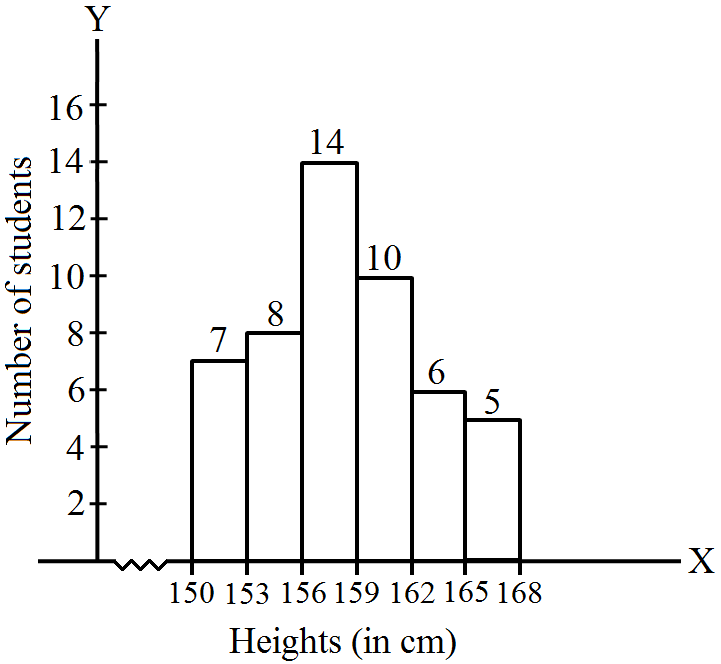
Draw a histogram of the following distribution:
Heights (in cm)
Number of students
150-153
153-156
156-159
159-162
162-165
165-168
7
8
14
10
6
5
Answer
Clearly, the given frequency distribution is in exclusive form. Along the horizontal axis, we represent the class intervals of heights on some suitable scale. The corresponding frequencies of number of students are represented along the vertical axis on a suitable scale.

Since, the given intervals start with 150-153. It means that there is some break (vw) is indicated near the origin to signify the graph is drawn with a scale beginning at 150.

A histogram of the given distribution is given below:

View full question & answer
4 Marks Questions - Maths STD 9 Questions - Vidyadip