Question
Draw a neat labelled diagram : Mutation

Answer

Get the step-by-step solution for this question inside the Vidyadip app.

Get the answer in the app

Need a full question paper?

Generate a complete, print-ready paper with questions like this in minutes — across 16+ boards, with answer keys.

Start Generating Free

Similar questions

How much energy is consumed when a current of 5 amperes flows through the filament (or element) of a heater having resistance of 100 ohms for two hours? Express it in joules.
How does our body respond when adrenaline is secreted in large amounts into the blood?
Two lenses $A$ and $B$ have focal lengths of $+20\ cm$ and, $-10\ cm,$ respectively.
  1. What is the nature of lens $A$ and lens $B?$
  2. What is the power of lens $A$ and lens $B?$
  3. What is the power of combination if lenses $A$ and $B$ are held close together$?$
How are sodium, magnesium and potassium obtained from their molten chloride salts?
What is a seed? What are the parts of a seed? Explain with the help of a labelled diagram.
Here are some results of solutions tested with universal indicator paper:
  1. Sulphuric acid: Red
  2. Metal polish: Dark blue
  3. Washing-up liquid:
  4. Yellow Milk of magnesia:
  5. Light blue Oven cleaner:
  6. Purple Car battery acid: Pink
Arrange the solutions in order of their increasing pH values (starting with the one with the lowest pH).
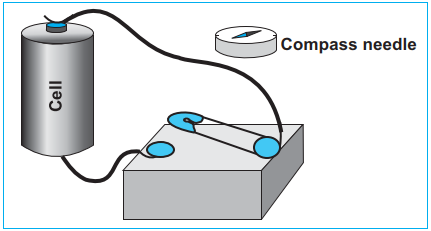
Make a circuit by connecting the two terminals of the electric cell to the key as shown in the fig. 5.13. Place the compass needle close to it. Note carefully the direction in which the compass needle is pointing, close the key for few seconds. Release the key and watch again. Repeat the steps again by changing its polarity. Record the observations.
Image

(i) Why does the needle get deflected when the key is pressed?
(ii) Connect two battery cells in series to the two ends of the wire and now form the key. What do you observe?
What is a solenoid? Draw a sketch to show the magnetic field pattern produced by a current-carrying solenoid.
Complete the paragraph by choosing the right options given below.
(minimum, near point, 25 cm, farthest, farthest distance, far point)
The _______ distance of an object from a normal eye, at which it is clearly visible without stress on the eye, is called the minimum distance of distinct vision. The position of the object at this distance is called the _______ of the eye, for a normal human eye, the near point is at _______. The _______ distance of an object from a human eye, at which it is clearly visible without stress on the eye is called _______ of distinct vision. The position of the object at this distance is called the _______ of the eye.
An electric bulb is connected to a source of 250 volts. The current passing through it is 0.27 A. What is the power of the bulb?