Question
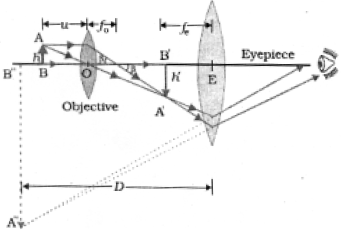
  1. Draw a neat labelled ray diagram of a compound microscope. Explain briefly its working.
  2. Why must both the objective and the eye-piece of a compound microscope have short focal lengths?
Answer


The objective forms a real, inverted, magnified image of the object. This serves as the object for the second lens, the eyepiece, which functions essentially like a simple microscope or magnifier, produces the final image, which is enlarged and virtual.
To achieve a large magnification of a small object; both the objective and eyepiece should have small focal lengths.

Need a full question paper?

Generate a complete, print-ready paper with questions like this in minutes — across 16+ boards, with answer keys.
Start Generating Free

Similar questions

  1.  
  1.  
Define the electric resistivity of a conductor.
Plot a graph showing the variation of resistivity with temperature in the case of a (a) conductor, (b) semiconductor.
Briefly, explain, how the difference in the behaviour of the two can be explained in terms of number density of charge carriers and relaxation time.
A cell of emf E and internal resistance r is connected across an external resistance R. Plot a graph showing the variation of P.D. across R, verses R.
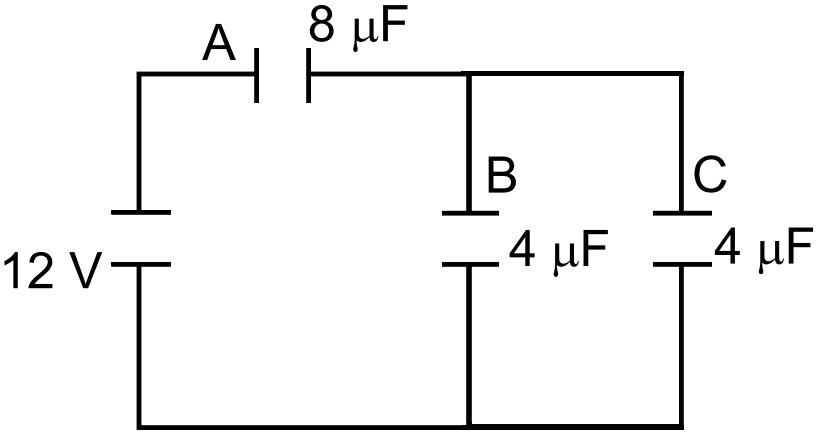
Find the charge appearing on each of the three capacitors shown in figure.
A 5.0 diopter lens forms a virtual image which is 4 times the object placed perpendicularly on the principal axis of the lens. Find the distance of the object from the lens.
Consider a uniform electric field E =
3 × 10³ $\hat{ i }$ N/C.
(a) What is the flux of this field through a square of 10 cm on a side whose plane is parallel to the yz plane?
(b) What is the flux through the same square if the normal to its plane makes of 60° angle with the x-axis?
A cylinder containing a gas is lifted from the first floor to the second floor. What is the amount of work done on the gas? What is the amount of work done by the gas? Is the internal energy of the gas increased? Is the temperature of the gas increased?
Explain isotopes, isobars, isotones and isomers by giving examples.
  1. Mention two properties of soft iron due to which it is preferred for making an electromagnet.
  2. State Gauss's law in magnetism. How is it different from Gauss's law in electrostatics and why?
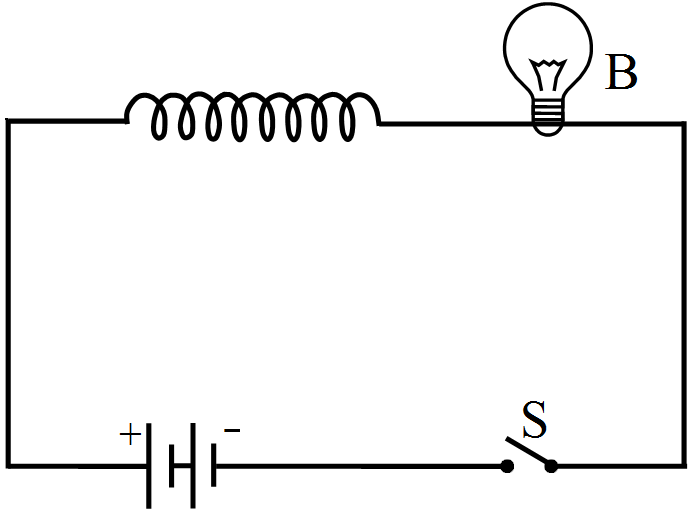
Figure shows a light bulb (B) and iron cored inductor connected to a dc battery through a switch (S).
  1. What will one observe when switch (S) is closed?
  2. How will the glow of the bulb change when the battery is replaced by an ac source of rms voltage equal to the voltage of dc battery? Justify your answer in each case.