Question
Explain isotopes, isobars, isotones and isomers by giving examples.

Answer

→ (i) Isotopes :
 The atoms which have atomic number Z same but atomic mass number A different, then such type of atoms are called the isotopes of each other.
For example :
Isotopes of hydrogen are ${ }_1 H ^1,{ }_1 H ^2,{ }_1 H ^3$
•${ }_1 H ^1$ - there is one proton but having no neutron.
• ${ }_1 H ^2$ - there is one proton one neutron.
• ${ }_1 H ^3$ - there is one proton and two neutrons.
Isotopes of carbon are ${ }_6 C ^{12},{ }_6 C ^{13},{ }_6 C ^{14}$
Isotopes of uranium are ${ }_{92} U ^{233},{ }_{92} C ^{235},{ }_{92} C ^{238}$
→ (ii) Isobar :
Atoms having same atomic mass number A , but different atomic number Z are called the isobars of each other.
→ For example :
${ }_1 H ^3$ and ${ }_2 He ^3$
${ }_{82} Pb^{214}$ and ${ }_{83} Bi ^{214}$
(iii) Isotone :
The atoms for which the neutron number N is the same but atomic number Z and mass number A are different are called isotones to each other.
For example :
${ }_{80} Hg ^{198} \text { and }{ }_{79} Au ^{197}$
→ (iv) Isomer :
→The atoms for which the atomic number Z and mass number A are same but their radioactive properties are different are called isomers of each other.
→For example :
${ }_{35} Br ^{80}$ contains a pair of isomers.

Need a full question paper?

Generate a complete, print-ready paper with questions like this in minutes — across 16+ boards, with answer keys.
Start Generating Free

Similar questions

State the law of radioactive decay.
Plot a graph showing the number $(N)$ of undecayed nuclei as a function of time $(t)$ for a given radioactive sample having half life $T_\frac12.$
Depict in the plot the number of undecayed nuclei at $(i) t = 3 T_\frac12$ and $(ii) t = 5 T_\frac12.$
Write Einstein's photoelectric equation and explain each term used in it.
A uniform tube closed at one end, contains a pellet of mercury $10\ cm$ long. When the tube is kept vertically with the closed$-$end upward, the length of the air column trapped is $20\ cm$. Find the length of the air column trapped when the tube is inverted so that the closedend goes down. Atmospheric pressure $= 75\ cm$ of mercury.
radioactive isotope has a half-life of 5 years. After how much time is its activity reduced to 3.125% of its original activity?
Find the acceleration of the moon with respect to the earth from the following data:
Distance between the earth and the moon $= 3.85 \times 10^5\ km$ and the time taken by the moon to complete one revolution around the earth $= 27.3$ days.
$i.$ State two important features of Einstein's photoelectric equation.
$ii.$ Radiation of frequency $10^{15} Hz$ is incident on two photosensitive surface $P$ and $Q.$ There is no photoemission from surface $P.$ Photoemission occurs from surface $Q$ but photoelectrons have zero kinetic energy. Explain these observations and find the value of work function for surface $Q.$
Explain Lorentz force and state its characteristics.
  1. A parallel plate capacitor $(C_1)$ having charge $Q$ is connected, to an identical uncharged capacitor $C_2$ in series. What would be the charge accumulated on the capacitor $C_2?$
  2. Three identical capacitors each of capacitance $3mF$ are connected, in tern, in series and in parallel combination to the common source of $V$ volt. Find out the ratio of the energies stored in two configurations.
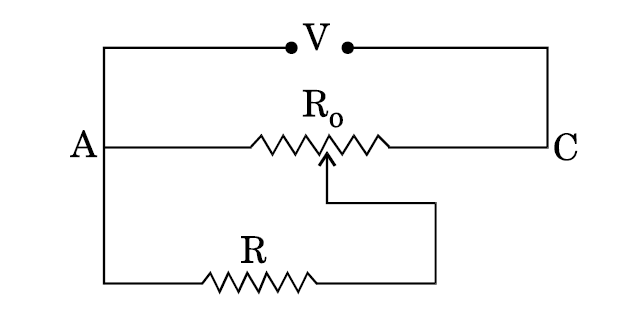
A resistance of $R \Omega$ draws current from a potentiometer as shown in the figure. The potentiometer has a total resistance $R_o\Omega$ . A voltage $V$ is supplied to the potentiometer. Derive an expression for the voltage across $R$ when the sliding contact is in the middle of the potentiometer.
Prove that the power dissipated in an ideal resistor connected to an ac source is $\frac{\text{V}^2_{\text{eff}}}{\text{R}}.$