Question
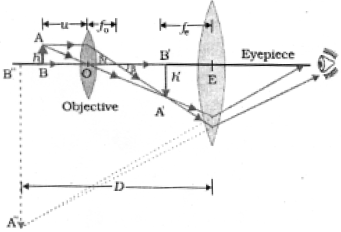
  1. Draw a neat labelled ray diagram of a compound microscope. Explain briefly its working.
  2. Why must both the objective and the eye-piece of a compound microscope have short focal lengths?
Answer


The objective forms a real, inverted, magnified image of the object. This serves as the object for the second lens, the eyepiece, which functions essentially like a simple microscope or magnifier, produces the final image, which is enlarged and virtual.

To achieve a large magnification of a small object; both the objective and eyepiece should have small focal lengths.

Need a full question paper?

Generate a complete, print-ready paper with questions like this in minutes — across 16+ boards, with answer keys.
Start Generating Free

Similar questions

How long can an electric lamp of 100W be kept glowing by fusion of 2.0 kg of deuterium? Take the fusion reaction as:
$^2_1\text{H}+^2_1\text{H}\rightarrow\ ^3_2\text{He}+\text{n}+3.27\text{ MeV}$
Prove that the force acting on a current-carrying wire, joining two fixed points a and b in a uniform magnetic field, is independent of the shape of the wire.
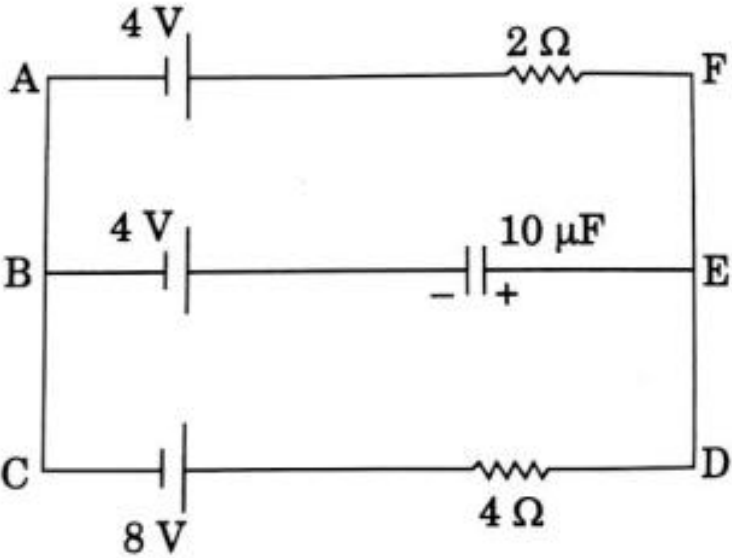
In the given circuit, with steady current, calculate the potential drop across the capacitor and the charge stored in it.

How does Maxwell modify Ampere's circuital law? Explain.
  1. State two important features of Einstein's photoelectric equation.
  2. Radiation of frequency 1015 Hz is incident on two photosensitive surface P and Q. There is no photoemission from surface P. Photoemission occurs from surface Q but photoelectrons have zero kinetic energy. Explain these observations and find the value of work function for surface Q.
Distinguish between nuclear fission and fusion. Show how in both these processes energy is released. Calculate the energy release in MeV in the deuterium-tritium fusion reaction:
$^{2}_{1}\text{H} + ^{3}_{1}\text{H}\rightarrow^{4}_{2}\text{H} +\text{n}$
Using the data:
$\text{m}(^{2}_{1}\text{H}) = 2.014102 \text{u}$
$\text{m}(^{3}_{1}\text{H}) = 3.016049\text{u}$
$\text{m}(^{4}_{2}\text{H}) = 4.002603 \text{u}$
$\text{m}_{n} = 1.008665 \text{n}$
$1\text{u} = 931.5\text{MeV/c}^{2}$.
Derive the formula for conductivity and resistivity of metals by obtaining the relationship between drift velocity and current density.
  1. Define the term ‘intensity of radiation’ in terms of photon picture of light.
  2. Two monochromatic beams, one red and the other blue, have the same intensity. In which case (i) The number of photons per unit area per second is larger, (ii) The maximum kinetic energy of the photoelectrons is more? Justify your answer.
The sunlight reaching Earth has maximum electric field of 810Vm-1. What is the maximum magnetic field in this light?
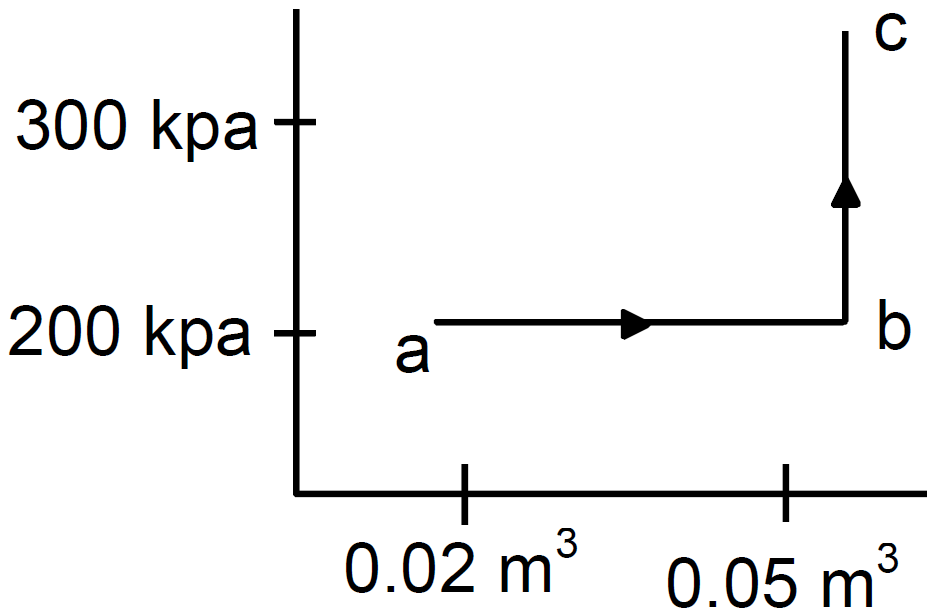
A substance is taken through the process abc as shown in figure. If the internal energy of the substance increases by 5000J and a heat of 2625cal is given to the system, calculate the value of J.