Question
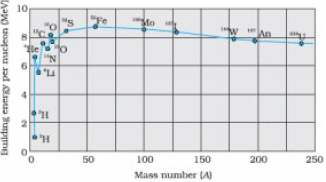
Draw a plot showing the variation of binding energy per nucleon versus the mass number A. Explain with the help of this plot the release of energy in the processes of nuclear fission and fusion.

Answer

Plot:

Explanation: A very heavy nucleus, say A = 240, has lower binding energy per nucleon compared to that of a nucleus with A = 120. Thus if a nucleus A = 240 breaks into two A = 120 nuclei, nucleons get more tightly bound.
This implies energy would be released in the process of fission.
Consider two very light nuclei  $({\text{A}}\leq 10) $ joining to form a heavier nucleus. The binding energy per nucleon of the fused heavier nuclei is more than the binding energy per nucleon of the lighter nuclei. This means that the final system is more tightly bound than the initial system. Again energy would be released in such a process of fusion.

Need a full question paper?

Generate a complete, print-ready paper with questions like this in minutes — across 16+ boards, with answer keys.
Start Generating Free

Similar questions

A bulb rated 60W at 220V is connected across a household supply of alternating voltage of 220V. Calculate the maximum instantaneous current through the filament.
The magnetic intensity Hat the centre of a long solenoid carrying a current of 2.0A, is found to be 1500A/m. Find the number of turns per centimetre of the solenoid.
The work function of a metal is 2.5 x 10 -19J.
  1. Find the threshold frequency for photoelectric emission.
  2. If the metal is exposed to a light beam of frequency 6.0 x 10⁻¹⁴ Hz, what will be the stopping potential?
What is the parallel connection of cells ? Derive the formula for equivalent $e m f$ and equivalent internal resistance for parallel connection of cell.
A resistance R and a capacitor C are connected in series to an ac source $\text{V}=\text{V}_0\sin\omega\text{t}.$
  1. Obtain the expression for the instantaneous current (I) in the circuit.
  2. Show graphically variations of V and I as a function of $\omega\text{t}.$
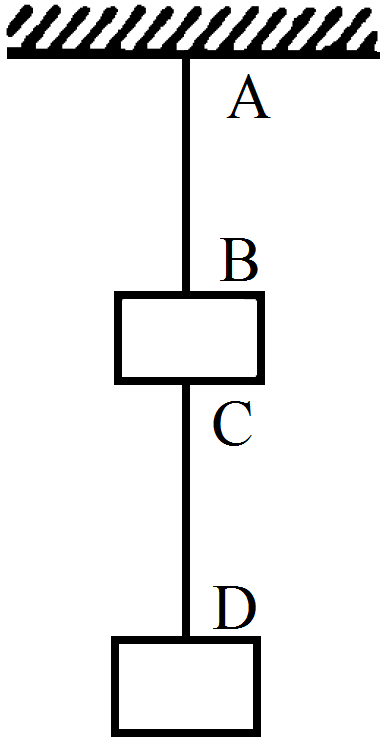
Two blocks each having a mass of 3.2kg are connected by a wire CD and the system is suspended from the ceiling by another wire AB figure, The linear mass delity of the wire AB is 10g/m and that of CD is 8g/m. Find the speed of a transverse wave pulse produced in AB and in CD.

Write first rule of Kirchhoff (junction rule).By drawing circuit diagram of Wheatstone Bridge, obtain condition for zero deflection in the bridge.
The luminous flux of a 1W sodium vapour lamp is more than that of a 10kW source of ultraviolet radiation. Comment.
Explain the effect of electric potential (potential difference) on photoelectric current and derive the definition and formula of stopping potential.