Question
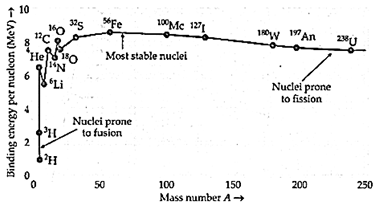
Draw a plot showing the variation of binding energy per nucleon with mass number A. Write two important conclusions which you can draw from this plot. Explain with the help of this plot, the release in energy in the processes of nuclear fusion and fission.

Answer

Image

Binding energy per nucleon as a function of mass number A.
Two important conclusions from this graph are:
i. Nuclear forces non-central and short ranged force.
ii. Nuclear forces between proton-neutron and neutron-neutron are strong and attractive in nature.
Explanation of Nuclear Fission: When a heavy nucleus (A ≥ 235 say) breaks into two lighter nuclei (nuclear fission), the binding energy per nucleon increases i.e, nucleons get more tightly bound. This implies that energy would be released in nuclear fission. 
Explanation of Nuclear Fusion: When two very light nuclei (A  ≤ 10) join to form a heavy nucleus, the binding is energy per nucleon of fused heavier nucleus more than the binding energy per nucleon of lighter nuclei, so again energy would be released in nuclear fusion.
Need a full question paper?

Generate a complete, print-ready paper with questions like this in minutes — across 16+ boards, with answer keys.

Start Generating Free

Similar questions

Obtain the first Bohr’s radius and the ground state energy of a muonic hydrogen atom [i.e., an atom in which a negatively charged muon $(\mu)$ of mass about 207me orbits around a proton].
A vector $\overrightarrow{\text{A}}$ makes an angle of 20° and $\overrightarrow{\text{B}}$ makes an angle of 110° with the X-axis. The magnitudes of these vectors are 3 m and 4 m respectively. Find the resultant.
What is called P-N junction? Name the methods of making P-N junction. Explain the diffusion method of making $P - N$ junction.
Define relaxation time of the free electrons drifting in a conductor. How is it related to the drift velocity of free electrons? Use this relation to deduce the expression for the electrical resistivity of the material. 
Identify the following electromagnetic radiations as per the frequencies given below:
  1. 1020Hz
  2. 109Hz
  3. 1011Hz
Write one application of each.
A charge Q is uniformly distributed over a rod of length l. Consider a hypothetical cube of edge l with the centre of the cube at one end of the rod. Find the minimum possible flux of the electric field through the entire surface of the cube.
Calculate the number of states per cubic metre of sodium in 3s band. The density of sodium is 1013kg/ m3. How many of them are empty?
Let AAA3 A4 A5 A6 A1 be a regular hexagon. Write the x-components of the vectors represented by the six sides taken in order. Use the fact that the resultant of these six vectors is zero, to prove that

$\cos0+\cos\frac{\pi}{3}+\cos\frac{2\pi}{3}+\cos\frac{3\pi}{3}+\cos\frac{4\pi}{3}+\cos\frac{5\pi}{3}=0.$

Use the known cosine values to verify the result.

A charged capacitor of capacitance C is discharged through a resistance R. A radioactive sample decays with an average-life $\tau.$ Find the value of R for which the ratio of the electrostatic field energy stored in the capacitor to the activity of the radioactive sample remains constant in time.
A coil of inductance 5.0mH and negligible resistance is connected to the oscillator of the previous problem. Find the peak currents in the circuit for $\omega=100\text{s}^{-1},500\text{s}^{-1},1000\text{s}^{-1}.$