Question 13 Marks
Consider a two-slit interference arrangements (Figure) such that the distance of the screen from the slits is half the distance between the slits. Obtain the value of D in terms of $\lambda$ such that the first minima on the screen fall at a distance D from the center O.
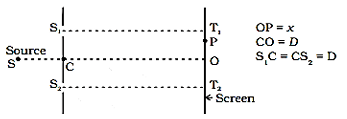
Answer
View full question & answer→\text { According to } \theta
$\begin{array}{l} d = D \text { (Given) ...(i) } \\
\ D=\frac{1}{2} d \text { (Given) ...(ii) }\end{array}$
d=2D
Path difference at $P = S _2 P - S _1 P$
Path difference $p=\sqrt{D^2+\left(x+\frac{d}{2}\right)^2}-\sqrt{D^2+\left(x-\frac{d}{2}\right)^2}$
Substitute the value of d and x from (i) and (ii)
$\begin{array}{l}=\sqrt{\left.D^2+(D)+D\right)^2}-\sqrt{D^2+(D-D)^2} \\
=\sqrt{5 D^2}-\sqrt{D^2}\end{array}$
$p=D(\sqrt{5}-1)$
The path difference for nth dark fringe from central maxima $O$ is $(2 n-1) \frac{\lambda}{2}$
$\therefore$ For 1st minima $p=\frac{\lambda}{2}$
Put the value of p in (iii)
$\begin{array}{l}\frac{\lambda}{2}=D(\sqrt{5}-1) \\
D=\frac{\lambda}{2(\sqrt{5}-1)}\end{array}$
Rationalizing the denominator, we get,
$\begin{array}{l}D=\frac{\lambda}{2(\sqrt{5}-1)} \times \frac{(\sqrt{5}+1)}{(\sqrt{5}+1)}=\frac{(2.236+1)}{2 \times(5-1)} \lambda=\frac{3.236}{2 \times 4} \lambda \\
=\frac{3.236}{8} \lambda=0.404 \lambda\end{array}$
$\begin{array}{l} d = D \text { (Given) ...(i) } \\
\ D=\frac{1}{2} d \text { (Given) ...(ii) }\end{array}$
d=2D
Path difference at $P = S _2 P - S _1 P$
Path difference $p=\sqrt{D^2+\left(x+\frac{d}{2}\right)^2}-\sqrt{D^2+\left(x-\frac{d}{2}\right)^2}$
Substitute the value of d and x from (i) and (ii)
$\begin{array}{l}=\sqrt{\left.D^2+(D)+D\right)^2}-\sqrt{D^2+(D-D)^2} \\
=\sqrt{5 D^2}-\sqrt{D^2}\end{array}$
$p=D(\sqrt{5}-1)$
The path difference for nth dark fringe from central maxima $O$ is $(2 n-1) \frac{\lambda}{2}$
$\therefore$ For 1st minima $p=\frac{\lambda}{2}$
Put the value of p in (iii)
$\begin{array}{l}\frac{\lambda}{2}=D(\sqrt{5}-1) \\
D=\frac{\lambda}{2(\sqrt{5}-1)}\end{array}$
Rationalizing the denominator, we get,
$\begin{array}{l}D=\frac{\lambda}{2(\sqrt{5}-1)} \times \frac{(\sqrt{5}+1)}{(\sqrt{5}+1)}=\frac{(2.236+1)}{2 \times(5-1)} \lambda=\frac{3.236}{2 \times 4} \lambda \\
=\frac{3.236}{8} \lambda=0.404 \lambda\end{array}$