Question
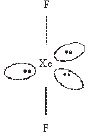
  1. Draw the structure of $XeF_2$ molecule.
  2. Write the outer electronic configuration of $Cr$ atom $(Z=24).$
Answer

  1. ​​​​​
  1. $3d^54s^1.$

Need a full question paper?

Generate a complete, print-ready paper with questions like this in minutes — across 16+ boards, with answer keys.

Start Generating Free

Similar questions

Give the major products that are formed by heating the following ethers with HI.
$ \ \ \ \ \ \ \ \ \ \ \ \ \ \ \ \ \ \ \ \ \ \ \ \ \ \ \ \ \ \ \ \ \ \ \ \ \ \ \ \ \ \ \ \ \ \text{CH}_3\\ \ \ \ \ \ \ \ \ \ \ \ \ \ \ \ \ \ \ \ \ \ \ \ \ \ \ \ \ \ \ \ \ \ \ \ \ \ \ \ \ \ \ \ \ \ \ \text{|}\\\text{CH}_3-\text{CH}_2-\text{CH}_2-\text{O}-\text{C}-\text{CH}_2-\text{CH}_3\\ \ \ \ \ \ \ \ \ \ \ \ \ \ \ \ \ \ \ \ \ \ \ \ \ \ \ \ \ \ \ \ \ \ \ \ \ \ \ \ \ \ \ \ \ \ \ \text{|}\\ \ \ \ \ \ \ \ \ \ \ \ \ \ \ \ \ \ \ \ \ \ \ \ \ \ \ \ \ \ \ \ \ \ \ \ \ \ \ \ \ \ \ \ \ \ \text{CH}_3$
Explain reduction reaction of carboxylic acids.
Write structures of different dihalogen derivatives of propane.
Write balanced chemical equations for the following reactions:
  1. $Ca_3P_2 + H_2O \rightarrow$
  2. $XeF_6 + 3H_2O \rightarrow$
Explain Crystal field splitting theory
What are the functions performed by histamine in the body?
How can you prepare $Cl_2$ from $HCl$ and $HCl$ from $Cl_2?$ Write reactions only.
What are the hydrolysis products of (i) sucrose, and (ii) lactose?
Which metal in the first series of transition metals exhibits $+1$ oxidation state most frequently and why$?$

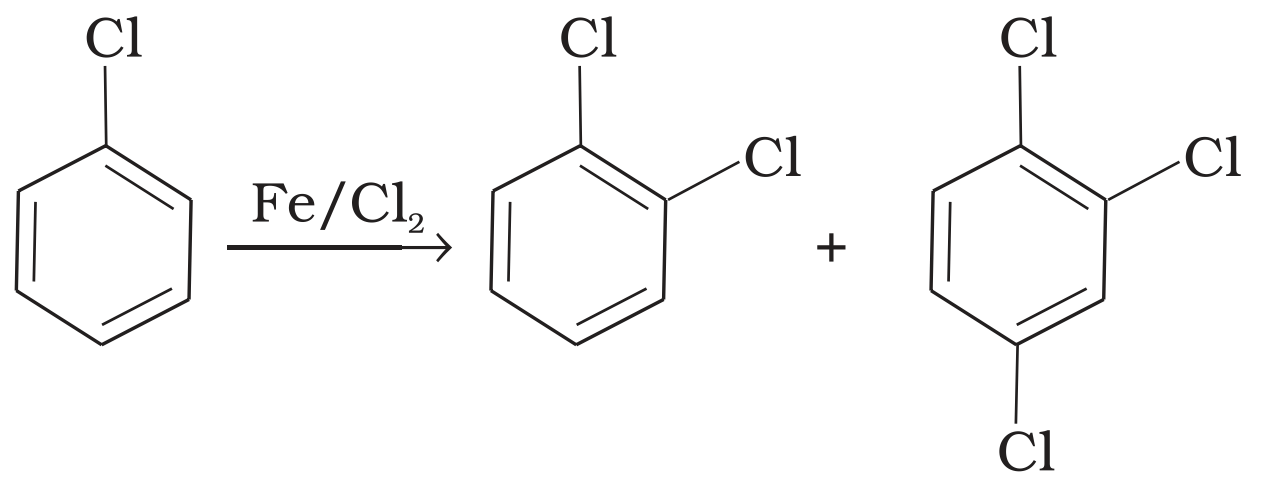
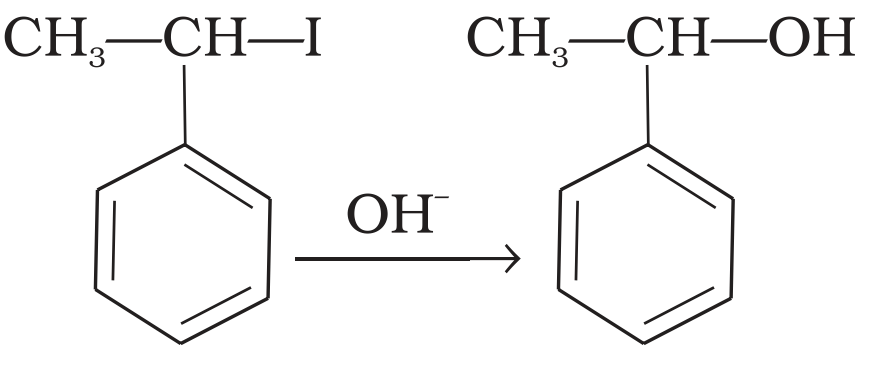
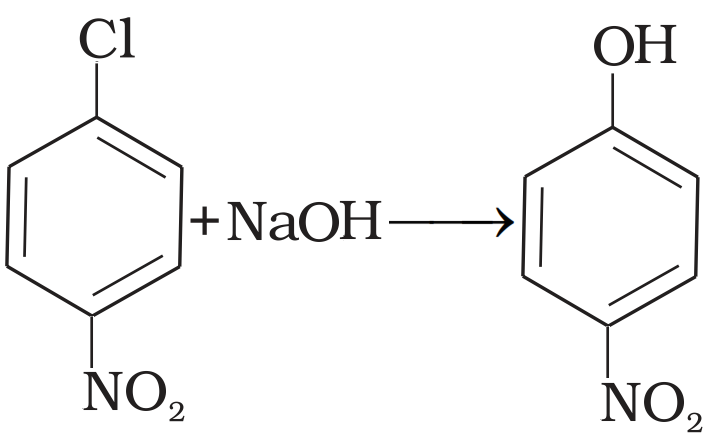
Match the reactions given in Column I with the names given in Column II.
  Column I   Column II
(i) (a) Nucleophilic aromatic substitution
(ii) $\text{CH}_3-\text{CH}==\text{CH}_2+\text{HBr}\xrightarrow{ \ \ \ \ \ }\text{CH}_3-\text{CH}-\text{CH}_3\ \ \ \ \ \ \ \ \ \ \ \ \ \ \ \ \ \ \ \ \ \ \ \ \ \ \ \ \ \ \ \ \ \ \ \ | \ \ \ \ \ \ \ \ \ \ \ \text{Br}$ (b) Electrophilic aromatic substitution
(iii) (c) Saytzeff elimination
(iv) (d) Electrophilic addition
(v) $\text{CH}_3\text{CH}_2\text{CH}\text{CH}_3\xrightarrow{\text{alc.KOH}}\text{CH}_3\text{CH}==\text{CH}\text{CH}_3\ \ \ \ \ \ \ |\ \ \ \ \ \ \ \ \ \ \ \ \ \ \ \ \text{Br}$ (e) Nucleophilic substitution $(S_N1)$