MCQ
Each electrical appliance is provided with a _______ core flexible cable:
  • A
    3
  • B
    2
  • C
    1
  • D
    4

Answer

  1. 3

Explanation:

Each electrical appliance is provided with three (3) core flexible cables. The insulation on the three wires is of different colours i.e  Brown for live wire, blue for neutral wire and green or yellow for earth wire.

Need a full question paper?

Generate a complete, print-ready paper with questions like this in minutes — across 16+ boards, with answer keys.
Start Generating Free

Similar questions

When an object is kept at any distance in front of a concave lens, the image formed is always:
  1. Virtual, erect and magnified.
  2. Virtual, inverted and diminished.
  3. Virtual, erect and diminished.
  4. Virtual, erect and same size as object.
If the image formed is always virtual, the mirror can be:
Long-sightedness: Hypermetropia Short-sightedness: 
Which of the following is more environment friendly?
  1. Burning of diesel.
  2. Burning of coal.
  3. Burning of charcoal.
  4. Burning of wood.
For a current in a long straight solenoid N- and S-poles are created at the two ends. Among the following statements, the incorrect statement is:
Most of the sources of energy that we sue represent stored solar energy. Which of the following is not ultimately derived from the sun's energy?
  1. Wind energy.
  2. Geothermal energy.
  3. Fossil fuels.
  4. Biomass.
The steps involved in observing a slide under a microscope are given below. They may not be in proper sequence.

  1. Focus the object under high power of the microscope.

  2. Place the slide on the stage of the microscope.

  3. Arrange the mirror to reflect maximum light to the slide.

  4. Focus the object under low power of the microscope.

The proper sequence of steps is:
If a magnification of, -1 is to be obtained by using a converging lens of focal length 12cm, then the object must be placed:
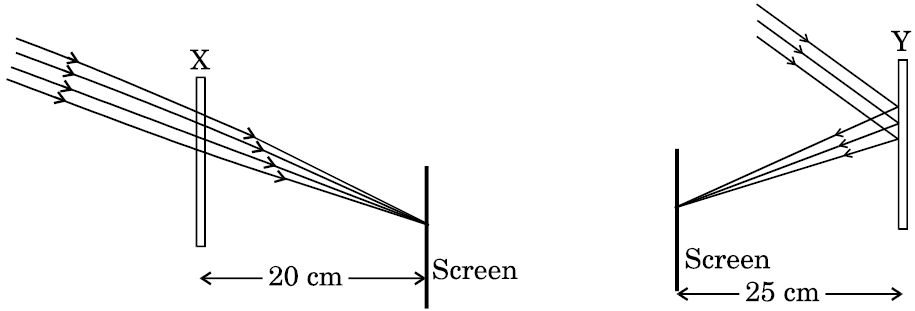
Study the given ray diagrams and select the correct statement from the following:
An object is 100mm in front of a concave mirror which produces an upright (erect image). The radius of curvature of the mirror is: