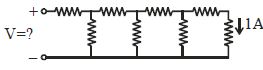
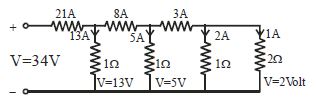
Each element in the finite chain of resistors shown in the figure is $1\,\Omega $. A current of $1\, A$ flows through the final element. Then what is the potential difference $V$ across input terminals of the chain ............... $\mathrm{volt}$
Medium


Download our appand get started for free
Experience the future of education. Simply download our apps or reach out to us for more information. Let's shape the future of learning together!No signup needed.*
Similar Questions
- 1If the balance point is obtained at the $35^{th} cm$ in a meter bridge the resistances in the left and right gaps are in the ratio ofView Solution
- 2What equal length of an iron wire and a copper-nickel alloy wire, each of $2 \; {mm}$ diameter connected parallel to give an equivalent resistance of $3 \Omega ?$View Solution
(Given resistivities of iron and copper-nickel alloy wire are $12 \;\mu \Omega {cm}$ and $51\; \mu \Omega {cm}$ respectively) (in ${m}$)
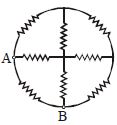
- 3Eight resistances each of resistance $5\,\Omega $ are connected in the circuit as shown in figure. The equivalent resistance between $A$ and $B$ isView Solution
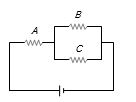
- 4Three identical resistances $A$, $B$ and $C$ are connected as shown in the given figure. The heat produced will be maximumView Solution
- 5In a wire of cross section radius $r,$ free electrons travel with drift velocity $v$ when a current $I$ flows through the wire. What is the current in another wire of half the radius and of the same material when the drift velocity is $2v$ ?View Solution
- 6A student has $10$ resistors of resistance ‘$r$’. The minimum resistance made by him from given resistors isView Solution
- 7If two wires having resistance $R$ and $2R$. Both joined in series and in parallel then ratio of heat generated in this situation, applying the same voltage,View Solution
- 8A cylindrical wire of radius $0.5 \,mm$ and conductivity $5 \times 10^{7}\, S / m$ is subjected to an electric field of $10 \,mV / m .$ The expected value of current in the wire will be $x ^{3} \,\pi mA$. The value of $x$ is ......View Solution
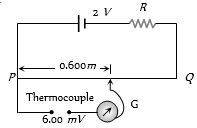
- 9Figure shows a simple potentiometer circuit for measuring a small $e.m.f$. produced by a thermocouple. The meter wire $PQ$ has a resistance $5 \,\Omega$ and the driver cell has an e.m.f. of $2\, V$. If a balance point is obtained $0.600\, m$ along $PQ$ when measuring an e.m.f. of $6.00\, mV$, what is the value of resistance $R$ ............... $\Omega$View Solution
- 10A $3\,^oC$ rise in temperature is observed in a conductor by passing a certain current. When the current is doubled, the rise in temperature will be ............. $^oC$View Solution