What equal length of an iron wire and a copper-nickel alloy wire, each of $2 \; {mm}$ diameter connected parallel to give an equivalent resistance of $3 \Omega ?$
(Given resistivities of iron and copper-nickel alloy wire are $12 \;\mu \Omega {cm}$ and $51\; \mu \Omega {cm}$ respectively) (in ${m}$)
JEE MAIN 2021, Diffcult


Download our appand get started for free
Experience the future of education. Simply download our apps or reach out to us for more information. Let's shape the future of learning together!No signup needed.*
Similar Questions
- 1A filament bulb $(500 \,W,\,\, 100 \,V)$ is to be used in a $230\, V$ main supply. When a resistance $R$ is connected in series, it works perfectly and the bulb consumes $500\,W.$ The value of $R$ is .................. $\Omega$View Solution
- 2View SolutionAssertion : An electric bulb becomes dim, when the electric heater in parallel circuit is switched on.
Reason : Dimness decreases after sometime.
- 3The electric current through a wire varies with time as $I=I_0+\beta t$. where $I_0=20 \mathrm{~A}$ and $\beta=3 \mathrm{~A} / \mathrm{s}$. The amount of electric charge crossed through a section of the wire in $20 \mathrm{~s}$ is :View Solution
- 4The resistivity of a potentiometer wire is $40 \times {10^{ - 8}}\,ohm - m$ and its area of cross-section is $8 \times {10^{ - 6}}\,{m^2}$. If $0.2\, amp$ current is flowing through the wire, the potential gradient will beView Solution
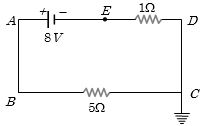
- 5In the given circuit, the potential of the point $E$ isView Solution
- 6An electric kettle has two heating coils. When one coil is used, water in the kettle boils in $5$ minutes, while when second coil is used, same water boils in $10\,\min$. If the two coils, connected in parallel are used simultaneously, the same water will boil in timeView Solution
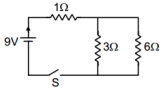
- 7After switch is closed, current drawn from the battery is (in $A$)View Solution
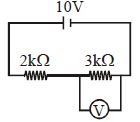
- 8In the circuit shown in figure, the resistance of voltmeter is $6\, k\Omega $. The voltmeter reading will be ................. $\mathrm{V}$View Solution
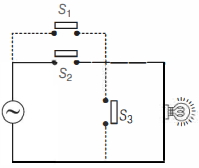
- 9View SolutionConsider the following circuit given below. The bulb will light up, if
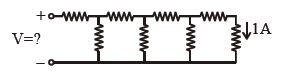
- 10Each element in the finite chain of resistors shown in the figure is $\,1\,\Omega $ . A current of $1\, A$ flows through the final element. Then what is the potential difference $V$ across input terminals of the chain .................. $\mathrm{volt}$View Solution