Bull in a China Shop La Opala is India's only opal glassware maker and ready to take on global competition.
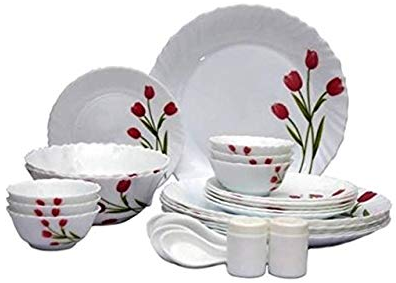
In the 19th century, it was common to import good china crockery in return for opium exports from Calcutta. However, bone china crockery never really caught on, because it used cow bone ash. Even today, food is served on glass plates at traditional weddings for this reason.
The porcelain and glass tableware market in India has always been strong. However, after independence and under foreign exchange restrictions, crockery imports tapered off and the market was filled with small manufacturers with products of suspect quality.
A small glass kiln, Radha Glass, at Madhupur in Bihar, has been making tea shop glasses, jars that are found in the neighbourhood grocery shop, and hurricane-lamp shades for decades. The eldest son of the family, Sushil Jhunjhunwala, inherited his father's business in the mid-1980s.
Jhunjhunwala realised that nothing big could had happen, if he stuck to traditional glass products and was persuaded to look around. He got an idea when, in late 1980s, during a trip to South Korea, he came across an opaque white glass called 'opal'. Impressed by its look, he decided to manufacture it with the use of imported machinery and La Opala was born in 1988.
Jhunjhunwala's timing was almost perfect because of liberalisation and the Indian middle-class affluence began to bloom after 1991, and every middle-class home was gifted one or two La Opala sets at a wedding. The idea was to bring out an elegant product, Indianise it and make it readily available at an affordable price. Also, the attractive oven-proof designs were a welcome change from the heavy porcelain and china tableware that dominated the Indian market at that time', recalls Jhunjhunwala.
In 1996, Jhunjhunwala started a handmade lead-crystal glassware unit in collaboration with Doosan of South Korea. It was a well-placed investment because labour rates in the main crystal manufacturing countries were high and also because the Indian middle-classes were developing a penchant for good glasses. Solitaire, handmade, lead-crystal glassware making has now matured with 1100 tpa production and annual sales at 18 crore. There are about 150 skilled workers who hand-carve crystal at the Madhupur plant.
In 2007, Jhunjhunwala started a second plant in Sitarganj near Haldwani in Uttarakhand, attracted by the hill-state tax regime and its proximity to Delhi's fancy market. Now, the plant capacity has just been doubled to 8000 tpa at an investment of 22 crore. La Opala, a silent performer, has reported sales of 157.66 crore and a PAT of 22.8 crore for the year ended March 2013, an increase of 34% in revenue from 117.5 crore sales, with PAT of 12.6 crore, in the previous year. La Opala is the only opal glassware manufacturer in India and holds 40% of the 400 crore estimated opal glassware market, in competition with global brands like Corelle of Corning, US and Luminarc of France.
Courtesy: Business India magazine, 27th May to 9th June, 2013 issue.
- How did Jhunjhunwala adapted his business to changing environment?
- By quoting the lines, identify the elements of business opportunity, as sensed by Jhunjhunwala while starting a handmade lead-crystal glassware unit in collaboration with Doosan of South Korea.
- Give any two entrepreneurial functions which Sushil Jhunjhunwala performed.