MCQ
Elastic coefficient of material on increasing temperature :
  • A
    increases
  • decreases
  • C
    does not depend
  • D
    increase upto a limit and then starts decreasing

Answer

Correct option: B.
decreases
B

Need a full question paper?

Generate a complete, print-ready paper with questions like this in minutes — across 16+ boards, with answer keys.
Start Generating Free

Similar questions

A string $2.0\, m$ long and fixed at its end is driven by a $240\, Hz$ vibrator. The string vibrates in its third harmonic mode. The speed of the wave and its fundamental frequency is
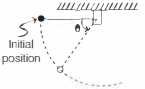
Figure below shows a small mass connected to a string, which is attached to a vertical post. If the ball is released, when the string is horizontal as shown below. The magnitude of the total acceleration (including radial and tangential) of the mass as a function of the angle $\theta$ is
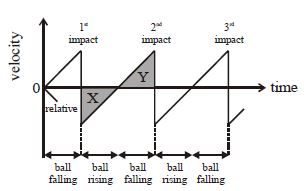
A steel ball is released from rest a distance above a rigid horizontal surface and bounces several time. The diagram shows how its velocity varies with time. Which statement correctly explains why the areas $X$ and $Y$ are equal?
A man in a balloon rising vertically with an acceleration of $4.9\,m/{\sec ^2}$ releases a ball $2$ sec after the balloon is let go from the ground. The greatest height above the ground reached by the ball is...........$m$ $(g = 9.8\,m/{\sec ^2})$
The formula $X = 5YZ^2$,  $X$ and $Z$ have dimensions of capacitance and magnetic field respectively. What are the dimensions of $Y$ in $SI$ units?
Inertia is that property of a body by virtue of which the body is
A body of mass ${m_1}$is moving with a velocity $V$. It collides with another stationary body of mass ${m_2}.$ They get embedded. At the point of collision, the velocity of the system
A lead bullet at $27°C$ just melts when stopped by an obstacle. Assuming that $25\%$ of heat is absorbed by the obstacle, then the velocity of the bullet at the time of striking........ $m/sec$  ($M.P.$ of lead $= 327°C,$ specific heat of lead $= 0.03\, cal/gm°C,$ latent heat of fusion of lead $= 6\, cal/gm$ and $J = 4.2\, joule/cal)$
A stone is projected from the ground with velocity $50 \,m/s$ at an angle of ${30^o}$. It crosses a wall after $3$ sec. How far beyond the wall the stone will strike the ground ..........  $m$ $(g = 10\,m/{\sec ^2})$
Suppose universal gravitational constant starts to decrease, then: