MCQ
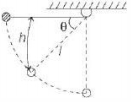
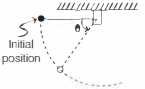
Figure below shows a small mass connected to a string, which is attached to a vertical post. If the ball is released, when the string is horizontal as shown below. The magnitude of the total acceleration (including radial and tangential) of the mass as a function of the angle $\theta$ is
  • A
    $g \sin \theta$
  • B
    $g \sqrt{3 \cos ^2 \theta+1}$
  • C
    $g \cos \theta$
  • $g \sqrt{3 \sin ^2 \theta+1}$

Answer

Correct option: D.
$g \sqrt{3 \sin ^2 \theta+1}$
d
(d)

As ball falls through height $h$ and string turns by angle $\theta$,

Velocity of ball is obtained by equating kinetic and potential energies

$\Rightarrow \frac{1}{2} m v^2 =m g h$

$\Rightarrow v^2=2 g h$

$\Rightarrow v^2=2 g l \sin \theta$

So, radial acceleration is

$a_r=\frac{v^2}{l}=2 g \sin \theta$

'Tangential acceleration is produced by component of weight along the string.

$\therefore$ Tangential acceleration is

$a_t=g \cos \theta$

Hence, total acceleration is

$a=\sqrt{ a _t^2+ a _r^2}$

$=\sqrt{4 g^2 \sin ^2 \theta+g^2 \cos ^2 \theta}$

$=g\sqrt{1+3 \sin ^2 \theta}$

Need a full question paper?

Generate a complete, print-ready paper with questions like this in minutes — across 16+ boards, with answer keys.

Start Generating Free

Similar questions

The ratio of kinetic energy of a planet at perigee and apogee during its motion around the sun in elliptical orbit of eccentricity $e$ is ..........
When a capillary tube is dipped into a liquid, the liquid neither rises nor falls in the capillary.
  1. The surface tension of the liquid must be zero.
  2. The contact angle must be 90º.
  3. The surface tension may be zero.
  4. The contact angle may be 90°.
The x-component of the resultant of several vectors:
  1. Is equal to the sum of the x-components of the vectors.
  2. May be smaller than the sum of the magnitudes of the vectors.
  3. May be greater than the sum of the magnitudes of the vectors.
  4. May be equal to the sum of the magnitudes of the vectors.
Consider two rods of same length and different specific heats $\left( c _1, c _2\right)$, thermal conductivities $\left( K _1, K_2\right)$ and area of cross-sections $\left(A_1, A_2\right)$ and both having temperatures $\left(T_1, T_2\right)$ at their ends. If their rate of loss of heat due to conduction is equal, then:
In a resonance tube, the first resonance is obtained when the level of water in the tube is at $16\,cm$ from the open end. Neglecting end correction, the next resonance will be obtained when the level of water from the open end is .... $cm$
$v-t$ graph of an object of mass $1\,\, kg$ is shown
A string $1\,\,m$ long is drawn by a $300\,\,Hz$ vibrator attached to its end. The string vibrates in $3$ segments. The speed of transverse waves in the string is equal to .... $m/s$
Volt/metre is the unit of
The magnitude of gravitational potential energy of the moon-earth system is U with zero potential energy at infinite separation. The kinetic energy of the moon with respect to the earth is K.
  1. U < K
  2. U > K
  3. U = K
A particle of mass $2 \,kg$ travels along a straight line with velocity $v=a \sqrt{x}$, where $a$ is a constant. The work done by net force during the displacement of particle from $x=0$ to $x=4 \,m$ is .........