MCQ
Elasticity is due to:
  • A
    Decrease of $PE$ with separation between atoms/ molecules.
  • B
    Increase of $PE$ with separation between atoms/ molecules.
  • Asymmetric nature of $PE$ curve.
  • D
    None of the above.

Answer

Correct option: C.
Asymmetric nature of $PE$ curve.

Need a full question paper?

Generate a complete, print-ready paper with questions like this in minutes — across 16+ boards, with answer keys.
Start Generating Free

Similar questions

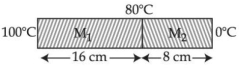
Two metallic blocks $M_{1}$ and $M_{2}$ of same area of cross-section are connected to each other (as shown in figure). If the thermal conductivity of $M _{2}$ is $K$ then the thermal conductivity of $M _{1}$ will be ]...............$K$ [Assume steady state heat conduction]
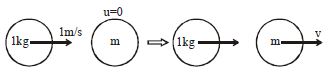
A particle of mass $1\, kg$ moving with velocity $1\, m/s$, collides elastically with another particle of mass $m$. In the collision particle of mass $1\, kg$ loses $\frac{3}{4}$of its $K.E.$ The value of $m$ is :
A small mass executes linear $SHM$ about $O$ with amplitude $a$ and period $T.$ Its displacement from $O$ at time $T/8$ after passing through $O$ is :
The acceleration due to gravity at pole and equator can be related as
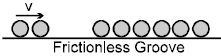
Six steel balls of identical size are lined up long a straight frictionless groove. Two similar balls moving with a speed $V$ along the groove collide with this row on the extreme left hand then
A player caught a cricket ball of mass $150 \mathrm{~g}$ moving at a speed of $20 \mathrm{~m} / \mathrm{s}$. If the catching process is completed in $0.1 \mathrm{~s}$, the magnitude of force exerted by the ball on the hand of the player is:
The angle between two vectors given by $6\hat i + 6\hat j - 3\hat k$ and $7\hat i + 4\hat j + 4\hat k$ is
A toy-car, blowing its horn, is moving with a steady speed of $5\, m/s$ , away from a wall. An observer, towards whom the toy car is moving, is able to hear $5\, beats$ per second. If the velocity of sound in air is $340\, m/s$, the frequency of the horn of the toy car is close to  ... $Hz$
Consider two containers $A$ and $B$ containing identical gases at the same pressure, volume and temperature. The gas in container $A$ is compressed to half of its original volume isothermally while the gas in container $B$ is compressed to half of its original value adiabatically. The ratio of final pressure of gas in $B$ to that of gas in $A$ is
Two simple pendulums of lengths $1.44 \,m$ and $1\, m$ start swinging together. After how many vibrations will they again start swinging together