MCQ
The acceleration due to gravity at pole and equator can be related as
  • A
    ${g_p} < {g_e}$
  • B
    ${g_p} = {g_e} = g$
  • C
    ${g_p} = {g_e} < g$
  • ${g_p} > {g_e}$

Answer

Correct option: D.
${g_p} > {g_e}$
d
(d)

Need a full question paper?

Generate a complete, print-ready paper with questions like this in minutes — across 16+ boards, with answer keys.

Start Generating Free

Similar questions

A block of mass $10\, kg$ starts sliding on a surface with an initial velocity of $9.8\, ms ^{-1}$. The coefficient of friction between the surface and bock is $0.5$. The distance covered by the block before coming to rest is: [use $g =9.8\, ms ^{-2}$ ].........$m$
The Bernoulli's equation is given by $p +\frac{1}{2} \rho v ^{2}+ h \rho g = k$

where $p =$ pressure, $\rho =$ density, $v =$ speed, $h =$ height of the liquid column, $g=$ acceleration due to gravity and $k$ is constant. The dimensional formula for $k$ is same as that for
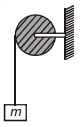
A disc of mass $m$ and radius $r$ is free to rotate about its centre as shown in the figure. A string is wrapped over its rim and a block of mass $m$ is attached to the free end of the string. The system is released from rest. The speed of the block as it descends through a height $h$, is .....
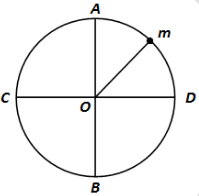
A small sphere is attached to a cord and rotates in a vertical circle about a point Or. If the average speed of the sphere is increased, the cord is most likely to break at the orientation when the mass is at:
The velocity and acceleration vectors of a particle undergoing circular motion are $\overrightarrow{ v }=2 \hat{ i } m / s$ and $\overrightarrow{ a }=2 \hat{ i }+4 \hat{ j } m / s ^2$ respectively at an instant of time. The radius of the circle is $........\,m$
A mercury drop of $1\, cm$ radius is broken into ${10^6}$ small drops. The energy used will be (surface tension of mercury is $35 \times {10^{ - 3}}N/cm)$
A parallel beam of light is incident on a converging lens parallel to its principal axis. As one moves away from the lens on the other side on its principal axis, the intensity of light:
A particle of mass $m $ is moving in a horizontal circle of radius $r$  under a centripetal force equal to $ - K/{r^2}$, where $K$  is a constant. The total energy of the particle is
When two sound waves are superimposed, beats are produced when they have
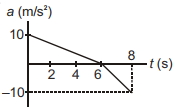
The acceleration-time graph for a particle moving along $x$-axis is shown in figure. If the initial velocity of particle is $-5 \,m / s$, the velocity at $t=8 \,s$ is ....... $m / s$