Question
Electric field is in the direction in which the potential ____ steepest.

Answer

  1. Decreases.

Need a full question paper?

Generate a complete, print-ready paper with questions like this in minutes — across 16+ boards, with answer keys.
Start Generating Free

Similar questions

Two or more resistors are said to be in ...A... if one end of all resistors is joined together and similarly the other ends joined together, Here, A refers to:
Ampere’s circuital law states that:
A ray of light incidents on a plane mirror at an angle of 30°.  The deviation produced in the ray is(a) 30°(b) 60°(c) 90°(d) 120°
       
Lines which represent places of constant angle of dip are called(a) Isobaric lines(b) Isogonic lines(c) Isoclinic lines(d) Isodynamic lines
       
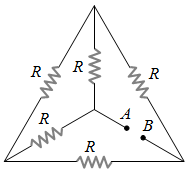
If each of the resistance of the network shown in the figure is $R,$ the equivalent resistance between $A$ and $B$ is
The Electric field at a point is:
Penetrating power of X-rays can be increased by(a) Increasing the potential difference between anode and cathode(b) Decreasing the potential difference between anode and cathode(c) Increasing the cathode filament current(d) Decreasing the cathode filament current


In a process on a system, the initial pressure and volume are equal to the final pressure and volume.
  1. The initial temperature must be equal to the final temperature.
  2. The initial internal energy must be equal to the final internal energy.
  3. The net heat given to the system in the process must be zero.
  4. The net work done by the system in the process must be zero.
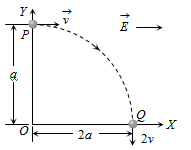
A particle of charge $+q$ and mass $m$ moving under the influence of a uniform electric field  $Eî$ and a uniform magnetic field $B \hat{k}$  follows trajectory from $P$ to $Q$ as shown in figure. The velocities at $P$ and $Q$ are $v^{\hat{1}}$ and -$-2 v^{\hat{\jmath}}$ respectively. Which of the following statement$(s)$ is/are correct
A point charge q is rotated along a circle in the electric field generated by another point charge Q. The work done by the electric field on the roatating charge in one complete revolution is:
  1. Zero.
  2. Positive.
  3. Negative.
  4. Zero if the charge Q is at the centre and nonzero otherwise.