MCQ
Electrical resistivity of any given metallic wire depends upon:
  • A
    Its thickness
  • B
    Its shape
  • C
    Nature of the material
  • D
    Its length

Answer

  1. Nature of the material

Need a full question paper?

Generate a complete, print-ready paper with questions like this in minutes — across 16+ boards, with answer keys.
Start Generating Free

Similar questions

An electric bulb is connected to a 220V generator. The current is 0.50A. What is the power of the bulb?
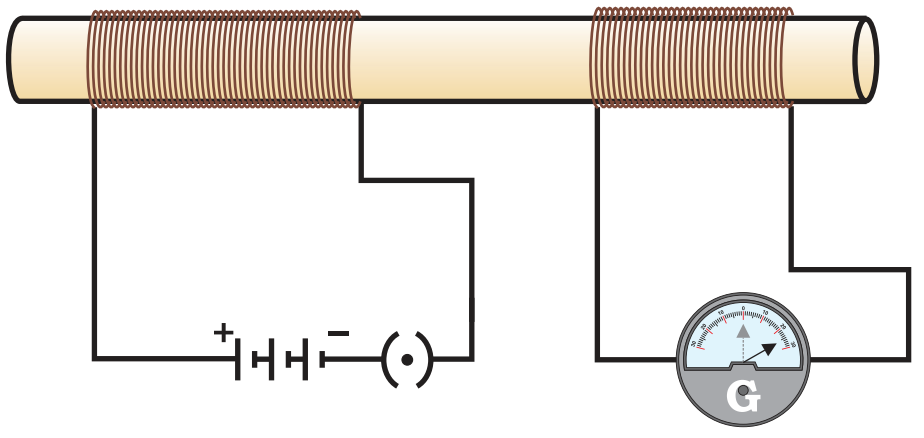
In the arrangement shown in Figure there are two coils wound on a non-conducting cylindrical rod. Initially the key is not inserted. Then the key is inserted and later removed. Then,
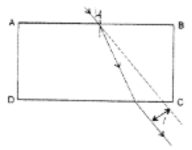
A student traces the path of a ray of light passing through a rectangular glass slab for three different values of angle of incidence (i) namely $30^{\circ}, 45^{\circ}, 60^{\circ}$. He produces the incident ray and measures the perpendicular distance, $l$, between the produced incident ray and the emergent ray.
Image 
He will observe that
Which of the following is likely to be the correct wattage for an electric iron used in our homes?
  1. 60W.
  2. 250W.
  3. 850W.
  4. 2000W.
The image formed by a concave mirror is real, inverted and of the same size as the object. The position of the object must then be:
  1. At the focus.
  2. Between the centre of curvature and focus.
  3. At the centre of curvature.
  4. Beyond the centre of curvature.
The resistivity of a certain material is $0.6 Ω\ \text{m}. $ The material is most likely to be:
The force exerted on a current-carrying wire placed in a magnetic field is zero when the angle between the wire and the direction of magnetic field is:
Coulomb is the SI unit of:
The direction of current in the coil at one end of an electromagnet is clockwise. This end of the electromagnet will be:
What is the maximum resistance which can be made using five resistors each of $\frac{1}{5}\Omega$?

  1. $\frac{1}{5}\Omega$

  2. $10\Omega$

  3. $5\Omega$

  4. $1\Omega$