Why is electrical wiring usually made from copper :
- ABecause copper is shiny.
- ✓Because copper conducts electricity.
- CBecause copper is not magnetic
- Dnone of these
Answer: B.
View full solution →1,298 questions across 18 question groups — pick any mix to generate a Science paper with step-by-step answer keys.
M.C.Q
181 Q→02Assertion - Reasoning (1 Marks)
19 Q→03Fill in the blank
10 Q→04True-False
3 Q→05[1 Mark Questions]
129 Q→06[2 Mark Questions]
144 Q→07[3 Mark Questions]
108 Q→08[5 marks Questions]
48 Q→09case /data -based (4 Marks)
13 Q→10M.C.Q-[Phy-1M]
171 Q→11Assertion - Reasoning [Phy-1 M]
19 Q→12Fill in the blank [Phy-1M]
10 Q→13True-False [Phy-1M]
3 Q→14Answer the questions.[Phy-1M]
129 Q→15Answer the questions.[Phy-2M]
144 Q→16Answer the questions.[Phy-3M]
107 Q→17case /data -based [Phy-4M]
13 Q→18Answer the questions.[Phy-5M]
47 Q→One sample from each question group in this chapter. Select any group above to see the full set with answer keys.
Answer: B.
View full solution →Answer: C.
View full solution →Answer: C.
View full solution →Answer: D.
View full solution →Answer: D.
View full solution →Answer: B.
View full solution →Answer: C.
View full solution →Answer: C.
View full solution →Answer: A.
View full solution →Answer: A.
View full solution →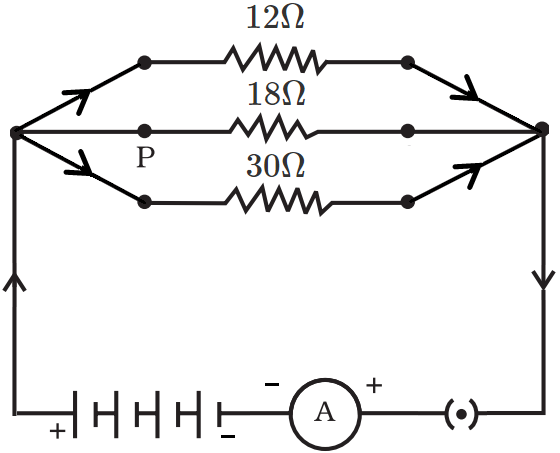
| Silver | $1.60\times10^{-8} \Omega \text{ m}$ |
| Copper | $1.62\times10^{-8} \Omega \text{ m}$ |
| Tungsten | $5.20\times10^{-8} \Omega \text{ m}$ |
| Iron | $10.0\times10^{-8} \Omega \text{ m}$ |
| Mercury | $94.0\times10^{-8} \Omega \text{ m}$ |
| Nichrome | $100\times10^{-6} \Omega \text{ m}$ |
| - | Meterial | Resistivity ($\Omega$ m) |
| Conductors | Silver | $1.60 \times 10^{-8}$ |
| Copper | $1.60\times 10^{-8}$ | |
| Aluminium | $2.63\times 10^{-8}$ | |
| Tungsten | $5.20 \times 10^{-8}$ | |
| Nickel | $6.84\times 10^{-8}$ | |
| Iron | $10.0 \times 10^{-8}$ | |
| Chromoium | $12.9 \times 10^{-8}$ | |
| Mercury | $94.0\times 10^{-8}$ | |
| Manganese | $1.84 \times 10^{-6}$ | |
| Constant (alloy of Cu, Mn and Ni) | $49 \times 10^{-6}$ | |
| Alloys | Manganin (alloy of Cu, Mn and Ni) | $44 \times 10^{-6}$ |
| Nichrome (alloy of Ni, Cr, MN and Fe) | $100 \times 10^{-6}$ | |
| Glass | $10^{10}-10^{14}$ | |
| Insulators | Hard rubber | $10^{13}-10^{16}$ |
| Ebonite | $10^{15}-10^{17}$ | |
| Diamond | $10^{12}-10^{13}$ | |
| Paper (dry) | $10^{12}$ |
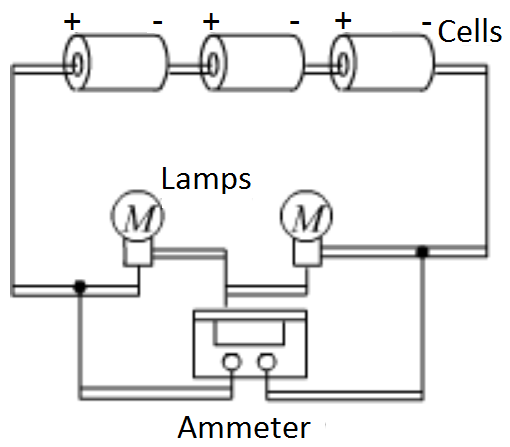
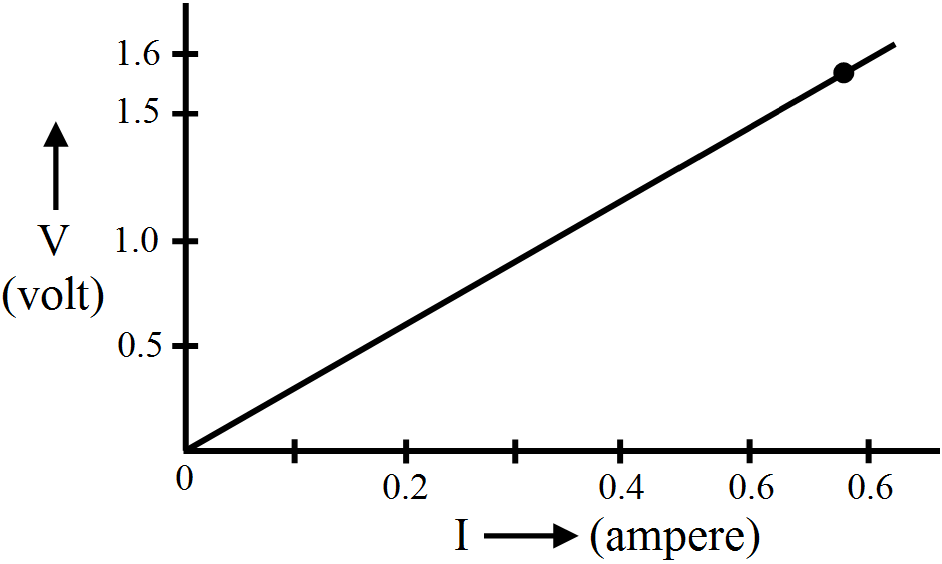
| I (amperes) | 0.5 | 1.0 | 2.0 | 3.0 | 4.0 |
| V (volts) | 1.6 | 3.4 | 6.7 | 10.2 | 13.2 |
| - | Meterial | Resistivity ($\Omega$m) |
| Conductors | Silver | 1.60× 10⁻⁸ |
| Copper | 1.60× 10⁻⁸ | |
| Aluminium | 2.63 × 10⁻⁸ | |
| Tungsten | 5.20 × 10⁻⁸ | |
| Nickel | 6.84 × 10⁻⁸ | |
| Iron | 10.0 × 10⁻⁸ | |
| Chromoium | 12.9 × 10⁻⁸ | |
| Mercury | 94.0 × 10⁻⁸ | |
| Manganese | 1.84 × 10⁻⁶ | |
| Constant (alloy of Cu, Mn and Ni) | 49× 10-6 | |
| Alloys | Manganin (alloy of Cu, Mn and Ni) | 44× 10-6 |
| Nichrome (alloy of Ni, Cr, MN and Fe) | 100 × 10-6 | |
| Glass | 1010- 1014 | |
| Insulators | Hard rubber | 1013 - 1016 |
| Ebonite | 1015- 1017 | |
| Diamond | 1012- 1013 | |
| Paper (dry) | 1012 |
The rate of flow of charge is called electric current. The SJ unit of electric current is Ampere (A). The direction of flow of current is always opposite to the direction of flow of electrons in the current. The electric potential is defined as the amount of work done in bringing a unit positive test charge from infinity to a point in the electric field. The amount of work done in bringing a unit positive test charge from one point to another point in an electric field is defined as potential difference.
$\text{V}_{\text{AB}}=\text{V}_{\text{B}}-\text{V}_\text{A}=\frac{\text{W}_{\text{BA}}}{\text{q}}$
The SJ unit of potential and potential difference is volt.
OR
The obstruction offered by a conductor in the path of flow of current is called resistance. The SJ unit of resistance is ohm (Q). It has been found that the resistance of a conductor depends on the temperature of the conductor. As the temperature increases, the resistance also increases. But the resistance of alloys like mangnin, Constantin and nichrome is almost unaffected by temperature. The resistance of a conductor also depends on the length of conductor and the area of cross-section of the conductor. More be the length, more will be the resistance, more be the area of cross-section, lesser will be the resistance.
The heating effect of current is obtained by transformation of electrical energy in heat energy. Just as mechanical energy used to overcome friction is covered into heat, in the same way, electrical energy is converted into heat energy when an electric current flows through a resistance wire. The heat produced in a conductor, when a current flows through it is found to depend directly on (a) strength of current (b) resistance of the conductor (c) time for which the current flows. The mathematical expression is given by $\text{H} = \text{I}^2\text{Rt}.$
The electrical fuse, electrical heater, electric iron, electric geyser etc. all are based on the heating effect of current.
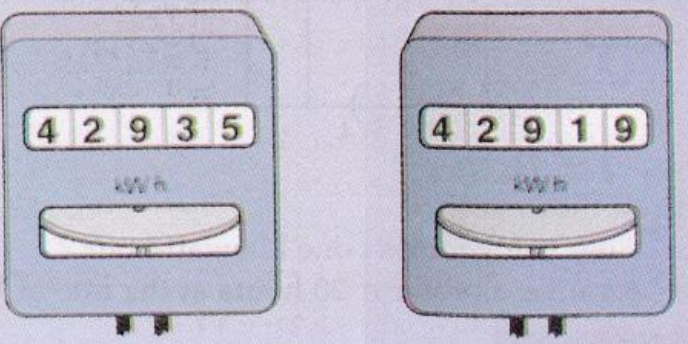
The electrical energy consumed by an electrical appliance is given by the product of its power rating and the time for which it is used. The SI unit of electrical energy is Joule. Actually, Joule represents a very small quantity of energy, and therefore it is inconvenient to use where a large quantity of energy is involved. So for commercial purposes we use a bigger unit of electrical energy which is called kilowatt-hour. 1 kilowatt-hour is equal to 3.6 × 10⁶ joules of electrical energy.
| Silver | $1.60\times10^{-8} \Omega \text{ m}$ |
| Copper | $1.62\times10^{-8} \Omega \text{ m}$ |
| Tungsten | $5.20\times10^{-8} \Omega \text{ m}$ |
| Iron | $10.0\times10^{-8} \Omega \text{ m}$ |
| Mercury | $94.0\times10^{-8} \Omega \text{ m}$ |
| Nichrome | $100\times10^{-6} \Omega \text{ m}$ |
Answer the following questions in relation to them:
Pick question groups from the list above, set marks and difficulty, and export a branded PDF with step-by-step answer keys. First 3 chapters free — no signup.