Question
Electromagnetic waves are produced by:
- A static charge.
- A moving charge.
- An accelerating charge.
- Chargeless particles.
Explanation:
A static charge produces an electrostatic field. A moving charge produces a magnetic field. Electromagnetic waves are produced by an accelerating charge.
Generate a complete, print-ready paper with questions like this in minutes — across 16+ boards, with answer keys.
A potentiometer circuit shown in the figure is set up to measure e.m.f. of a cell E. As the point P moves from X to Y the galvanometer G shows deflection always in one direction, but the deflection decreases continuously until Y is reached. In order to obtain balance point between X and Y it is necessary to

|
(a) Decreases the resistance R |
(b) Increase the resistance R |
|
(c) Reverse the terminals of battery V |
(d) Reverse the terminals of cell E |
A proton moving with a velocity, 2.5  , enters a magnetic field of intensity 2.5T making an angle 30° with the magnetic field. The force on the proton is
|
(a) 3 |
(b) 5 |
(c) 6 |
(d) 9 |
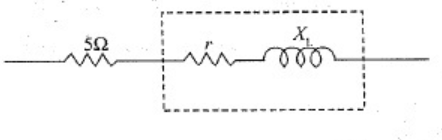
A variable condenser is permanently connected to a 100 V battery. If the capacity is changed from 2μF to 10 μF, then change in energy is equal to
|
(a) 2 |
(b) 2.5 |
(c) 3.5 |
(d) 4 |
Assertion : Neutrons penetrate matter more readily as compared to protons.
Reason : Neutrons are slightly more massive than protons.
|
(a) If both assertion and reason are true and the reason is the correct explanation of the assertion. |
|
(b) If both assertion and reason are true but reason is not the correct explanation of the assertion. |
|
(c) If assertion is true but reason is false. |
|
(d) If the assertion and reason both are false. |
Lines which represent places of constant angle of dip are called
| (a) Isobaric lines | (b) Isogonic lines | (c) Isoclinic lines | (d) Isodynamic lines |
Two identical parallel plate capacitors are connected in series to a battery of 100 V. A dielectric slab of dielectric constant 4.0 is inserted between the plates of second capacitor. The potential difference across the capacitors will now be respectively
|
(a) 50 V, 50 V |
(b) 80 V, 20 V |
(c) 20 V, 80 V |
(d) 75 V, 25 V |

