Question
Electromagnetic waves travel only through.

Answer

  1. oscillating electric and magnetic fields whose directions are perpendicular to each other
Explanation:
Electromagnetic waves travel through oscillating electric and magnetic fields whose directions are perpendicular to each other.

Need a full question paper?

Generate a complete, print-ready paper with questions like this in minutes — across 16+ boards, with answer keys.
Start Generating Free

Similar questions

Assertion : For the scattering of $\alpha-$particles at a large angles, only the nucleus of the atom is responsible.
Reason : Nucleus is very heavy in comparison to electrons.
The dimension $\ce{ML^{-1} T^{-2}}$ can correspond to$:$
According to Joule's law, if potential difference across a conductor of material of resistivity remains constant, then heat produced in the conductor is directly proportional to
The tangent galvanometer, when connected in series with a standard resistance can be used as(a) An ammeter(b) A voltmeter(c) A wattmeter(d) Both an ammeter and a voltmeter
   
   
Consider the situation of the previous problem. The force on the central charge due to the shell is:
  1. Towards left.
  2. Towards right.
  3. Upward.
  4. Zero.
The number of turns in primary and secondary coils of a transformer are 100 and 20 respectively. If an alternating potential of 200 volt is applied to the primary, the induced potential in secondary will be(a) 10 V(b) 40 V(c) 1000 V(d) 20,000 V
       
A potential difference of $300$ volts is applied to a combination of $2.0\ mF$ and $8.0\ mF$ capacitors connected in series. The charge on the $2.0\ mF$ capacitor is
If the energy of the photon is increased by a factor of 4, then its momentum(a) Does not change(b) Decreases by a factor of 4(c) Increases by a factor of 4(d) Decreases by a factor of 2
   
   
Nuclear forces are:
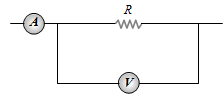
The ammeter $A$ reads $2\ A$ and the voltmeter $V$ reads $20\ V.$  the value of resistance $R$ is $($Assuming finite resistance's of ammeter and voltmeter$)$