MCQ
Electromagnetic waves travel only through.
- Amaterial medium
- Bvacuum
- Coscillating electric and magnetic fields
- Doscillating electric and magnetic fields whose directions are perpendicular to each other
Explanation:
Electromagnetic waves travel through oscillating electric and magnetic fields whose directions are perpendicular to each other.
Generate a complete, print-ready paper with questions like this in minutes — across 16+ boards, with answer keys.
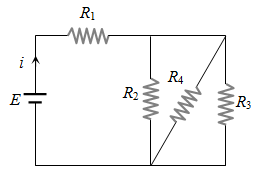
In the circuit given E = 6.0 V, R1 = 100 ohms, R2 = R3 = 50 ohms, R4 = 75 ohms. The equivalent resistance of the circuit, in ohms, is
|
(a) 11.875 |
(b) 26.31 |
(c) 118.75 |
(d) None of these |
In which radioactive disintegration, neutron dissociates into proton and electron
|
(a) |
(b) β - emission |
(c) γ - emission |
(d) Positron emission |
Two wires of the same material and equal length are joined in parallel combination. If one of them has half the thickness of the other and the thinner wire has a resistance of 8 ohms, the resistance of the combination is equal to
|
(a) |
(b) |
(c) |
(d) |
.......... happens when a wave passes from one medium to another at an angle.
The relationship between λ and half life ( of a radioactive substance is
|
(a) λ = |
(b) λ = |
(c) λ = |
(d) λ = |
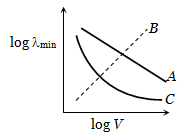
The dependence of the short wavelength limit  on the accelerating potential V is represented by the curve of figure
|
(a) A |
(b) B |
(c) C |
(d) None of these |
A rod of length 20 cm is rotating with angular speed of 100 rps in a magnetic field of strength 0.5 T about it’s one end. What is the potential difference between two ends of the rod
|
(a) 2.28 V |
(b) 4.28 V |
(c) 6.28 V |
(d) 2.5 V |
The photoelectric threshold wavelength for potassium (work function being 2eV ) is
|
(a) 310 nm |
(b) 620 nm |
(c) 1200 nm |
(d) 2100 nm |


