MCQ
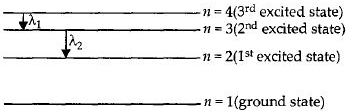
Electron in hydrogen atom first jumps from third excited state to second excited state and then from second excited to the first excited state. The ratio of the  wavelengths $\lambda_1 :\lambda_2$ emitted in the two cases is
  • A
    $\frac{7}{5}$
  • B
    $\;\frac{{27}}{{20}}$
  • C
    $\;\frac{{27}}{5}$
  • $\;\frac{{20}}{7}$

Answer

Correct option: D.
$\;\frac{{20}}{7}$
d
According to Rydberg formula

$\frac{1}{\lambda}=R\left[\frac{1}{n_{f}^{2}}-\frac{1}{n_{i}^{2}}\right]$

In first case, $n_{f}=3, n_{i}=4$

$\therefore \quad \frac{1}{\lambda_{1}}=R\left[\frac{1}{3^{2}}-\frac{1}{4^{2}}\right]=R\left[\frac{1}{9}-\frac{1}{16}\right]=\frac{7}{144} R$    .... $(i)$

In second case, $n_{f}=2, n_{i}=3$

$\therefore \quad \frac{1}{\lambda_{2}}=R\left[\frac{1}{2^{2}}-\frac{1}{3^{2}}\right]=R\left[\frac{1}{4}-\frac{1}{9}\right]=\frac{5}{36} R$    .... $(ii)$

Divide $(ii)$ by $(i)$, we get

$\frac{\lambda_{1}}{\lambda_{2}}=\frac{5}{36} \times \frac{144}{7}=\frac{20}{7}$

Need a full question paper?

Generate a complete, print-ready paper with questions like this in minutes — across 16+ boards, with answer keys.

Start Generating Free