MCQ
Electronic configuration of ${H^ - }$ is
  • A
    $1{s^0}$
  • B
    $1{s^1}$
  • $1{s^2}$
  • D
    $1{s^1}\,2{s^1}$

Answer

Correct option: C.
$1{s^2}$
c
(c) Electronic configuration of ${H^ - }$ is $1{s^2}$. It has $2 $ electrons in extra nuclear space.

Need a full question paper?

Generate a complete, print-ready paper with questions like this in minutes — across 16+ boards, with answer keys.

Start Generating Free

Similar questions

Calculate the millimoles of $SeO_3^{2-}$ in solution on the basis of following data : $70\,ml$ of $\frac{M}{60}$ solution of $KBrO_3$ was added to $SeO_3^{2-}$ solution. The bromine evolved was removed by boiling and excess of $KBrO_3$ was back titrated with $12.5\, mL$ of $\frac{M}{25}$ solution of $NaAsO_2$. The reactions are given below.

$I.\,SeO_3^{2 - } + BrO_3^ -  + {H^ + } \to SeO_4^{2 - } + B{r_2} + {H_2}O$

$II.\,BrO_3^ -  + AsO_2^ -  + {H_2}O \to B{r^ - } + AsO_4^{3 - } + {H^ + }$

The percentage of copper and oxygen in samples of $CuO$ obtained by different methods were found to be the same. This illustrates the law of
Consider the following reaction and determine which of the conditions will shift the equilibrium position to the right ?

$4N{H_3}(g)\,+\,5{O_2}(g)\,\, \rightleftharpoons \,4NO(g)\, + \,6{H_2}O(g)\, + \,Heat$
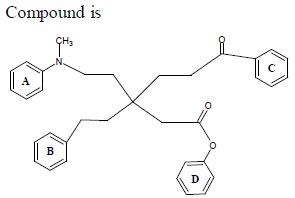
The following compound has four aromatic rings marked as $A,B,C$ and $D$. Rank them in terms of increasing reactivity towards electrophilic aromatic substitution?
Among given species identify the isostructural pairs
Which of the following is paramagnetic
Most reactive compound in following toward electrophilic substitution reaction is
There is no ring strain in cyclohexane, but cyclobutane has an angle strin of $9^\circ 44\ ′$. If $\Delta\text{H}_\text{C}^\circ $​ of cyclohexane per $\ce{(CH_2​)}$ group is $660\text{ kJ mol}^{-1}$ and $\Delta\text{H}_\text{C}^\circ $ of cyclobutane is $2744 \text{ kJ mol}^{-1}$, what is the ring strain in $\text{kJ mol}^{-1}$ of cyclobutane?
The total number of valence electrons in $4.2\,gm$ of $N_3^ - $ ion is ............. $\mathrm{N_A}$ (${N_A}$ is the Avogadro's number)
Which of the following represents an excited state of an atom?