Question
Electronic configuration of some of the elements are given :
Type of elementElementAtomic numberNumber of electrons in shell
MetalsSodium (Na)Magnesium (Mg)Aluminium (Al)1112132828283
Non-metalsOxygen (O)Sulphur (S)Chlorine (Cl)8161726286287
(i) State one physical property to distinguish between metals and non-metals.
(ii) What is the nature of the bond formed when magnesium reacts with chlorine? Write the formula of the compound.
or
(ii) What is common between oxygen and sulphur? Draw the electron dot structure of $O _2$ molecule.
Answer

(i) Metals are malleable and ductile while non-metals are brittle.
(ii) Ionic bond formed transfer of electrons from magnesium to chloride.
or
(ii) Both have same number of valence electron. Both belongs to the same group (Group 16) of the periodic table.

Need a full question paper?

Generate a complete, print-ready paper with questions like this in minutes — across 16+ boards, with answer keys.

Start Generating Free

Similar questions

Corrosion is the phenomenon of deterioration of surface of metal in presence of air and moisture. It is a natural process and in the presence of a moist atmosphere, chemically active metals get corroded. This is oxidation reaction. Rusting is the process where iron corrodes due to exposure to the atmosphere. The main circumstance of corrosion occurs with iron because it is a structural material in construction, bridges, buildings, rail transport, ships, etc. Aluminium is also an important structural metal, but even aluminium undergoes oxidation reactions. However, aluminium doesn't corrode or oxidize as rapidly as its reactivity suggests. An alloy of aluminium or any other metal like magnesium can make aluminium stronger and harder.
Copper $( Cu )$ corrodes and forms a basic green carbonate and lead corrodes to form a white lead oxide or carbonate.
(i) What is rusting?
(ii) Which two metals do not corrode easily?
(iii) List two properties of alloys.
or
(iv) What is the effect of corrosion on electrical conductivity?
Read the following and answer any four questions from (i) to (v).Reactions, in which one element takes place of another element in a compound, are known as displacement reactions. ln general, more reactive elements displaces a less reactive element from its compound. ln all single displacement reactions, only one element displaces another element from its compound. The single displacement reactions are, however, written as just displacement reactions. The displacement reaction between iron (III) oxide and powdered aluminum produces so much heat that iron metal obtained is in molten form.
  1. which of the metals from its salt solution displaces copper ?
  2. When zinc reacts with dilute sulfuric acid, which gas is evolved ?
  3. When dry hydrogen is passed over a heated oxide of metal X using the apparatus , what substance is obtained and it could be in which form ?
          OR
    a) Which reactions are called displacement reaction?
    b) When dilute hydrochloric acid is added to granulated zinc placed in a test tube, what result will be there after observation ?
When steam is passed through red hot iron, iron oxide and hydrogen gas is formed.
The balanced equation for the reaction is shown below.
$\begin{array}{l}3 Fe +4 H _2 O \longrightarrow Fe _3 O _4+4 H _2 \\ \begin{array}{llll}\text { (Iron) } & \text { (water) } & \text { (iron oxide) } & \text { (hydrogen) }\end{array} \\\end{array}$
1. Is heating iron to red hot a physical or a chemical change? Explain your answer.
2. What is true for the balanced chemical equation shown above?
  A. Four atoms of water combine with iron to form four atoms of hydrogen.
  B. Three atoms of iron combine with water to form four atoms of hydrogen.
  C. Four molecules of water combine with iron to form an atom of iron oxide.
  D. Three atoms of iron combine with water to form one molecule of iron oxide.
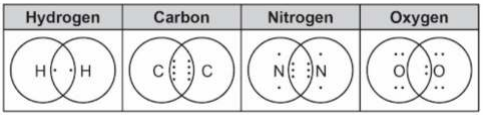
The pictures show the bonds formed by the sharing of electrons by the atoms of four different
molecules.

Image
1. Which molecule has the strongest bond between its atoms?
  A. Hydrogen
  B. Carbon
  C. Nitrogen
  D. Oxygen
2. What is this type of bond between atoms known as?
3. Which of these is another way of representing the bonds between the atoms of a nitrogen molecule?
  A. $N 0 N$
  C. $N \equiv N$
  B. $N \times N$
  D. $N - N$
4. Which of these statements is true about carbon compounds?
Circle ‘Yes’ or ‘No’ for the correct response.

Is this true about carbon compounds?

Yes or No

They are good conductors of electricity.

Yes/No

They exist in either saturated or unsaturated form

Yes/No

They have lower boiling points than ionic compounds.

Yes/No

Redox reactions are those reactions in which oxidation and reduction occur simultaneously. A redox reaction is made up of two half reactions. In the first half reaction, oxidation takes place and in second half reaction, reduction occurs. Oxidation is a process in which a substance loses electrons and in reduction, a substance gains electrons. The substance which gains electrons is reduced and acts as an oxidising agent. On the other hand, a substance which loses electrons is oxidised and acts as a reducing agent.
i. Illustrate where oxidation and reduction occurs together with an example?
ii. What do you mean by oxidising agent and reducing agent?
iii. For the given reaction, identify the oxidation and reduction parts.
$ZnO + CO \longrightarrow Zn + CO _2$
OR
In the following reaction, which substance is reduced?
$\mathrm{PbS}+4 \mathrm{H}_{2} \mathrm{O}_{2} \longrightarrow \mathrm{PbSO}_{4}+4 \mathrm{H}_{2} \mathrm{O}$
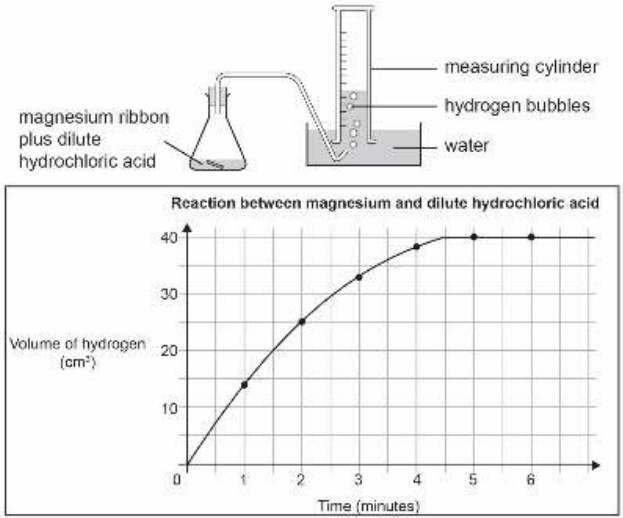
A piece of magnesium ribbon is added to a lask containing dilute hydrochloric acid.
Hydrogen gas is formed which is collected in the measuring cylinder.
The amount of hydrogen formed with time is plotted on a graph.
The line on the graph indicates the rate of chemical reaction occurring in the lask.

Image
5. At what time is the reaction rate the fastest in the lask?
A. At 1 minute
B. At 3 minutes
C. At 4 minutes
D. At 6 minutes
6. The reaction is repeated with magnesium powder in place of magnesium ribbon under the same conditions. Will the reaction rate increase or decrease?
Explain your answer with reference to the volume of hydrogen formed in the lask at 2 minutes.
7. Which of these could increase the rate of reaction in the lask?
Circle ‘Yes’ or ‘No’ for each row.

Will this increase the rate of reaction?

Yes or No

Adding more acid to the flask

Yes/No

Heating the acid in the flask

Yes/No

Using a higher concentration of acid

Yes/No

8. Magnesium reacts with hydrochloric acid to form magnesium chloride and hydrogen gas.
Write a balanced chemical equation to show the reaction.
9. Which of these is an example of decomposition reaction?
A. Melting of glaciers
B. Rusting of old bridges
C. Rotting of fruits and vegetables
D. Absorption of carbon dioxide by oceans
10. Methane gas released from waste water treatment plants can be used as a source of fuel. Which chemical equation represents combustion of methane to produce heat energy?
A. $CH _4+ CO _2 \rightarrow 2 O _2+2 H _2 O$
B. $CH _4+2 O _2 \rightarrow CO _2+2 H _2 O$
C. $2 O _2+2 H _2 O \rightarrow CO _2+ CH _4$
D. $CO _2+2 O _2 \rightarrow CH _4+2 H _2 O$

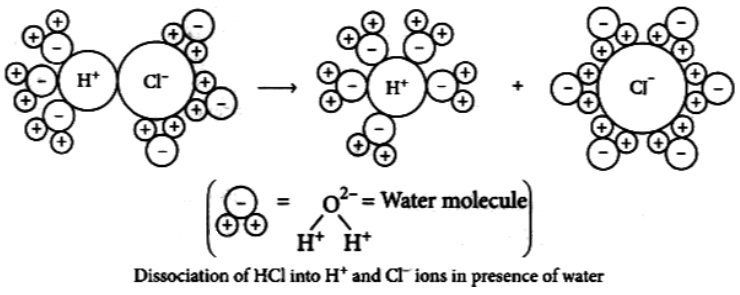
The acidic behaviour of acids is due to the presence of hydrogen ( $H ^{+}$) ions in them. They produce hydrogen ions in the presence of water. Water is a polar solvent and this property of water helps in weakening the bond between the ions and makes them soluble.
Hence, acids and bases produce ions in aqueous solutions. It may be noted that a dry HCl gas or a solution of hydrogen chloride in organic, non-polar solvents like toluene or benzene do not show acidic properties. This is because hydrogen chloride does not undergo ionization in toluene.
The reason why HCl splits into $H ^{+}$and $Cl ^{-}$ions in presence of water lies in the fact that water molecules, being polar, pull the $H ^{+}$and $Cl ^{-}$ions apart and thus, the bond in HCl is broken.
Image
i. Which acids are present in bee stings?
ii. If the pH of a solution is 8 , then find its $\left[ H ^{+}\right]$ion.
iii. If you are given water, Hydrochloric acid, and Acetic acid, then mention increasing the order of acid strength.
OR
If you are provided $H _3 PO _4, C _2 H _5 OH , H _2 CO _3$, and $CH _3 COOH$, then which compound does not give $H ^{+}$ions in an aqueous solution?
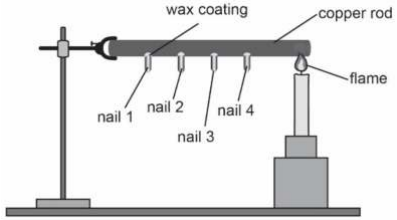
Riya wants to ind out how metal conducts heat.
She attaches four nails on a copper rod with wax.
Riya heats one end of the copper rod with a lame.
Image
1. Which nail will fall last?
  A. Nail 1
  B. Nail 2
  C. Nail 3
  D. Nail 4
2. What should Riya keep the same in her activity?
  A. Length of the nails
  B. Material of the nails
  C. Thickness of wax coatings
  D. Distance between the nails 
When a more reactive element displaces a less reactive element from its compound, it is called a displacement reaction. The reaction is of two types. Single displacement reaction and double displacement reaction.
Iron being more reactive than copper displaces copper from an aqueous solution of copper sulphate. This is an example of a single displacement reaction.
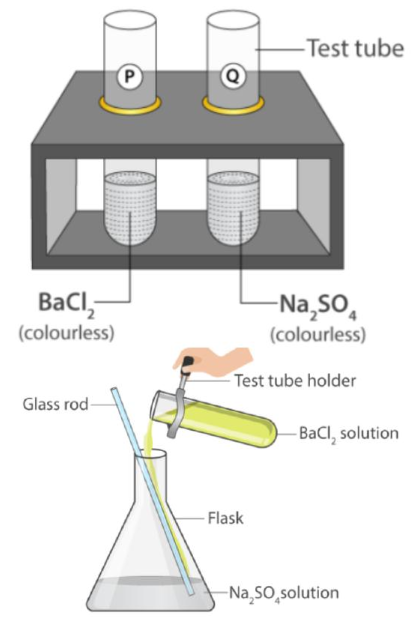
On adding silver nitrate solution to sodium bromide, a yellow ppt of silver bromide and solution of sodium nitrate is formed. This is an example of a double displacement reaction.
i. When dil. sulphuric acid is added to pieces of iron sulphide, hydrogen sulphide gas is produced and soluble ferrous sulphate is formed. Which chemical reaction is involved in this process?
ii. Mention reaction which is used for the preparation of oxygen gas in the laboratory.
iii. What are the products formed in the double displacement reaction discussed below?
Image
OR
Which elements displace aluminum from its salt?