Question
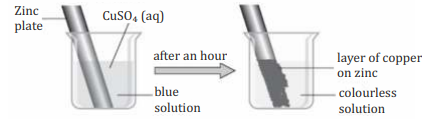
Redox reactions are those reactions in which oxidation and reduction occur simultaneously. A redox reaction is made up of two half reactions. In the first half reaction, oxidation takes place and in second half reaction, reduction occurs. Oxidation is a process in which a substance loses electrons and in reduction, a substance gains electrons. The substance which gains electrons is reduced and acts as an oxidising agent. On the other hand, a substance which loses electrons is oxidised and acts as a reducing agent.
i. Illustrate where oxidation and reduction occurs together with an example?
ii. What do you mean by oxidising agent and reducing agent?
iii. For the given reaction, identify the oxidation and reduction parts.
$ZnO + CO \longrightarrow Zn + CO _2$
OR
In the following reaction, which substance is reduced?
$\mathrm{PbS}+4 \mathrm{H}_{2} \mathrm{O}_{2} \longrightarrow \mathrm{PbSO}_{4}+4 \mathrm{H}_{2} \mathrm{O}$
Answer

i. The oxidation and reduction occurring together are called a redox reaction. $\mathrm{CuO}+\mathrm{H}_{2} \longrightarrow \mathrm{Cu}+\mathrm{H}_{2} \mathrm{O}$. Example: In this reaction, copper oxide is being reduced to copper whereas hydrogen is being oxidised to water.
ii. Oxidising agents give oxygen to or removes hydrogen from other substances. The reducing agent undergoes loss of electrons. A reducing agent (also called a reductant or reducer) is an element or compound that loses (or "donates") an electron to another chemical species in a redox chemical reaction.
iii. ZnO is being reduced
ZnO is reduced to Zn and CO is oxidised to $\mathrm{CO}_{2}$
OR
$\mathrm{H}_{2} \mathrm{O}_{2}$ is reduced to water by removal of oxygen.

Need a full question paper?

Generate a complete, print-ready paper with questions like this in minutes — across 16+ boards, with answer keys.

Start Generating Free

Similar questions

The earth's crust is the major source of metals-seawater contains some soluble salts such as sodium chloride, magnesium chloride, etc. The elements or compounds, which occur naturally in the earth's crust are known as minerals. At some places, minerals contain a very high percentage of a particular metal and the metal can be profitably extracted from it. These minerals are called ores.
(i) Name the chief ore of mercury and zinc.
(ii) Write equations for the extraction of copper from its sulphide ore.
or
(ii) Define the process used to convert carbonate ores into metal oxide.
Read the following and answer any four questions from (i) to (v).
A reaction in which two or more reactants combine to form a single product is called a combination reaction. For example, calcium oxide reacts vigorously with water to form calcium hydroxide. The reaction is highly exothermic in nature, as lots of heat is produced during the reaction.
$\quad$$CaO _{( s )} \ \ \ + \ \ \ H _2 O _{( l )} \longrightarrow Ca ( OH )_{2( aq )} \ + \  H ^2$
Calcium oxide$\qquad$Water $\quad$ Calcium hydroxide
Solution of Ca(OH)2 is used for white wash the walls. Calcium hydroxide reacts slowly with carbon dioxide in air to form a thin layer of calcium carbonate on the wall which gives a shiny appearance to wall. Calcium carbonate will formafter two or three days of white wash.
  1. What is the chemical name of quick lime?
  2. When carbon dioxide is passed through lime water, what will be the reaction?
  3. which reaction is formed when calcium oxide reacts vigorously with water?
    OR
    A) what is a combination reaction?
    B) Which is an endothermic reaction?
Read the following and answer any three questions from (i) to (iv).

Ionic compound is a chemical compound in which ions are held together by ionic bonds. An ionic bond is the type of chemical bond in which two oppositely charged ions are held through electrostatic forces. We know that, metal atoms have loosely bound valence electrons in their valence shell and non-metal atoms need electrons in their valence shell to attain noble gas configuration. The metal atom loses the valence electrons while non-metal atom accepts these electrons. By losing electrons, metal atoms change to cations and by accepting electrons, non-metals form anions. Ionic compounds are generally solid and exist in the form of crystal. They have high melting and boiling points.

  1. Write two element which can change to a cation?

  2. Write two element which can change to an anion?

  3. Which Ionic compounds are soluble and how?
             
             OR
  4. What are Ionic compounds? Give two examples.
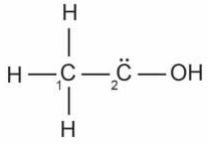
The picture shows the incomplete chain structure of a carbon compound.
The second carbon atom has two free electrons.


Image
5. How many oxygen atoms can combine with the second carbon atom to complete the structure?
  A. One
  B. Two
  C. Three
  D. Fou
6. Which of these molecules contains a double bond?
  A. CH₄
  B. C₂H₄
  C. C₃H₈
  D. C₄H₁₀
A part of a homologous series is shown below.
C₃H₄, C₄H₆, C₅H₈ 
7. Which of these compounds is a part of the series shown above?
  A. C₂H₂
  B. C₂H₄
  C. C₈H₆
  D. C₆H₁₄

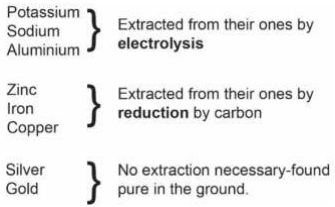
The chart shows the process of extraction of some metals.

Image

9. Which of these metals requires electricity for extraction from its ore?
  A. Zinc
  B. Silver
  C. Copper
  D. Aluminium

Electronic configuration of some of the elements are given :
Type of elementElementAtomic numberNumber of electrons in shell
MetalsSodium (Na)Magnesium (Mg)Aluminium (Al)1112132828283
Non-metalsOxygen (O)Sulphur (S)Chlorine (Cl)8161726286287
(i) State one physical property to distinguish between metals and non-metals.
(ii) What is the nature of the bond formed when magnesium reacts with chlorine? Write the formula of the compound.
or
(ii) What is common between oxygen and sulphur? Draw the electron dot structure of $O _2$ molecule.
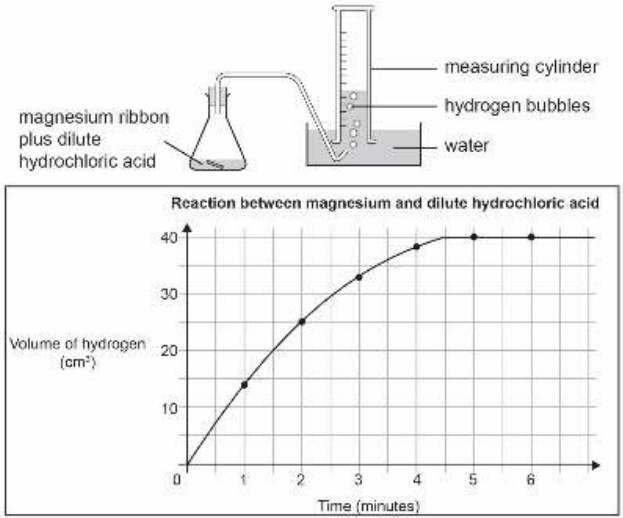
A piece of magnesium ribbon is added to a lask containing dilute hydrochloric acid.
Hydrogen gas is formed which is collected in the measuring cylinder.
The amount of hydrogen formed with time is plotted on a graph.
The line on the graph indicates the rate of chemical reaction occurring in the lask.

Image
5. At what time is the reaction rate the fastest in the lask?
A. At 1 minute
B. At 3 minutes
C. At 4 minutes
D. At 6 minutes
6. The reaction is repeated with magnesium powder in place of magnesium ribbon under the same conditions. Will the reaction rate increase or decrease?
Explain your answer with reference to the volume of hydrogen formed in the lask at 2 minutes.
7. Which of these could increase the rate of reaction in the lask?
Circle ‘Yes’ or ‘No’ for each row.

Will this increase the rate of reaction?

Yes or No

Adding more acid to the flask

Yes/No

Heating the acid in the flask

Yes/No

Using a higher concentration of acid

Yes/No

8. Magnesium reacts with hydrochloric acid to form magnesium chloride and hydrogen gas.
Write a balanced chemical equation to show the reaction.
9. Which of these is an example of decomposition reaction?
A. Melting of glaciers
B. Rusting of old bridges
C. Rotting of fruits and vegetables
D. Absorption of carbon dioxide by oceans
10. Methane gas released from waste water treatment plants can be used as a source of fuel. Which chemical equation represents combustion of methane to produce heat energy?
A. $CH _4+ CO _2 \rightarrow 2 O _2+2 H _2 O$
B. $CH _4+2 O _2 \rightarrow CO _2+2 H _2 O$
C. $2 O _2+2 H _2 O \rightarrow CO _2+ CH _4$
D. $CO _2+2 O _2 \rightarrow CH _4+2 H _2 O$