Question
Electrons are emitted from a photosensitive surface when it is illuminated by green light but electron emission does not take place by yellow light. Will the electrons be emitted when the surface is illuminated by (i) red light, and (ii) blue light?
Answer

  1. No.
  2. Yes.
Reason: According to colour sequence VIBGYOR, the frequency of red light photons is less than threshold frequency of photo metal but frequency of blue light photons is more than threshold frequency of photo metal; so (i) electrons will not be emitted by red light and (ii) electrons will be emitted by blue light.

Need a full question paper?

Generate a complete, print-ready paper with questions like this in minutes — across 16+ boards, with answer keys.

Start Generating Free

Similar questions

Explain the method of charging by friction briefly.
The torque of the weight of any body about any vertical axis is zero. Is it always correct?
(a) Calculate the potential at a point $P$ located at a distance of 9 cm due to the charge $4 \times 10^{-7} C$.(b) Now, find the work done in bringing the charge $2 \times 10^{-9} C$ from infinity to point P . Does the answer depend on the path along which the charge is brought?
Suppose the acceleration due to gravity at a place is $10\ m/s^2.$ Find its value in $\ cm/($minute$)^2.$
Find the ratio of the mean speed of hydrogen molecules to the mean speed of nitrogen molecules in a sample contammg a mixture of the two gases.
What will be the path of a charged particle moving in a region of crossed (or transverse) uniform electrostatic and magnetic fields with initial velocity zero?
A wheel is making revolutions about its axis with uniform angular acceleration. Starting from rest, it reaches 100rev/sec in 4 seconds. Find the angular acceleration. Find the angle rotated during these four seconds.
Find the energy equivalent of one atomic mass unit, first in Joules and then in $MeV$. Using this, express the mass defect of ${ }_8^{16} O$ in $MeV / c ^2$.
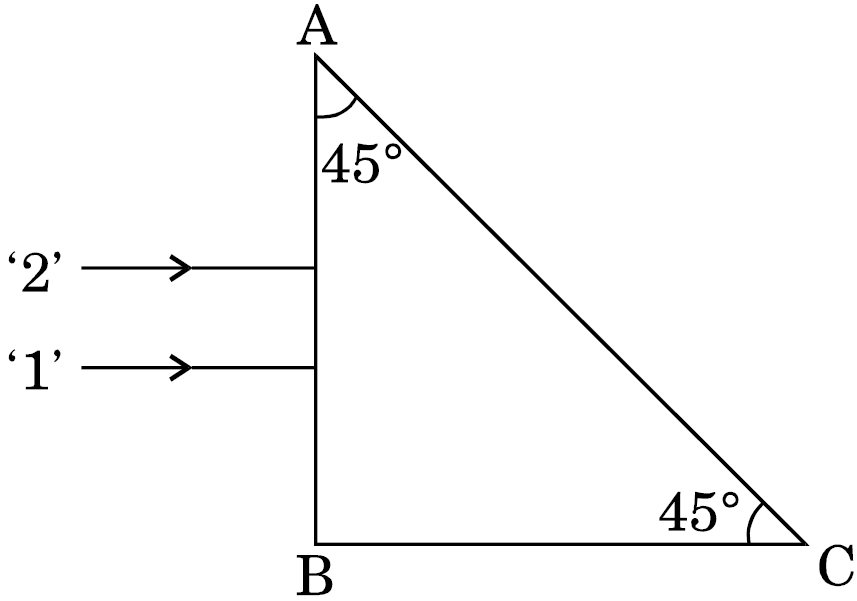
Two monochromatic rays of light are incident normally on the face AB of an isosceles right-angled prism ABC. The refractive indices of the glass prism for the two rays ‘1’ and ‘2’ are respectively 1.3 and 1.5 Trace the path of these rays after entering through the prism.
Answer the following:
a. Magnetic field lines can be entirely confined within the core of a toroid, but not within a straight solenoid. Why?
b. Does a bar magnet exert a torque on itself due to its own field? Justify your answer.
c. When an electron revolves around a nucleus, obtain the expression for the magnetic moment associated with it.