Equal potentials are applied on an iron and copper wire of same length. In order to have the same current flow in the two wires, the ratio $r$ (iron)/$r$ (copper) of their radii must be (Given that specific resistance of iron = $1.0 \times {10^{ - 7}}$ $ ohm-m$ and specific resistance of copper = $1.7 \times {10^{ - 8}}\,ohm-m$)
Easy
Download our app for free and get started
(b) $\frac{{{r_{{\rm{iron}}}}}}{{{r_{{\rm{Copper}}}}}} = \sqrt {\frac{{{\rho _{{\rm{iron}}}}}}{{{\rho _{{\rm{copper}}}}}}} = \sqrt {\frac{{1 \times {{10}^{ - 7}}}}{{1.7 \times {{10}^{ - 8}}}}} \approx 2.4$.

Download our appand get started for free
Experience the future of education. Simply download our apps or reach out to us for more information. Let's shape the future of learning together!No signup needed.*
Similar Questions
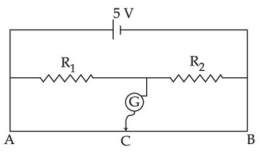
- 1In the given figure of meter bridge experiment, the balancing length $AC$ corresponding to null deflection of the galvanometer is $40\,cm$. The balancing length, if the radius of the wire $AB$ is doubled, will be $....cm$View Solution
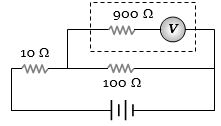
- 2The potential difference across the $100\,\Omega$ resistance in the following circuit is measured by a voltmeter of $900 \,\Omega$ resistance. The percentage error made in reading the potential difference isView Solution
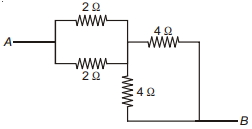
- 3Effective resistance across $A B$ in the network shown in .......... $\Omega$View Solution
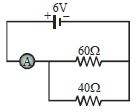
- 4The measurement of ammeter in the following circuit is ................... $A$ (Assuming ideal ammeter)View Solution
- 5$A$ constant voltage is applied between the two ends of a uniform metallic wire. Some heat is developed in it. The heat developed is doubled ifView Solution
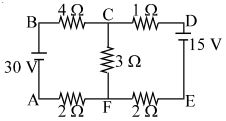
- 6The figure shows a network of five resistances and two batteries The current through the $30\,V$ battery is ............... $A$View Solution
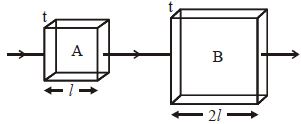
- 7Two square metal plates $A$ and $B$ are of the same thickness and material. The side of $B$ is twice that of $A$. These are connected as shown in series. If the resistances of $A$ and $B$ are denoted by $R_A$ and $R_B,$ then $(R_A/R_B)$ isView Solution
- 8View SolutionIn meter bridge or Wheatstone bridge for measurement of resistance, the known and the unknown resistances are interchanged. The error so removed is
- 9View SolutionThe resistivity of a wire depends on its
- 10A $16\, \Omega$ wire is bend to form a square loop. A $9 \,{V}$ supply having internal resistance of $1 \,\Omega$ is connected across one of its sides. The potential drop across the diagonals of the square loop is $.......\,\times 10^{-1} \,{V}$View Solution