Equations ${y_1} = A\sin \omega t$ and ${y_2} = \frac{A}{2}\sin \omega t + \frac{A}{2}\cos \omega t$ represent $S.H.M.$ The ratio of the amplitudes of the two motions is
Medium
Download our app for free and get started
(d) ${y_2} = \frac{A}{2}\sin \omega \,t + \frac{A}{2}\cos \omega \,t$
${y_2} = \frac{A}{2}(\sin \omega \,t + \cos \omega \,t) = \frac{A}{2} \times \sqrt 2 \;[\sin (\omega \,t + {45^o})]$
${y_2} = \frac{A}{{\sqrt 2 }}\sin (\omega \,t + {45^o})$$ \Rightarrow \frac{{{A_1}}}{{{A_2}}} = \frac{A}{{A/\sqrt 2 }} = \sqrt 2 $

Download our appand get started for free
Experience the future of education. Simply download our apps or reach out to us for more information. Let's shape the future of learning together!No signup needed.*
Similar Questions
- 1The equation of a simple harmonic motion is $X = 0.34\cos (3000t + 0.74)$ where $X$ and $t$ are in $mm$ and $sec$. The frequency of motion isView Solution
- 2A particle of mass $10$ grams is executing simple harmonic motion with an amplitude of $0.5\, m$ and periodic time of $(\pi /5)$ seconds. The maximum value of the force acting on the particle is ... $N$View Solution
- 3The displacement y of a particle executing periodic motion is given by $y = 4{\cos ^2}(t/2)\sin (1000t)$. This expression may be considered to be a result of the superposition of ........... independent harmonic motionsView Solution
- 4A simple pendulum of length $L$ and mass (bob) $M$ is oscillating in a plane about a vertical line between angular limits $ - \varphi $ and $ + \varphi $. For an angular displacement $\theta (|\theta | < \varphi )$, the tension in the string and the velocity of the bob are $T$ and $ v$ respectively. The following relations hold good under the above conditionsView Solution
- 5The function ${\sin ^2}(\omega t)$ representsView Solution
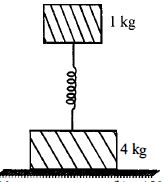
- 6Two bodies of masses $1\, kg$ and $4\, kg$ are connected to a vertical spring, as shown in the figure. The smaller mass executes simple harmonic motion of angular frequency $25\, rad/s$, and amplitude $1.6\, cm$ while the bigger mass remains stationary on the ground. The maximum force exerted by the system on the floor is ..... $N$ ( take $g = 10\, ms^{-2}$)View Solution
- 7The period of oscillation of a simple pendulum of length $L$ suspended from the roof of a vehicle which moves without friction down an inclined plane of inclination $\alpha$, is given byView Solution
- 8An object of mass $0.5\, {kg}$ is executing simple harmonic motion. Its amplitude is $5\, {cm}$ and time period (T) is $0.2\, {s} .$ What will be the potential energy of the object at an instant $t=\frac{T}{4}$ s starting from mean position. Assume that the initial phase of the oscillation is zero. (In ${J}$)View Solution
- 9Two simple harmonic motions $y_1 = A \sin \omega t$ and $y_2 =A \cos \omega t$ are superimposed on a particle of mass $m.$ The total mechanical energy of the particle is :View Solution
- 10The length of simple pendulum is increased by $44\%$. The percentage increase in its time period will be ..... $\%$View Solution