Question
Equipotential surfaces are 5 cm apart from each other. How much work will be required to move a 500 µC charge between distant points?

Answer

Potential difference between any two points on the post-isopotential surface $\Delta V =$ zero
Therefore work $W =$ charge $q \times$ potential difference $(\Delta V )$$=100 \mu C \times 0=\text { zero }$
i.e, no work has to be done.

Need a full question paper?

Generate a complete, print-ready paper with questions like this in minutes — across 16+ boards, with answer keys.
Start Generating Free

Similar questions

Lithium (Z = 3) has two stable isotopes 6Li and 7Li. When neutrons are bombarded on lithium sample, electrons and $\alpha$-particles are ejected. Write down the nuclear process taking place.
An electric dipole of length 2 cm, when placed with its axis making an angle of $60^\circ$with a uniform electric field, experiences a torque of $8\sqrt{3}$ Nm. Calculate the potential energy of the dipole, if it has a charge of $\pm4\text{nC}.$
Explain the term ‘drift velocity’ of electrons in a conductor. Hence obtain the expression for the current through a conductor in terms of ‘drift velocity’.
In a solenoid, there are 500 turns/meter and current flowing in it is 5 A . Length of the solenoid is 0.5 m and its radius is 1 cm . Calculate the intensity of magnetic field inside the solenoid.
The potential difference between the terminals of a 6.0V battery is 7.2V when it is being charged by a current of 2.0A. What is the internal resistance of the battery?
A free neutron beta-decays to a proton with a half-life of 14 minutes.
  1. What is the decay constant?
  2. Find the energy liberated in the process.
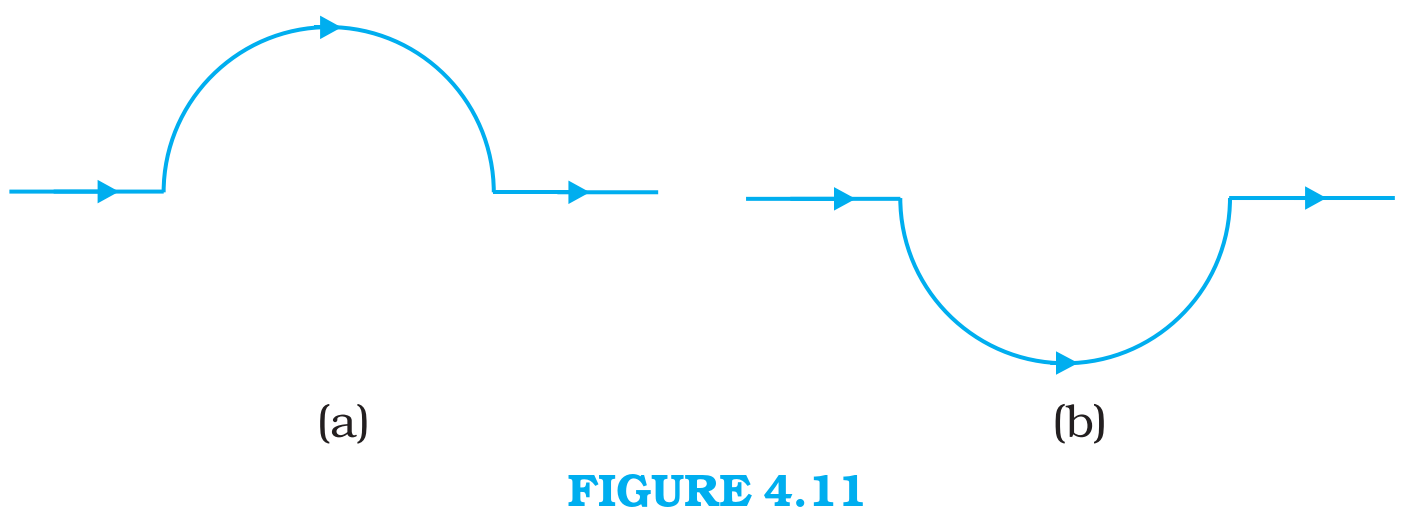
A straight wire carrying a current of $12 A$ is bent into a semi-circular arc of radius $2.0 cm$ as shown in Fig. 4.11 (a). Consider the magnetic field $B$ at the centre of the arc. (a) What is the magnetic field due to the straight segments? (b) In what way the contribution to $B$ from the semicircle differs from that of a circular loop and in what way does it resemble? (c) Would your answer be different if the wire were bent into a semi-circular arc of the same radius but in the opposite way as shown in Fig. 4.11(b)?
Image
In which situation is there a displacement current, but no conduction current?
Find the cutoff wavelength for the continuous X-rays coming from an X-ray tube operating at 30kV.
Express dielectric constant of a medium in terms of capacitance. What is its SI unit?