MCQ
Equipotential surfaces:
  • A
    Are closer in regions of large electric fields compared to regions of lower electric fields.
  • B
    Will be more crowded near sharp edges of a conductor.
  • C
    Will be more crowded near regions of large charge densities.
  • D
    Will always be equally spaced.

Answer

  1. Are closer in regions of large electric fields compared to regions of lower electric fields.
  2. Will be more crowded near sharp edges of a conductor.
  3. Will be more crowded near regions of large charge densities.

Equipotential surfaces are closer in regions of large electric fields because electric field intensity is inversely proportional to the separation between equipotential surfaces. 

As the electric field intensities is large near sharp edges of a charged conductor or near the regions of large charge densities. Therefore, numbers of equipotential surfaces are closer to such places or in other words they are more crowded.

Need a full question paper?

Generate a complete, print-ready paper with questions like this in minutes — across 16+ boards, with answer keys.

Start Generating Free

Similar questions

Two wires of same size whose resistivities$\rho_1$ are $\rho_2$ and are joined in series. The equivalent resistivity of the combination will be:
The first law of thermodynamics is a statement of:
  1. Conservation of heat.
  2. Conservation of work.
  3. Conservation of momentum.
  4. Conservation of energy.
The subatomic particle that is emitted from a metal surface, when it is heated is a/an _________:
A very long bar magnet is placed with its north pole coinciding with the centre of a circular loop carrying as electric current i. The magnetic field due to the magnet at a point on the periphery of the wire is B. The radius of the loop is a. The force on the wire is:
  1. Very nearly $2\pi\text{aiB}$ perpendicular to the plane of the wire.
  2. $2\pi\text{aiB}$ in the plane of the wire.
  3. $\pi\text{aiB}$ along the magnet.
  4. Zero.
If a proton and electron have same de Broglie wavelength, then:

Magnetic intensity for an axial point due to a short bar magnet of magnetic moment M is given by

(a)  ×

(b)  ×

(c)

(d) ×

In an induction coil, the secondary e.m.f. is

(a) Zero during break of the circuit

(b) Very high during make of the circuit

(c) Zero during make of the circuit

(d) Very high during break of the circuit

Eight dipoles of charges of magnitude e are placed inside a cube. The total electric flux coming out of the cube will be

(a)  

(b)  

(c)

(d) Zero

In hydrogen bomb large amount of energy is produced due to :

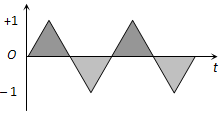
An alternating current of frequency 200 rad/sec and peak value 1A as shown in the figure, is applied to the primary of a transformer. If the coefficient of mutual induction between the primary and the secondary is 1.5 H, the voltage induced in the secondary will be

(a) 300 V

(b) 191 V

(c) 220 V 

(d) 471 V