Question
Equivalent resistance between A and B will be

|
(a) 2 ohm |
(b) 18 ohm |
(c) 6 ohm |
(d) 3.6 ohm |
Equivalent resistance between A and B will be
|
(a) 2 ohm |
(b) 18 ohm |
(c) 6 ohm |
(d) 3.6 ohm |
(d) 3.6 ohm
Generate a complete, print-ready paper with questions like this in minutes — across 16+ boards, with answer keys.
To get the maximum current from a parallel combination of n identical cells each of internal resistance r in an external resistance R, when
|
(a) R >> r |
(b) R << r |
(c) R = r |
(d) None of these |
Barrier potential of a P-N junction diode does not depend on
|
(a) Temperature |
(b) Forward bias |
(c) Doping density |
(d) Diode design |
Two magnets of equal mass are joined at right angles to each other as shown the magnet 1 has a magnetic moment 3 times that of magnet 2. This arrangement is pivoted so that it is free to rotate in the horizontal plane. In equilibrium what angle will the magnet 1 subtend with the magnetic meridian

|
(a) |
(b) |
(c) |
(d) 0° |
In the circuit shown here  and battery B = 20V. The switch
  is first closed. It is then opened and afterwards
  is closed. What is the charge finally on
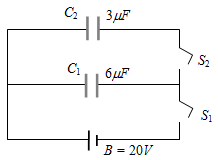
|
(a) 120 μC |
(b) 80 μC |
(c) 40 μC |
(d) 20 μC |
Magnifying glass forms:
When plate voltage in diode valve is increased from 100 volt to 150 volt then plate current increases from 7.5 mA to 12 mA. The dynamic plastic resistance will be
|
(a) 10 kW |
(b) 11 kW |
(c) 15 kW |
(d) 11.1 kW |


