Question
Establish a relation between electric current and drift velocity.
OR
Prove that the current density of a metallic conductor is directly proportional to the drift speed of electrons.
Answer

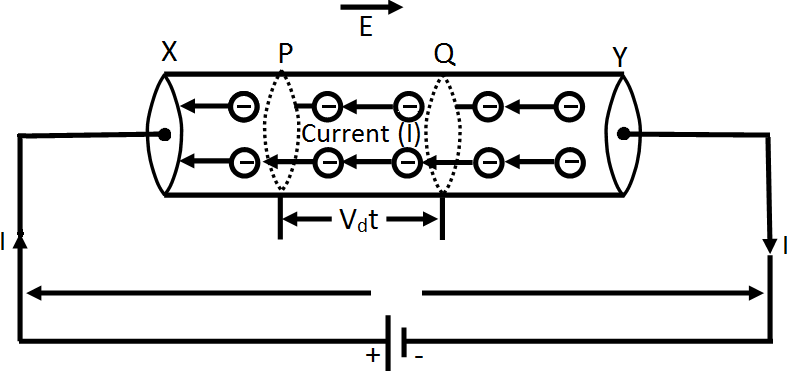
Relation between electric current and drift velocity: Consider a uniform metallic wire XY of length l and cross-sectional area A. A potential difference V is applied across the ends X and Y of the wire. This causes an electric field at each point of the wire of strength.

$\text{E}=\frac{\text{V}}{\text{l}}\dots\text{(i)}$ Due to this electric field, the electrons gain a drift velocity vd opposite to direction of electric field. If q be the charge passing through the cross-section of wire in t seconds, then $\text{Current in write I}=\frac{\text{q}}{\text{r}}\dots\text{(ii)}$ The distance traversed by each electron in time t = average velocity × time = vd t If we consider two planes P and Q at a distance vd t in a conductor, then the total charge flowing in time t will be equal to the total charge on the electrons present within the cylinder PQ. The volume of this cylinder = cross sectional area × height = A vd t If n is the number of free electrons in the wire per unit volume, then the number of free electrons in the cylinder = n(Avd t) If charge on each electron is $-e (e = 1.6 \times 10^{-19}C)$, then the total charge flowing through a cross-section of the wire $q = (nA_vd t) (-e) = –neA_vd t ...(iii)$ $\therefore$ Current flowing in the wire, $\text{I}=\frac{\text{q}}{\text{t}}=\frac{-\text{v}}{\text{t}}$ i.e., current I = -neAvd ...(iv) This is the relation between electric current and drift velocity. Negative sign shows that the direction of current is opposite to the drift velocity. Numerically I = -neAvd ...(v) $\therefore$ Current density, $\text{J}=\frac{\text{I}}{\text{A}}=\text{d}$ $\Rightarrow\text{J}\propto\text{vd.}$ That is, current density of a metallic conductor is directly proportional to the drift velocity.

Need a full question paper?

Generate a complete, print-ready paper with questions like this in minutes — across 16+ boards, with answer keys.

Start Generating Free

Similar questions


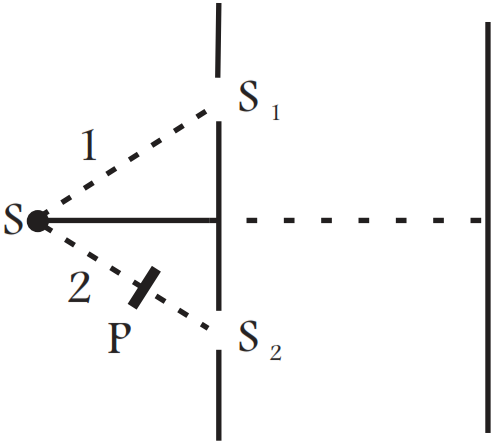
Figure shown a two slit arrangement with a source which emits unpolarised light. P is a polariser with axis whose direction is not given. If $I_0$ is the intensity of the principal maxima when no polariser is present, calculate in the present case, the intensity of the principal maxima as well as of the first minima.
Two charges q and -3q are placed fixed on x-axis separated by distance 'd'. Where should a third charge 2q be placed such that it will not experience any force?
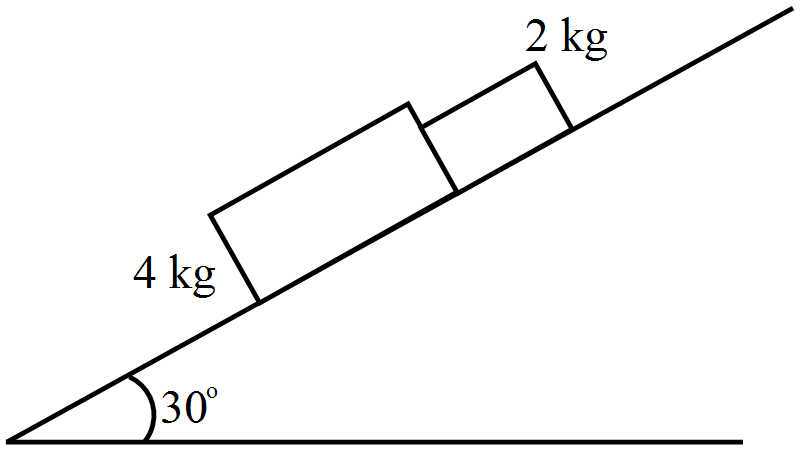
Figure shows two blocks in contact sliding down an inclined surface of inclination 30°. The friction coefficient between the block of mass 2.0kg and the incline is $\mu_1,$ and that between the block of mass 4.0kg and the incline is $\mu_2.$ Calculate the acceleration of the 2.0kg block if:
  1. $\mu_1=0.20$ and $\mu_2=0.30$
  2. $\mu_1=0.30$ and $\mu_2=0.20$ Take $\text{g}=10\text{m/s}^2.$
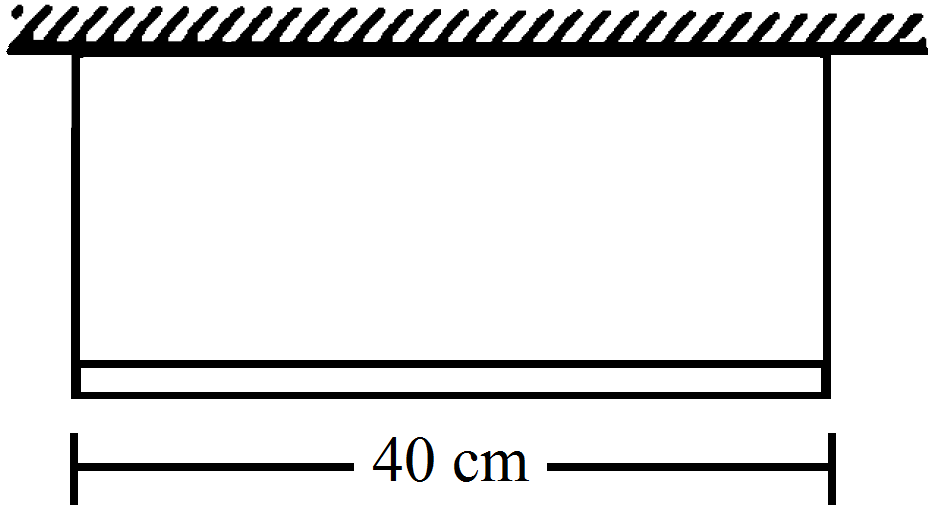
A uniform horizontal rod of length 40cm and mass 1.2kg is supported by two identical wires as shown in figure, Where should a mass of 4.8kg be placed on the rod so that the same tuning fork may excite the wire on left into its fundamental vibrations and that on right into its first overtone? Take $g = 10m/s^2.$
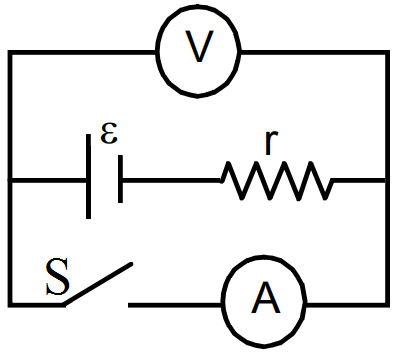
Figure. shows an arrangement to measure the emf $\in$ and internal resistance r of a battery. The voltmeter has a very high resistance and the ammeter also has some resistance. The voltmeter reads 1.52V when the switch S is open. When the switch is closed, the voltmeter reading drops to 1.45V and the ammeter reads 1.0A. Find the emf and the internal resistance of the battery.
A circular coil of 200 turns has a radius of 10cm and carries a current of 2.0A.
  1. Find the magnitude of the magnetic field. B at the centre of the coil.
  2. At what distance from the centre along the axis of the coil will the field B drop to half its value at the centre? $\big(\sqrt[3]{4}=1.5874\ ...\big)$
The current in a discharging LR circuit without the battery drops from 2.0A to 1.0A in 0.10s.
  1. Find the time constant of the circuit.
  2. If the inductance of the circuit is 4.0H, what is its resistance?
$a.$ Using the ray diagram for a system of two lenses of focal lengths $f_1$ and $f_2$ in contact with each other, show that the two lens system can be regarded as equivalent to a single lens of focal length $f$, where
 $\frac{1}{ f }=\frac{1}{ f _1}+\frac{1}{ f _2}$
Also write the relation for the equivalent power of the lens combination.
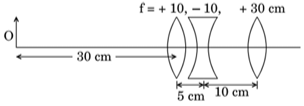
$b.$ Determine the position of the image formed by the lens combination given in the figure. 
Image
A constant force $\text{F}=\frac{\text{m}_2\text{g}}{2}$ is applied on the block of mass $m_1$ as shown in figure. The string and the pulley are light and the surface of the table is smooth. Find the acceleration of $m_1.$​​​​​​​
Consider the circuit shown in the figure. Find (a) the current in the circuit (b) the potential drop across the $5\Omega$ resistor (c) the potential drop across the $10\Omega$ resistor. (d) Answer the parts (a), (b) and (c) with reference to the figure.