Question
Two charges q and -3q are placed fixed on x-axis separated by distance 'd'. Where should a third charge 2q be placed such that it will not experience any force?

Answer

The force on any charge will be zero only if net electric field at the position of charge is zero. Let electric field is zero at a distance x from charge q.

At point $\text{P},\vec{\text{E}_\text{A}}+\vec{\text{E}_\text{B}}=0\Rightarrow|\vec{\text{E}_\text{A}}|=|\vec{\text{E}_\text{B}}|$
$\Rightarrow\ \frac{\text{q}}{4\pi\in_0\text{x}^2}=\frac{3\text{q}}{4\pi\in_0(\text{x}+\text{d})^2}$
$\Rightarrow\ (\text{x}+\text{d})^2=3\text{x}^2$
$\Rightarrow\ \text{x}^2+\text{d}^2=2\text{dx}=3\text{x}^2$
$\therefore\ 2\text{x}^2-2\text{dx}-\text{d}^2=0$
or $\text{x}=\frac{\text{d}}{2}\pm\frac{\sqrt{3\text{d}}}{2}$
(Negative sign lies between q and -3q and hence is unaceptable.)
Hence $\text{x}=-\frac{\text{d}}{2}+\frac{\sqrt{3\text{d}}}{2}=\frac{\text{d}}{2}(1+\sqrt{3})$
Hence if charge 2q is placed at a distance $\frac{\text{d}}{2}(1+\sqrt{3})$ to the left of q.

Need a full question paper?

Generate a complete, print-ready paper with questions like this in minutes — across 16+ boards, with answer keys.
Start Generating Free

Similar questions

Find the charge required to flow through an electrolyte to liberate one atom of.
  1. A monovalent material.
  2. A divalent material.
A circuit containing a 80 mH inductor and a 60 μF capacitor in series is connected to a 230V, 50Hz supply. The resistance of the circuit is negligible.
  1. Obtain the current amplitude and rms values.
  2. Obtain the rms values of potential drops across each element.
  3. What is the average power transferred to the inductor?
  4. What is the average power transferred to the capacitor?
  5. What is the total average power absorbed by the circuit? ['Average' implies 'averaged over one cycle'.]
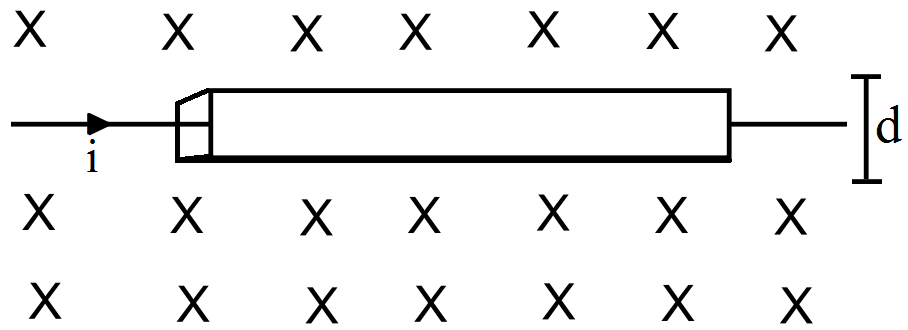
A current i is passed through a silver strip of width d and area of cross-section A. The number of free electrons per unit volume is n.
  1. Find the drift velocity v of the electrons.
  2. If a magnetic field B exists in the region, as shown in the figure, what is the average magnetic force on the free electrons?
  3. Due to the magnetic force, the free electrons get accumulated on one side of the conductor along its length. This produces a transverse electric field in the conductor, which opposes the magnetic force on the electrons. Find the magnitude of the electric field which will stop further accumulation of electrons.
  4. What will be the potential difference developed across the width of the conductor due to the electron-accumulation? The appearance of a transverse emf, when a current-carrying wire is placed in a magnetic field, is called Hall effect.
It is found that yellow light does not eject photoelectrons from a metal. Is it advisable to try with orange light? With green light?
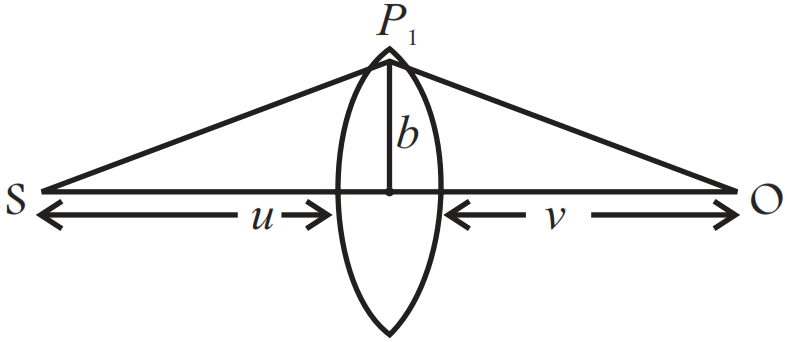
Consider a thin lens placed between a source (S) and an observer (O) (Fig). Let the thickness of the lens vary as $\text{w}\text{(b)}=\text{w}_0-\frac{\text{b}^2}{\alpha}$, where b is the verticle distance from the pole. $w_0$ is a constant. Using Fermat’s principle i.e. the time of transit for a ray between the source and observer is an extremum, find the condition that all paraxial rays starting from the source will converge at a point O on the axis. Find the focal length.
What are the dimensions of $\chi$, the magnetic susceptibility? Consider an H-atom. Guess an expression for $\chi$, upto a constant by constructing a quantity of dimensions of $\chi$, out of parameters of the atom: e, m, v, R and $\mu _0$ . Here, m is the electronic mass, v is electronic velocity, R is Bohr radius. Estimate the number so obtained and compare with the value of $|\chi|\sim10^{-5}$ for many solid materials.
The heavier block in an Atwood machine has a mass twice that of the lighter one. The tension in the string is 16.0N when the system is set into motion. Find the decrease in the gravitational potential energy during the first second after the system is released from rest.
Write Gauss' law in electrostatics. With the help of a suitable example and a diagram, show that the outward flux due to point charge ' $q$ ' in a closed surface in vaccum does not depend on the size and shape of the surface and its magnitude is $\frac{q}{\epsilon_0}$.
A biconvex thick lens is constructed with glass $(\mu=1.50)$ Each of the surfaces has a radius of 10cm and the thickness at the middle is 5cm. Locate the image of an object placed far away from the lens.
Given below are some famous numbers associated with electromagnetic radiations in different contexts in physics. State the part of the electromagnetic spectrum to which each belongs.
  1. 21 cm (wavelength emitted by atomic hydrogen in interstellar space).
  2. 1057 MHz (frequency of radiation arising from two close energy levels in hydrogen; known as Lamb shift).
  3. 2.7 K [temperature associated with the isotropic radiation filling all space-thought to be a relic of the ‘big-bang’ origin of the universe].
  4. 5890 Å - 5896 Å [double lines of sodium]
  5. 14.4 keV [energy of a particular transition in $^{57}Fe$ nucleus associated with a famous high resolution spectroscopic method (Mössbauer spectroscopy)].