MCQ
Ethylene reacts with bromine to form
- AChloroethane
- ✓Ethylene dibromide
- CCyclohexane
- D$1-$ bromo propane
$\mathop {{H_2}C = C{H_2}}\limits_{{\text{Ethylene}}} \; + \mathop {B{r_2}}\limits_{{\text{Bromine}}} \to $ $\mathop {\begin{array}{*{20}{c}}
{{H_2}C - C{H_2}} \\
{|\,\,\,\,\,\,\,\,\,|} \\
{\,\,\,Br\,\,\,\,\,Br}
\end{array}}\limits_{Ethylene\,\,dibromide} $
Generate a complete, print-ready paper with questions like this in minutes — across 16+ boards, with answer keys.
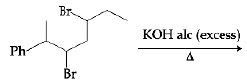
$(a)$ Number of $S-S$ bonds in $H_2S_nO_6$ are $(n +1)$
$(b)$ When $F_2$ reacts with $H_2O$ it forms $HF,$ $O_2$ & $O_3.$
$(c)$ $XeF_6$ on hydrolysis shows disproportionation reaction
$(d)$ $Al$ metal on reacting with dilute $NaOH$ gives a white precipitate of $Al (OH)_3$ as a final product
$(A)$ Sublimation enthalpy
$(B)$ Ionisation enthalpy
$(C)$ Hydration enthalpy
$(D)$ Electron gain enthalpy
The total number of above properties that affect the reduction potential is ...... .