Question
Evaluate: $\int_{-1}^1 \frac{1+x^2}{9-x^2} d x$

Answer

$ \text { Let } I =\int_{-1}^1 \frac{1+x^2}{9-x^2} d x$
$\therefore I =\int_{-1}^1 \frac{1}{9-x^2} d x+\int_{-1}^1 \frac{x^3}{9-x^2} d x$
$= I _1+ I _2 \ldots \text {...(say) } \ldots . . . \text { (i) } $
Let $f (x)=\frac{1}{9-x^2}$
$ \therefore f (- x )=\frac{1}{9-(-x)^2}$
$=\frac{1}{9-x^2}$
$= f ( x ) $
$\therefore f ( x )$ is an even function.
$ \therefore I _1=\int_{-1}^1 \frac{1}{9-x^2} d x$
$=2 \int_0^1 \frac{1}{9-x^2} d x$
$=2 \int_0^1 \frac{1}{3^2-x^2} d x$
$=2\left[\frac{1}{2 \times 3} \cdot \log \left|\frac{3+x}{3-x}\right|\right]_0^1$
$=\frac{1}{3}\left[\log \left(\frac{4}{2}\right)-\log (1)\right] $
$\therefore I _1=\frac{1}{3} \log 2$
Let $g(x)=\frac{x^3}{9-x^2}$
$ \therefore g(-x)=\frac{(-x)^3}{9-(-x)^2}$
$=\frac{-x^3}{9-x^2}$
$=-g(x) $
$\therefore g(x)$ is an odd function.
$\therefore I _2=\int_{-1}^1 \frac{x^3}{9-x^2} d x=0$
From (i), we get
$ I = I _1+ I _2$
$\therefore I =\frac{1}{3} \log 2+0$
$\therefore I =\frac{1}{3} \log 2 $

Need a full question paper?

Generate a complete, print-ready paper with questions like this in minutes — across 16+ boards, with answer keys.

Start Generating Free

Similar questions

Determine whether $\bar{a}$ and $\bar{b}$ are orthogonal, parallel or neither.

1.$\bar{a}=-9 \hat{i}+6 \hat{j}+15 \hat{k} \bar{b}=6 \hat{i}-4 \hat{j}-10 \hat{k}$

2.$\bar{a}=2 \hat{i}+3 \hat{j}-\hat{k}, \bar{b}=5 \hat{i}-2 \hat{j}+4 \hat{k}$

3.$\bar{a}=-\frac{3}{5} \hat{i}+\frac{1}{2} \hat{j}+\frac{1}{3} \hat{k}, \bar{b}=5 \hat{i}+4 \hat{j}+3 \hat{k}$

4.$\bar{a}=4 \hat{i}-\hat{j}+6 \hat{k}, \bar{a}=5 \hat{i}-2 \hat{j}+4 \hat{k}$

Differentiate the following w.r.t. x:

$\tan ^{-1}\left(\frac{x}{1+6 x^2}\right)+\cot ^{-1}\left(\frac{1-10 x^2}{7 x}\right)$

Show that $\frac{d y}{d x}=\frac{y}{x}$ in the following, where a and $p$ are constants.

$\sec \left(\frac{x^5+y^5}{x^5-y^5}\right)=a^2$

Prove that two vectors whose direction cosines are given by relations al + bm + cn = 0

and $\mathrm{fmn}+\mathrm{gnl}+\mathrm{hlm}=0$ are perpendicular if $\frac{f}{a}+\frac{g}{b}+\frac{h}{c}=0$

Show that the height of a right circular cylinder of greatest volume that can be inscribed in a right circular cone is one-third of that of the cone.
OABCDE is a regular hexagon. The points $A$ and $B$ have position vectors $\bar{a}$ and $\bar{b}$

respectively, referred to the origin $\mathrm{O}$. Find, in terms of $\bar{a}$ and $\bar{b}$ the position vectors of $\mathrm{C}, \mathrm{D}$

and E.
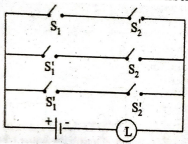
Simplify the following circuit so that new circuit has minimum number of switches. Also draw simplified circuit.
Image
Prove that $2 \tan ^{-1}\left(\frac{1}{8}\right)+\tan ^{-1}\left(\frac{1}{7}\right)+2 \tan ^{-1}\left(\frac{1}{5}\right)=\frac{\pi}{4}$
Differentiate the following w.r.t. x:

$\frac{\left(x^2+2 x+2\right)^{\frac{3}{2}}}{(\sqrt{x}+3)^3(\cos x)^x}$

Find the inverse of the following matrices by the adjoint method : $\left[\begin{array}{ccc}1 & 0 & 0 \\ 3 & 3 & 0 \\ 5 & 2 & -1\end{array}\right]$