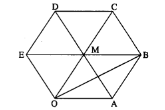
Given: $\overline{\mathrm{OA}}=\bar{a}_r \overline{\mathrm{OB}}=\bar{a}$ Let $\mathrm{AD}, \mathrm{BE}, \mathrm{OC}$ meet at $\mathrm{M}$.
Then M bisects AD, BE, OC.
$\overline{\mathrm{AB}}=\overline{\mathrm{AO}}+\overline{\mathrm{OB}}=-\overline{\mathrm{OA}}+\overline{\mathrm{OB}}=-\bar{a}+\bar{b}=\bar{b}-\bar{a}$
∵ OABM is a parallelogram
$\begin{aligned} & \therefore \overline{\mathrm{OM}}=\overline{\mathrm{AB}}=\bar{b}-\bar{a} \\ & \overline{\mathrm{OC}}=2 \overline{\mathrm{OM}}=2(\bar{b}-\bar{a})=2 \bar{b}-2 \bar{a}\end{aligned}$
$\begin{aligned} \overline{\mathrm{OD}} & =\overline{\mathrm{OC}}+\overline{\mathrm{CD}} \\ & =\overline{\mathrm{OC}}-\overline{\mathrm{DC}}\end{aligned}$
$\begin{aligned} & =\overline{\mathrm{OC}}-\overline{\mathrm{OA}} \quad \ldots[\because \mathrm{OA}=\mathrm{DC} \text { and } \mathrm{OA} \| \mathrm{DC}] \\ & =2 \bar{b}-2 \bar{a}-\bar{a} \\ & =2 \bar{b}-3 \bar{a}\end{aligned}$
$\begin{aligned} \overline{\mathrm{OE}} & =\overline{\mathrm{OM}}+\overline{\mathrm{ME}} \\ & =(\bar{b}-\bar{a})-\overline{\mathrm{EM}}\end{aligned}$
$\begin{aligned} & =\bar{b}-\bar{a}-\bar{a} \quad \ldots[\because \mathrm{EM}=\mathrm{OA} \text { and } \mathrm{EM} \| \mathrm{OA}] \\ & =\bar{b}-2 \bar{a}\end{aligned}$
$\begin{aligned} & =\bar{b}-\bar{a}-\bar{a} \quad \ldots[\because \mathrm{EM}=\mathrm{OA} \text { and } \mathrm{EM} \| \mathrm{OA}] \\ & =\bar{b}-2 \bar{a}\end{aligned}$
Hence, the position vectors of $\mathrm{C}, \mathrm{D}$ and $\mathrm{E}$ are $2 \bar{b}-2 \bar{a}_t 2 \bar{b}-3 \bar{a}$ and $\bar{b}-2 \bar{a}$ respectively.