Question
Evaluate: $\int\limits_0^{\pi/2}\frac{\text{x sin x cos x}}{\text{sin}^{4}\text{x + cos}^{4}\text{x}}\text{dx}$.

Answer

$\text{I}=\int\limits_{0}^{\pi/2}\frac{\text{x sin x cos x}}{\text{sin}^{4}\text{x}+\text{cos}^{4}\text{x}}\text{dx}\ .....\text{(i)}$
$\text{I}=\int\limits_{0}^{\frac{\pi}{2}}{\pi}\frac{(\frac{\pi}{2}-x)\sin(\frac{\pi}{2}-x)\cos(\frac{\pi}{2}-x)}{\sin^{4}(\frac{\pi}{2}-x)+\cos^{4}(\frac{\pi}{2}-x)}\text{dx}=\int\limits_0^{\frac{\pi}{2}}\frac{(\frac{\pi}{2}-x)\text{cos x sin x dx}}{{\sin x}^4+\cos x^{4}}\ ......\text{(ii)}$
$2I = \text{I}=\frac{\pi}{2}\int\limits_{0}^{\frac{\pi}{2}}\frac{\text{sin x cos x}}{\text{sin}^{4}+\text{cos}^{4}\text{x}}\text{dx}=\frac{\pi}{2}\int\limits_0^{\frac{\pi}{2}}\frac{\text{tan x}\cdot\text{sec}^{2}\text{x dx}}{\text{1+tan}^{4}\text{x}}$
$\text{I}=\frac{\pi}{4}\frac{1}{2}\int\limits_0^{\infty}\frac{\text{dt}}{\text{1+t}^{2}}$ where $t = \tan^2 x.$
$=\frac{\pi}{8}[\tan ^{-1}\text{t}]_{0}^\infty=\frac{\pi}{8}\cdot\frac{\pi}{2}=\frac{\pi^{2}}{16}$.

Need a full question paper?

Generate a complete, print-ready paper with questions like this in minutes — across 16+ boards, with answer keys.
Start Generating Free

Similar questions

If A = { 1, 2, 3}, B = { 4, 5, 6, 7} and let f = {(1, 4), (2, 5), (3, 6)} be a function from A to B. Show that f is one-one.
Find the equations of the tangent and the normal to the following curves at the indicated points.
$\frac{\text{x}^2}{\text{a}^2}+\frac{\text{y}^2}{\text{b}^2}=1\text{ at }(\text{a}\sec\theta,\text{b}\tan\theta)$
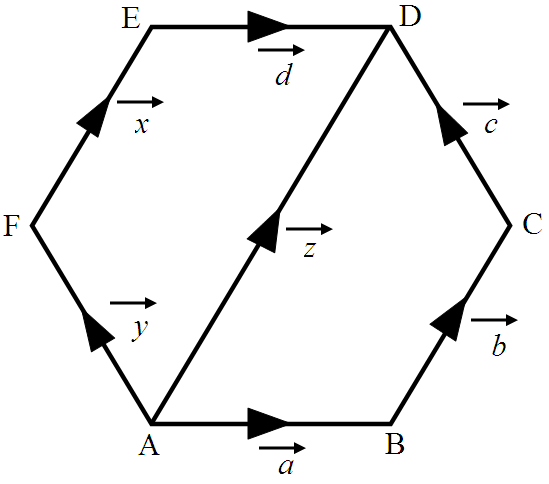
In Figure ABCD is a regular hexagon, which vectors are:
  1. Collinear.
  2. Equal.
  3. Co-initial.
  4. Collinear but not equal.
Find a unit vector perpendicular to the plane containing the vectors $\vec{\text{a}}=2\hat{\text{i}}+\hat{\text{j}}+\hat{\text{k}}$ and $\vec{\text{b}}=\hat{\text{i}}+2\hat{\text{j}}+\hat{\text{k}.}$
Prove the following identities:
$\begin{vmatrix}\text{a}+\text{x}&\text{y}&\text{z}\\\text{x}&\text{a}+\text{y}&\text{z}\\\text{x}&\text{y}&\text{a}+\text{z}\end{vmatrix}=\text{a}^2(\text{a}+\text{x}+\text{y}+\text{z})$
A letter is known to have come either from $\text{LONDON}$ or $\text{CLIFTON}$. On the envelope just two consecutive letters $ON$ are visible. What is the probability that the letter has come from,$\text{CLIFTON}$?
Evaluate: $ \int\limits_0^\pi\frac{\text{x tan x}}{\text{sec x + tan x}}\text{dx}$.
Find graphically, the maximum value of Z = 2x + 5y, subject to constraints given below:
$2\text{x}+4\text{y}\leq8$
$3\text{x}+\text{y}\leq6$
$\text{x}+\text{y}\leq4$
$\text{x}\geq0,\text{y}\geq0$
Solve the following differential equation:
$\text{x}\frac{\text{dy}}{\text{dx}}=\text{y}-\text{x}\cos^2\Big(\frac{\text{y}}{\text{x}}\Big)$
A biased die is such that $\text{P}(4)=\frac{1}{10}$ and other scores being equally likely. The die is tossed twice. If X is the ‘number of fours seen’, find the variance of the random variable X.