Question
Evaluate the following definite integrals:
$\int_{1}^\limits{4}\frac{\text{x}^2+\text{x}}{\sqrt{2\text{x}+1}}\text{ dx}$

Answer

Let $\text{I}=\int_{1}^\limits{4}\frac{\text{x}^2+\text{x}}{\sqrt{2\text{x}+1}}\text{ dx}$
Let $2\text{x}+1=\text{u}$
$\Rightarrow\text{x}=\frac{\text{u}-1}{2}$
$\Rightarrow\text{dx}=\frac{\text{du}}{2}$
$\therefore\ \text{I}=\int\frac{\big(\frac{\text{u}-1}{2}\big)^2+\frac{\text{u}-1}{2}}{\sqrt{\text{u}}}\frac{\text{du}}{2}$
$\Rightarrow\text{I}=\frac{1}{8}\int\frac{\text{u}^2+1-2\text{u}+2\text{u}-2}{\sqrt{\text{u}}}\text{ du}$
$\Rightarrow\text{I}=\frac{1}{8}\int\frac{(\text{u}^2-1)}{\sqrt{\text{u}}}\text{ du}$
$\Rightarrow\text{I}=\frac{1}{8}\int\Big(\text{u}^{\frac{3}{2}}-\text{u}^{-\frac{1}{2}}\Big)\text{du}$
$\Rightarrow\text{I}=\frac{1}{8}\bigg[\frac{2\text{u}^{\frac{5}{2}}}{5}-\frac{2\text{u}^{\frac{1}{2}}}{1}\bigg]$
$\Rightarrow\text{I}=\frac{1}{8}\Big[\frac{2}{5}\times243-6-\frac{2}{5}\times9\sqrt{3}+2\sqrt{3}\Big]$
$\Rightarrow\text{I}=\frac{1}{8}\Big[\frac{456}{5}-\frac{8\sqrt{3}}{5}\Big]$
$\Rightarrow\text{I}=\frac{57-\sqrt{3}}{5}$

Need a full question paper?

Generate a complete, print-ready paper with questions like this in minutes — across 16+ boards, with answer keys.
Start Generating Free

Similar questions

A ladder 13m long leans against a wall. The foot of the ladder is pulled along the ground away from the wall, at the rate of 1.5m/ sec. How fast is the angle $\theta$ between the ladder and the ground is changing when the foot of the ladder is 12m away from the wall.
If $\text{P}\big(\text{x}\big)=\begin{bmatrix}\cos\text{x}&\sin\text{x}\\-\sin\text{x}&\cos\text{x}\end{bmatrix},$ then show that P(x)P(y) = P(x + y) = P(y)P(x).
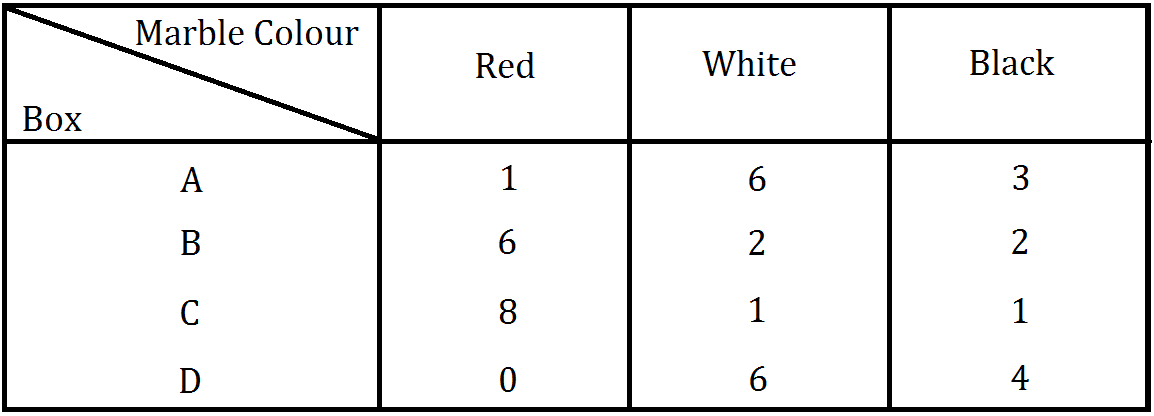
Suppose we have four boxes A, B, C, D containing coloured marbles as given below:
One of the boxes has been selected at random and a single marble is drawn from it. If the marble is red, what is the probability that it was drawn from,
  1. Box A?
  2. Box B?
  3. Box C?
For the matrix $\text{A} = \begin{bmatrix}3&2\\1&1\end{bmatrix},$ find the numbers a and b such that $A^2 + aA + bI = 0.$
Maximum Z = 15x + 10y
Subject to
$3\text{x}+2\text{y}\leq80$
$2\text{x}+3\text{y}\leq70$
$\text{x},\text{y}\geq0$
Find the area of the region $\{(\text{x},\text{y}):\text{x}^2+\text{y}^2\leq4,\text{x}+\text{y}\geq2\}$
Find the shortest distance between the following pairs of lines whose vector equation are:
$\vec{\text{r}}=(8+3\lambda)\hat{\text{i}}-(9+16\lambda)\hat{\text{j}}+(10+7\lambda)\hat{\text{k}}$ and $\vec{\text{r}}=15\hat{\text{i}}+29\hat{\text{j}}+5\hat{\text{k}}+\mu\big(3\hat{\text{i}}+8\hat{\text{j}}-5\hat{\text{k}}\big)$
Consider the binary operation * and o defined by the following tables on set S = {a, b, c, d}.
*
a
b
c
d
a
a
b
c
d
b
b
a
d
c
c
c
d
a
b
d
d
c
b
a
A particle moves along the curve $y = x^2 + 2x.$ At what point(s) on the curve are the $x$ and $y$ coordinates of the particle changing at the same rate?
Using differentials, find the approximate values of the following:
$\log_\text{e}10.01$ it being given that $\log_{10}=0.4343$