Question
Evaluate the following:
If $A=60^{\circ}$ and $B=30^{\circ}$, verify that:
$\cos(\text{A}+\text{B})=\cos\text{A}\cos\text{B}-\sin\text{A}\sin\text{B}$
Answer

$\text{A}=60^\circ$ and $\text{B}=30^\circ$
Now, $\text{A}+\text{B}=60^\circ+30^\circ=90^\circ$
Also, $\text{A}-\text{B}=60^\circ-30^\circ=30^\circ$
$\cos(\text{A}+\text{B})=\cos90^\circ=0$
$\cos\text{A}\cos\text{B}-\sin\text{A}\sin\text{B}$
$=\cos60^\circ\cos30^\circ-\sin60^\circ\sin30^\circ$
$=\Big(\frac{1}{2}\times\frac{\sqrt{3}}{2}-\frac{\sqrt{3}}{2}\times\frac12\Big)=\Big(\frac{\sqrt{3}}{4}+\frac{\sqrt{3}}{4}\Big)=0$
$\therefore\ \cos(\text{A}+\text{B})=\cos\text{A}\cos\text{B}+\sin\text{A}\sin\text{B}$

Need a full question paper?

Generate a complete, print-ready paper with questions like this in minutes — across 16+ boards, with answer keys.

Start Generating Free

Similar questions

A solid toy is in the form of a hemisphere surmounted by a right circular cone. The height of cone is $4\ cm$ and the diameter of the base is $8\ cm$. Determine the volume of the toy. If a cube circumscribes the toy, then find the difference of the volumes of cube and the toy. Also, find the total surface area of the toy.
If at some time of the day the ratio of the height of a vertically standing pole to the length of its shadow on the ground is $\sqrt{3}:1$ then find the angle of elevation of the sun at that times.
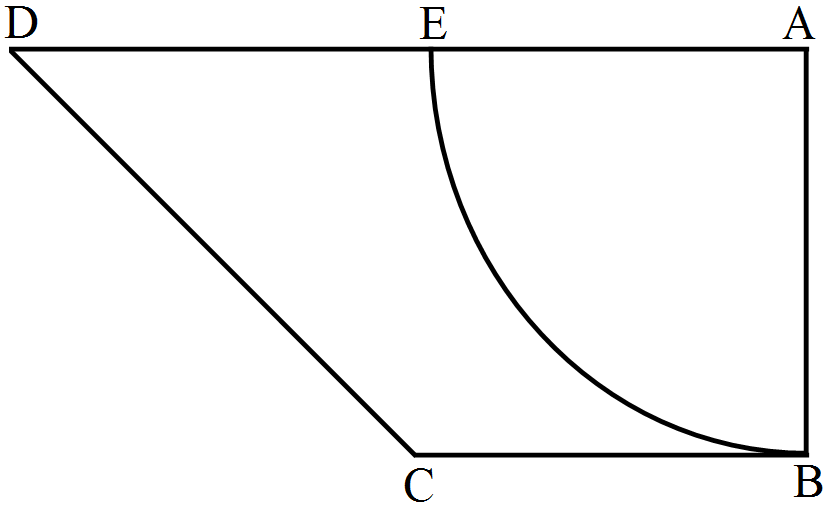
In tha given fingure, $ABCD$ is a trapezium of area $24.5cm^2$. $24.5cm^2$ If $\text{AD}||\text{BC},\ \angle\text{DAB}=90^\circ,\ \text{AD}=10\text{cm},\ \text{BC}=4\text{cm}$ and ABE is quadrant of a circle then find the area of the shaded region. $\Big[\text{Use }\pi=\frac{22}{7}\Big]$
In an equilateral triangle with side a, prove that area $=\frac{\sqrt{3}}{4}\text{a}^2.$
Solve the following quadratic equation:
$\frac{\text{x}}{\text{x}+1}+\frac{\text{x}+1}{\text{x}}=2\frac{4}{15},$ $\text{x}\neq0,-1$
Cards numbered $1$ to $30$ are put in a bag. A card is drawn at random from this bag. Find the probability that the number on the drawn card is:
  1. Not divisible by $3.$
  2. A prime number great than $7.$
  3. Not a perfect square number.
Solve graphically that the following system of equation has infinitely many solutions:
$2x + 3y = 6$
$4x + 6y = 12$
Solve the following quadratic equation:
$\frac{4}{\text{x}}-3=\frac{5}{\text{2x}+3},$ $\text{x}\neq=0,\ \frac{-3}{2}$
Solve for $x$ and $y$
$\frac{\text{x}}{\text{a}}+\frac{\text{y}}{\text{b}}=2,$
$\text{ax}-\text{by}=\text{a}^2-\text{b}^2$
If $\cos\theta=\frac{7}{25},$ find the value of the all T-ratios of $\theta.$