Question
Evaluate the following integrals:
$\int \frac{\text{x}^2}{(\text{x}-1)\sqrt{\text{x}+2}}\text{ dx}$
Answer

We have,
$\text{I}=\int \frac{\text{x}^2}{(\text{x}-1)\sqrt{\text{x}+2}}\text{ dx}$
Putting $\text{x}+2=\text{t}^2$
$\text{x}=\text{t}^2-2$
Diff both sides
$\text{dx}=2\text{t dt} $
$\text{I}=\int\frac{(\text{t}^2-2)^2}{(\text{t}^2-2-1)\text{t}}2\text{t dt}$
$=2\int\frac{(\text{t}^2-2)^2\text{dt}}{\text{t}^2-3}$
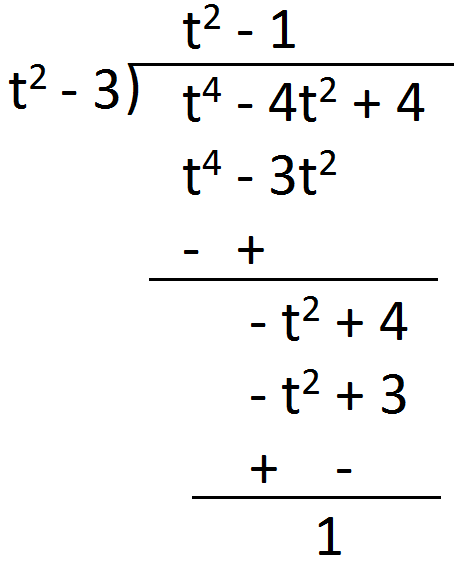
$=2\int\frac{(\text{t}^4-4\text{t}^2+4)}{\text{t}^2-3}\text{ dt}$
Dividing numerator by denominator, we get

$\therefore\ \text{I}=2\int\Big(\text{t}^2-1+\frac{1}{\text{t}^2-3}\Big)\text{ dt}$
$=2\int\text{t}^2\text{ dt}-2\int\text{ dt}+2\int\frac{\text{dt}}{\text{t}^2-(\sqrt{3})^2}$
$=2\Big[\frac{\text{t}^3}{3}\Big]-2\text{t}+2\times\frac{1}{2\sqrt{3}}\log\Big|\frac{\text{t}-\sqrt{3}}{\text{t}+\sqrt{3}}\Big|+\text{C}$
$=\frac{2}{3}(\sqrt{\text{x}+2})^3-2\sqrt{\text{x}+2}+\frac{1}{\sqrt{3}}\log\bigg|\frac{\sqrt{\text{x}+2}-\sqrt{3}}{\sqrt{\text{x}+2}+\sqrt{3}}\bigg|+\text{C}$
$=\frac{2}{3}(\text{x}+2)^{\frac{3}{2}}-2\sqrt{\text{x}+2}+\frac{1}{\sqrt{3}}\log\bigg|\frac{\sqrt{\text{x}+2}-\sqrt{3}}{\sqrt{\text{x}+2}+\sqrt{3}}\bigg|+\text{C}$

Need a full question paper?

Generate a complete, print-ready paper with questions like this in minutes — across 16+ boards, with answer keys.

Start Generating Free

Similar questions

Evaluate the following integrals:
$\int\text{e}^{2\text{x}}\Big(\frac{1-\sin2\text{x}}{1-\cos2\text{x}}\Big)\text{dx}$
For any a, b, x, y > 0, prove that:
$\frac{2}{3}\tan^{-1}\Big(\frac{3\text{a}\text{b}^2-\text{a}^3}{\text{b}^3-3\text{a}^2\text{b}}\Big)+\frac{2}{3}\tan^{-1}\Big(\frac{3\text{x}\text{y}^2-\text{x}^3}{\text{y}^3-3\text{x}^2\text{y}}\Big)=\tan^{-1}\frac{2\alpha\beta}{\alpha^2-\beta^2}$
where $\alpha=-\text{ax}+\text{by},\beta=\text{bx}+\text{ay}$
Evaluate the following definite integrals:$\int_{0}^\limits{\frac{\pi}{2}}\sin^3\text{x}\text{ dx}$
Using integration, find the area of the triangle $ABC$ coordinatrs of whise vertices $A(4, 1), B(6, 6)$ and $C(8, 4)$.
Solve the following differential equations:(9x + 5y) dy + (15x + 11y) dx = 0
If $\text{A}=\begin{bmatrix}1&0\\0&1\end{bmatrix},\text{B}\begin{bmatrix}1&0\\0&-1\end{bmatrix}$ and $\text{C}=\begin{bmatrix}0&1\\1&0\end{bmatrix},$ then show that $A^2 = B^2 = C^2 = l_2.$
Using differentials, find the approximate values of the following:
$\sqrt{25.02}$
If the axes are rectangular and p is the point (2, 3, -1), find the equation of the plane throught p at right angles to OP.
If $\vec{\text{a}},\vec{\text{b}}$ are the position vectors of A, B respectively, find the position vector of a point C in AB produced such that AC = 3AB and that a point D in BA produced such that BD = 2BA.
Let $\text{f}\text{(x)}=\frac{\log\Big(1+\frac{\text{x}}{\text{a}}\Big)-\log\Big(1-\frac{\text{x}}{\text{b}}\Big)}{\text{x}},\text{x}\neq0$ Find the value of f at x = 0. So that f becomes continuous at x = 0.