Question
Evaluate the following integrals:
$\int\limits^{\frac{\pi}{2}}_0\frac{\text{a}\sin\text{x}+\text{b}\sin\text{x}}{\sin\text{x}+\cos\text{x}}\text{ dx}$
Answer

Let $\text{I}=\int\limits^{\frac{\pi}{2}}_0\frac{\text{a}\sin\text{x}+\text{b}\sin\text{x}}{\sin\text{x}+\cos\text{x}}\text{ dx}\ ...(\text{i})$
Then,
$\text{I}=\int\limits^{\frac{\pi}{2}}_0\frac{\sin\big(\frac{\pi}{2}-\text{x}\big)+\text{b}\cos\big(\frac{\pi}{2}-\text{x}\big)}{\sin\big(\frac{\pi}{2}-\text{x}\big)+\cos\big(\frac{\pi}{2}-\text{x}\big)}\text{ dx}$ $\Bigg[\int\limits^{\text{a}}_0\text{f(x)}\text{dx}=\int\limits^{\text{a}}_0\text{f}(\text{a}-\text{x})\text{dx}\Bigg]$
$=\int\limits^{\frac{\pi}{2}}_0\frac{\text{a}\cos\text{x}+\text{b}\sin\text{x}}{\cos\text{x}+\sin\text{x}}\text{ dx}\ ....(\text{ii})$
Adding (i) and (ii) we get
$2\text{I}=\int\limits^{\frac{\pi}{2}}_0\Big(\frac{\text{a}\sin\text{x}+\text{b}\cos\text{x}}{\cos\text{x}+\sin\text{x}}+\frac{\text{a}\cos\text{x}+\text{b}\sin\text{x}}{\sin\text{x}+\cos\text{x}}\Big)\text{dx}$
$\Rightarrow2\text{I}=\int\limits^{\frac{\pi}{2}}_0\Big(\frac{\text{a}\sin\text{x}+\text{b}\cos\text{x}+\text{a}\cos\text{x}+\text{b}\sin\text{x}}{\sin\text{x}+\cos\text{x}}\Big)\text{dx}$
$\Rightarrow2\text{I}=\int\limits^{\frac{\pi}{2}}_0\frac{(\text{a}+\text{b})\sin\text{x}+(\text{a}+\text{b})\cos\text{x}}{\sin\text{x}+\cos\text{x}}\text{ dx}$
$\Rightarrow2\text{I}=\int\limits^{\frac{\pi}{2}}_0\frac{(\text{a}+\text{b})(\sin\text{x}+\cos\text{x})}{\sin\text{x}+\cos\text{x}}\text{ dx}$
$\Rightarrow2\text{I}=\int\limits^{\frac{\pi}{2}}_0(\text{a}+\text{b})\text{dx}$
$\Rightarrow2\text{I}=(\text{a}+\text{b})\times\big[\text{x}\big]^{\frac{\pi}{2}}_0$
$\Rightarrow2\text{I}=(\text{a}+\text{b})\times\Big(\frac{\pi}{2}-0\Big)$
$\Rightarrow2\text{I}=\frac{\pi}{2}(\text{a}+\text{b})$
$\Rightarrow\text{I}=\frac{\pi}{4}(\text{a}+\text{b})$

Need a full question paper?

Generate a complete, print-ready paper with questions like this in minutes — across 16+ boards, with answer keys.

Start Generating Free

Similar questions

Verify Lagrange's mean value theorem for the following function on the indicated intervals. find a point $'c\ '$ in the indicated interval as stated by the Lagrange's mean value theorem. $f(x) = x^2 - 2x + 4$ on $[1, 5]$
Solve the following systems of linear equations by cramer's rule:
2x - y = -2,
3x + 4y = 3
Find the vector equation of the plane passing through the points P(2, 5, -3), Q(-2, -3, 5) and R(5, 3, -3).
Solve the following systems of linear equations by cramer's rule:
$3x + y + z = 2,$
$2x - 4y + 3z = -1,$
$4x + y - 3z = -11$
Find all vectors of magnitude $10\sqrt{3}$ that are perpendicular to the plane of $\hat{\text{i}}+2\hat{\text{j}}+\hat{\text{k}}$ and $-\hat{\text{i}}+3\hat{\text{i}}+4\hat{\text{k}}.$
$\text{If (x}-\text{a})^2+(\text{y}-\text{b})^2=\text{c}^2,$  for some c > 0 , prove that
$\frac{\Big[1+\Big(\frac{\text{dy}}{\text{dx}}\Big)^2\Big]^{\frac{3}{2}}}{\frac{\text{d}^2\text{y}}{\text{dx}^2}}$
is a constant independent of a and b.
Solve the following system of equations by matrix method:$8x + 4y + 3z = 18$
$2x + y + z = 5$
$x + 2y + z = 5$
Find the angle between the follwing pairs of lines$: \vec{\text{r}}=\big(4\hat{\text{i}}-\hat{\text{j}}\big)+\lambda\big(\hat{\text{i}}+2\hat{\text{j}}-2\hat{\text{k}}\big)$ and $\vec{\text{r}}=\hat{\text{i}}-\hat{\text{j}}+2\hat{\text{k}}-\mu\big(2\hat{\text{i}}+4\hat{\text{j}}-4\hat{\text{k}}\big)$
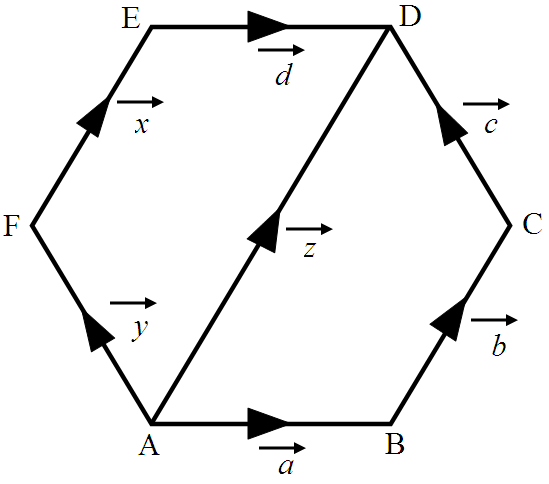
In Figure ABCD is a regular hexagon, which vectors are:
  1. Collinear.
  2. Equal.
  3. Co-initial.
  4. Collinear but not equal.
Evaluate the following integrals:
$\int\limits^{\text{a}}_0\sin{-1}{\sqrt\frac{\text{x}}{\text{a}+\text{x}}}\text{ dx}$