MCQ
Even if a physical quantity depends upon three quantities, out of which two are dimensionally same, then the formula cannot be derived by the method of dimensions. This statement
  • A
    May be true
  • B
    May be false
  • Must be true
  • D
    Must be false

Answer

Correct option: C.
Must be true
c
(c)

This statement is completely correct. If a quantity depends upon two other quantities which are dimensionally same then formula's validity can be checked but it can't be derived by the method of dimensions.

Need a full question paper?

Generate a complete, print-ready paper with questions like this in minutes — across 16+ boards, with answer keys.
Start Generating Free

Similar questions

$Assertion$ : For a system of particles under central force field, the total angular momentum is conserved.
$Reason$ : The torque acting on such a system is zero.
Out of the following which quantity does not depend on path
Inside a uniform spherical shell:
  1. The gravitational potential is zero.
  2. The gravitational field is zero.
  3. The gravitational potential is same everywhere.
  4. The gravitational field is same everywhere.
The negative of the work done by the conservative internal forces on a system equals the change in:
A triode is operated in the linear region of its characteristics. If the plate voltage is slightly increased, the dynamic plate resistance will:
  1. Increase.
  2. Decrease.
  3. Remain almost the same.
  4. Become zero.
A ball of mass $160\, g$ is thrown up at an angle of $60^o$ to the horizontal at a speed of $10\, m\,s^{-1}$ . The angular momentum of the ball at the highest point of the trajectcry with respect to the point from which the ball is thrown is nearly ........ $kg\, m^2/s$  $(g\, = 10\, m\,s^{-2})$
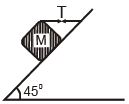
A block of mass $15 \,kg $ is resting on a rough inclined plane as shown in figure. The  block is tied up by a horizontal string which has tension of $50\,N$. The minimum  coefficient of friction between the surfaces of contact is $(g = 10\,m/s^2)$
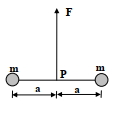
Two particle of mass $m$ each are tied at the ends of a light string of length $2 \mathrm{a}$. The whole system is kept on a frictionless horizontal surface with the string held tight so that each mass is at a distance $'a'$ from the center $\mathrm{P}$ (as shown in the figure). Now, the mid-point of the string is pulled vertically upwards with a small but constant force $F$. As a result, the particles move towards each other on the surface. The magnitude of acceleration, when the separation between them becomes $2 \mathrm{x}$ is
The physical quantities not having same dimensions are
The spherical shape of rain-drop is due to