MCQ
Example of coenzyme is:
  • A
    COA
  • B
    NAD
  • C
    FAD
  • D
    All of the above

Answer

  1. All of the above

Explanation:

For some biochemical reactions, a substance other than enzymes and substrate is required.

These substances are called as coenzymes or cofactors.

The coenzymes usually serve as an acceptor or donor of an atom or a group, example - nicotinamide adenine dinucleotide (NAD) which is derived from vitamin niacin, flavin adenine dinucleotide (FAD) which is derived from vitamin riboflavin, Coenzyme A which is derived from pantothenate etc.

Need a full question paper?

Generate a complete, print-ready paper with questions like this in minutes — across 16+ boards, with answer keys.

Start Generating Free

Similar questions

Lactose on hydrolysis gives
Nucleic acids are:
In an electrochemical reaction of lead, at standard temperature, if $E _{\left( Pb ^{2+} / Pb \right)}^0= m$ Volt and $E _{\left( Pb ^{4+} / Pb \right)}^0= n$ Volt, then the value of $E _{\left( Pb ^{2+} / Pb ^{4+}\right)}^0$ is given by $m-x n$. The value of $x$ is $...........$. (Nearest integer)
Which of following do not gives Aldol condensation reaction ?
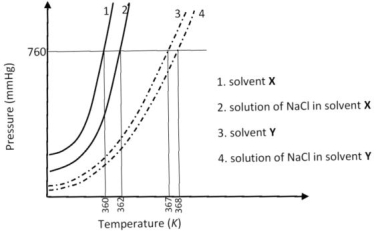
The plot given below shows $P - T$ curves (where $P$ is the pressure and $T$ is the temperature) for two solvents $X$ and $Y$ and isomolal solutions of $NaCl$ in these solvents. $NaCl$ completely dissociates in both the solvents.

On addition of equal number of moles of a non-volatile solute $S$ in equal amount (in $kg$ ) of these solvents, the elevation of boiling point of solvent $X$ is three times that of solvent $Y$. Solute $S$ is known to undergo dimerization in these solvents. If the degree of dimerization is $0.7$ in solvent $Y$, the degree of dimerization in solvent $X$ is. . . . . . .
Which of the following is non-conducting ?
Alkyl halides can be obtained by all methods except
Which of the following compounds are not soluble in water?
Methanol can be distinguish from ethanol by
At $298\, K$, the standard reduction potentials are $1.51\, V$ for $MnO_4^ - \,|\,M{n^{2 + }}$, $1.36\, V$ for $C{l_2}\,|\,C{l^ - }$, $1.07\, V$ for $B{r_2}\,|\,B{r^ - }$ and $0.54\, V$ for ${I_2}\,|\,{I^ - }$. At $pH\, = 3$ , permanganate is expected to oxidize $\left( {\frac{{RT}}{F} = 0.059\,V} \right)$