Question
Explain about refractive index in detail.

Answer

When a light ray propagating in first transparent medium is made incident obliquely on the surface of second transparent medium, it changes the direction of propagation in the second medium. For a given pair of transparent media, the extent of change in direction of propagation of incident light ray is expressed in terms of a physical quantity, called "Refractive Index" of second medium with respect to first medium, shown by symbol $n_{21}$. Its value is equal to constant appearing on R.H.S. of Snell's law. This value depends on speed of light in first and second transparent medium. Since speed of light is different in different media, value of refractive index is different for different pairs of media.
→ Speed of light is maximum in vacuum, equal to $3 \times 10^8 ms ^{-1}$. In air, it is very slightly less than this value. In water and glass, speed of light is reduced considerably.
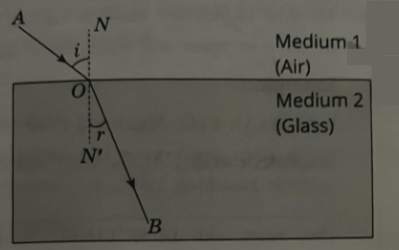
→ Relative refractive index :
Image
→ Consider a ray of light, travelling from medium 1 into medium 2 as shown in the figure. Suppose speeds of light in media 1 and 2 are respectively $v_1$ and $v_2$.
→ Now, refractive index of medium 2 with respect to medium 1 is given by ratio of speed of light in medium 1 to speed of light in medium 2. It is shown by symbol $n_{21}$. Thus,
$
n_{21}=\frac{v_1}{v_2}
$
→ Similarly, refractive index of medium 1 with respect to medium 2 is shown by symbol $n_{12}$ and it is given as :
$
n_{12}=\frac{v_2}{v_1}
$
→ Absolute refractive index of a given medium $\left(n_m\right)$
When first medium is air or vacuum, refractive index of second medium with respect to first medium is known as absolute refractive index of second medium, shown by symbol $n_2$ or $n_{m^*}$ If speed of light in air or vacuum is $c$ and speed of light in a given medium is $v$ then absolute refractive index of this medium is given by
$
n_m=\frac{c}{v}
$
→ In practice, absolute refractive index of a given medium is called its refractive index only.
→ Refractive indices of water, crown glass and diamond are found to be respectively 1.33, 1.52 and 2.42 .
→ A medium having greater refractive index is said to be optically denser. Conversely, a medium having smaller refractive index is said to be optically rarer.
→ Thus, optical density of a given medium gives measure of its ability to refract the incident light.
→ It should be noted that optical density of a medium is different than its mass density. A medium with greater optical density may have smaller mass density. For example refractive index of kerosene is 1.44 which is greater than refractive index of water which is 1.33 . Hence optical density of kerosene is greater than that of water but mass density of kerosene is smaller than that of water.

Need a full question paper?

Generate a complete, print-ready paper with questions like this in minutes — across 16+ boards, with answer keys.
Start Generating Free