Question
Explain and derive the work-energy theorem.

Answer

self

Need a full question paper?

Generate a complete, print-ready paper with questions like this in minutes — across 16+ boards, with answer keys.
Start Generating Free

Similar questions

A ball of mass $100g$ and having a charge of $4.9 \times 10^{-5}C$ is released from rest in a region where a horizontal electric field of $2.0 \times 10^4NC^{-1}$ exists.
  1. Find the resultant force acting on the ball.
  2. What will be the path of the ball?
  3. Where will the ball be at the end of $2s$?
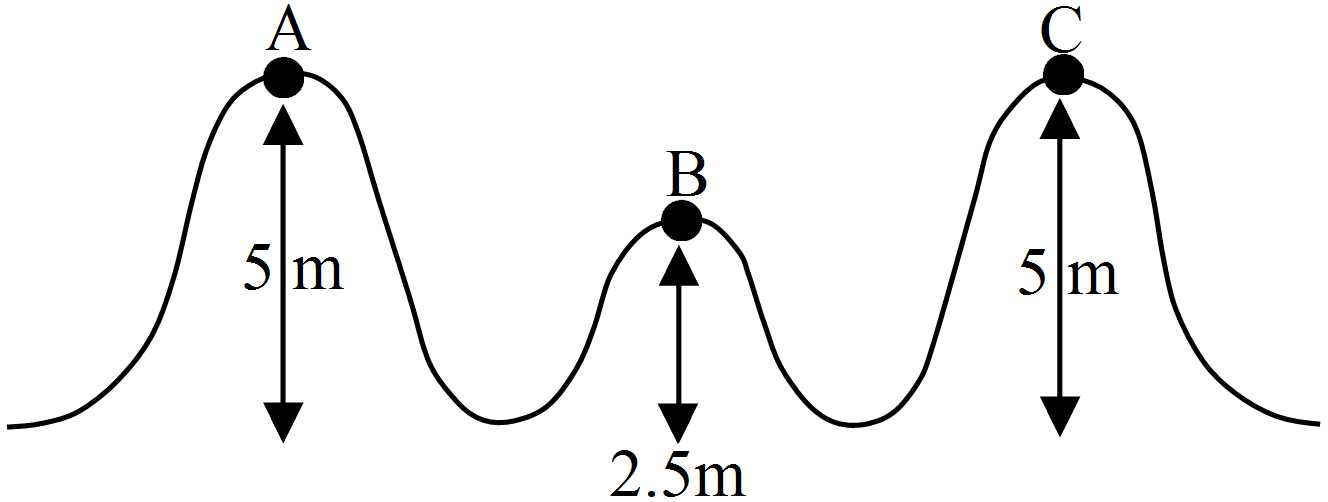
A mass 5kg starts sliding from A on a smooth surface shown in the figure. Find the velocity of the mass at B and C?
Define co-efficient of linear expansion coefficient of areal expansion and coefficient of volume expansion and obtain mutual relation between them.
A truck starts from rest and accelerates uniformly at $2.0ms^{-2}$. At $t = 10s$, a stone is dropped by a person standing on the top of the truck ($6m$ high from the ground). What are the (a) velocity, and (b) acceleration of the stone at $t = 11s$? (Neglect air resistance.)
A hoop of radius $2m$ weighs $100kg$. It rolls along a horizontal floor so that its centre of mass has a speed of $20cm/s$. How much work has to be done to stop it?
Derive expression for rate of flow of fluid as measured by venturimeter.
A particle executes simple harmonic motion of amplitude A.
i. At what distance from the mean position is its kinetic energy equal to its potential energy?
ii. At what points is its speed half the maximum speed?
A sound wave of frequency 100Hz is travelling in air. The speed of sound in air is 350m/s.
  1. By how much is the phase changed at a given point in 2.5ms?
  2. What is the phase difference at a given instant between two points separated by a distance of 10.0cm along the direction of propagation?
What is a heat engine? What are its essential parts? Explain its principle and establish the formula for its efficiency.
Assume that the thermal conductivity of copper is four times that of brass. Two rods of copper and brass of the same length, and cross-section are joined end to end. The free end of the copper rod is kept at 0°C and the free end of the brass rod at 100°C. Calculate the temperature at the junction of the two rods at equilibrium. (Ignore radiation losses.)