Question
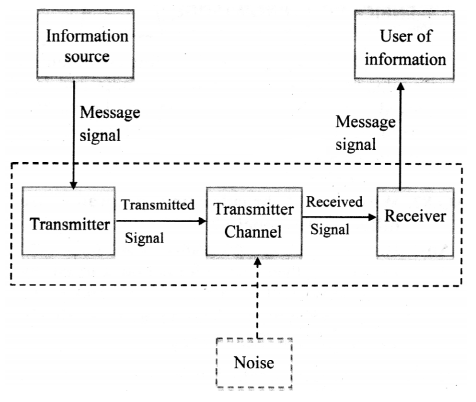
Explain block diagram of  communication system.

Answer

i. There are three basic (essential) elements of every communication system:
  1. Transmitter
  2. channel
  3. Receiver
ii. In a communication system, the transmitter is located at one place and the receiver at another place.
Image
iii. The communication channel is a passage through which signals transfer in between a transmitter and a receiver.
iv. This channel may be in the form of wires or cables, or may also be wireless, depending on the types of communication system.

Need a full question paper?

Generate a complete, print-ready paper with questions like this in minutes — across 16+ boards, with answer keys.
Start Generating Free

Similar questions

A lighter object $A$ and a heavier object $B$ are initially at rest. Both are imparted the same linear momentum. Which will start with greater kinetic energy: $A$ or $B$ or both will start with the same energy?
[Ans:$A$]
Focal power of the eye lens of a compound microscope is 6 dioptre. The microscope is to be used for maximum magnifying power (angular magnification) of at least $12.5.$ The packing instructions demand that length of the microscope should be $25\ cm.$ Determine minimum focal power of the objective. How much will its radius of curvature be if it is a biconvex lens of $n = 1.5.$
Obtain an expression for change in gravitational potential energy of any object displaced from one point to another.
Explain the concept of electrical conduction in a conductor.
Three equal charges of $10 \times 10^{-8}\ C$ respectively, each located at the corners of a right triangle whose sides are $15\ cm, 20\ cm$ and $25\ cm$ respectively. Find the force exerted on the charge located at the $90^\circ $ angle.
Explain the Gauss’ law for magnetic fields.
Explain formation of energy bands in solid sodium with neat labelled energy band diagrams.
A shell of mass $3 \ kg$ is dropped from some height. After falling freely for $2$ seconds, it explodes into two fragments of masses $2 \ kg$ and $1 \ kg.$ Kinetic energy provided by the explosion is $300 J.$ Using $g = 10 \ m/s^2,$ calculate velocities of the fragments. Justify your answer if you have more than one options.
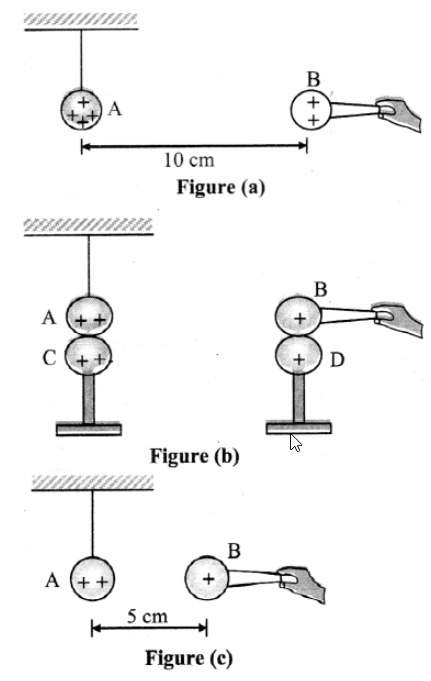
A charged metallic sphere A is suspended by a nylon thread. Another charged metallic sphere B held by an insulating handle is brought close to A such that the distance between their centres is 10 cm, as shown in figure (a). The resulting repulsion of A is noted (for example, by shining a beam of light and measuring the deflection of its shadow on a screen.) Spheres A and B are touched by uncharged spheres C and D respectively, as shown in figure (b). C and D are then removed and B is brought closer to A to a distance of 5.0 cm between their centres, as shown in figure (c). What is the expected repulsion of A on the basis of Coulomb’s law? Spheres A and C and spheres B and D have identical sizes. Ignore the sizes of A and B comparison to the separation between their centres.
Image
Explain how solids are classified on the basis of band theory of solids.