Question
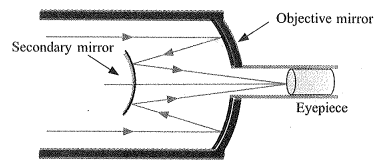
Explain Cassegrain telescpoe with the help of figure.

Answer

Image
→Figure shows construction of cassegrain telescope. It uses two mirrors. Among them, the concave mirror called the object mirror (main mirror) and the convex mirror is called the secondary mirror.
→An object mirror has a larger focal length and a secondary mirror has a less focal length.
→As shown in figure, rays from a distant object are reflected by the objective mirror and focussed at the principal focus.
→But another small convex mirror is placed in the path of these rays. The rays reflected by this mirror are observed through the eyepiece.

Need a full question paper?

Generate a complete, print-ready paper with questions like this in minutes — across 16+ boards, with answer keys.
Start Generating Free

Similar questions

Explain the Construction and working of gold leaf electroscope.
Two babies are born in a moving train, one in the compartment adjacent to the engine and other in the compartment adjacent to the guard. According to the train frame, the babies are born at the same instant of time. Who is elder accordmg to the ground frame?
Identify the electromagnetic waves whose wavelengths vary as :
(a) $10^{-12} m<\lambda<10^{-8}m$ (b) $10^{-3} m<\lambda<10^{-1}m$
Write one use of each.
Write an expression $F$ in vector form for a charge $q$ moving with a velocity $\vec{v}$ in a magnetic field $\vec{B}$. Obtain conditions with the help of this expression when this force is (i) maximum and (ii) minimum.
Answer the following questions:
  1. Draw a graph showing variation of photocurrent with anode potential for a particular intensity of incident radiation. Mark saturation current and stopping potential.
  2. By how much would be stopping potential for a given photosensitive surface go up if the frequency of the incident radiations were to be increased from $4 \times 10^{15}\ Hz$ to $8 \times 10^{15}\ Hz$?
Represent the Electric field and Magnetic field seen in the Electro magnetic waves $(EM$ waves$)$ in the form of equation.
Answer the following question:
Magnifying power of a simple microscope is inversely proportional to the focal length of the lens. What then stops us from using a convex lens of smaller and smaller focal length and achieving greater and greater magnifying power?
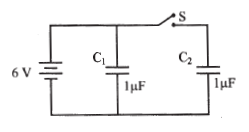
Figure shows two identical capacitors, $C_1$ and $C_2,$ each of $1 \mu F$ capacitance connected to a battery of $6 V.$ Initially switch $'S\ '$ is closed. After sometime $'S\ '$ is left open and dielectric slabs of dielectric constant $K = 3$ are inserted to fill completely the space between the plates of the two capacitors. How will the $(i)$ charge and $(ii)$ potential difference between the plates of the capacitors be affected after the slabs are inserted?
Because of the friction between the water in oceans with the earth's surface, the rotational kinetic energy of the earth is continuously decreasing. If the earth's angular speed decreases by $0.0016\ rad/ day$ in $100$ years, find the average torque of the friction on the earth. Radius of the earth is $6400\ km$ and its mass is $6.0 \times 10^{24}kg.$
The earth revolves round the sun because the sun attracts the earth. The sun also attracts the moon and this force is 'about twice as large as the attraction of the earth on the moon. Why does the moon not revolve round the sun? Or does it?